Showing posts with label soriano. Show all posts

Saturday, February 25, 2012

2012 Cubs Preview: Outfield

You're not doing it right, Alfonso.  When they
say, 'use your head', they don't mean it like that.
Aging bunch to be aided and eventually replaced by younger players

Although the past decade has seen all kinds of changes in the Wrigley outfield, 2012 will not bring drastic changes.  At least, not right away.

For the fifth consecutive season, veteran Alfonso Soriano will man left field (he started 2007 in center).  Soriano takes a lot of criticism for not living up to his gargantuan contract, and most of it is fair.  It was a bad contract to begin with and there's little hope that he'll ever return to the form the Cubs thought they were getting.

In his outstanding 2006 season with the Nationals, his walk year, he became only the fourth player ever to have a 40-40 season with 46 homers and 41 steals.  In five seasons since with the Cubs, he has totaled 54 steals.  In his first two seasons with the Cubs he hit .291 with 62 homers and 38 steals while missing significant time to leg injuries both years.  A reduction in steals was understandable, and the offense was definitely there so Cubs fans remained hopeful.  However, a miserable 2009 showed that he had lost a considerable amount of talent from his glory days with New York and Texas.  From 2009-11 he hit only .248 and averaged about 23 homers per season, a far cry from the 36 he averaged between 2004-06.  He had lost virtually all speed, stealing just 16 bases between 2009-11.

Add all of those offensive woes to his already bad defense, and you've got an average to below-average player making $20 million per year now.  Soriano flashed early power least season before again fading into the mediocrity Cubs fans have become accustomed to.  It was almost a tease, but he could do it again and give the Cubs a legitimate power threat.  He's not hard to get out because he still chases the sliders too much.  26 homers and 88 RBIs, however, aren't that bad if you ignore the average, contract, and defense.  That's only one home run less than Adrian Gonzalez's total of 27, and as many RBIs as Justin Upton produced last season.
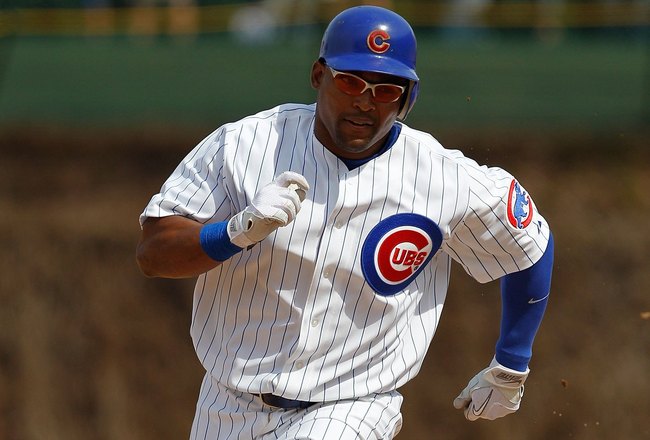
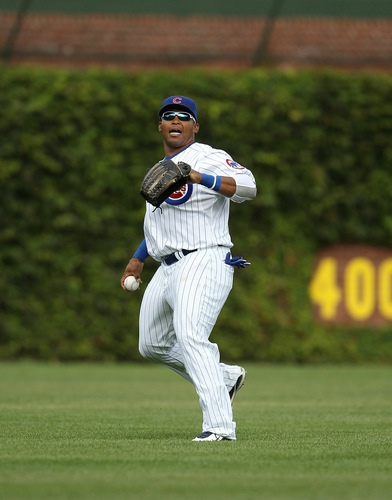
Center fielder Marlon Byrd
Despite all the negatives around Soriano, he represents the biggest power threat in this outfield.  The starting center fielder, Marlon Byrd, enters his third season with the Cubs and the final one on his contract.  Byrd is 34 and definitely declining offensively, bringing disappointing power and speed skills for a center fielder.  He is a fan favorite for his effort and defensive hustle, and those may get even better this season.  You see, Byrd lost about 40 pounds this offseason so the size comparisons to an NFL linebacker will most definitely not be heard anymore.  That's all good and well, but it won't make him any more valuable offensively where, frankly, he's lacking.

The starting right fielder will be newcomer David DeJesus.  DeJesus, like Soriano and Byrd, is on the wrong side of 30 although he is the youngest of the group at 32.  If there's one thing that has defined his career so far, it's been his ability to get on base.  He has a career .356 OBP with a career high of .384 from 2010.  Playing all but one year of his career with the Royals, he has virtually no winning experience.  Not even a year with Oakland in 2011 could change that.
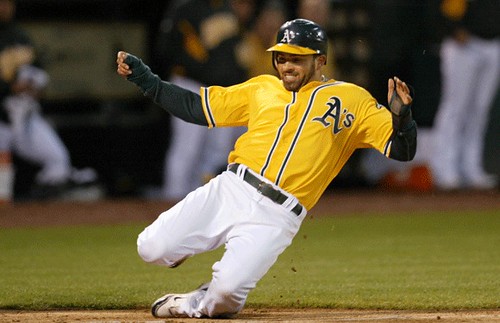
Right fielder David DeJesus
DeJesus does not have great size at 5'11", 190 lbs., but he's a nice, athletic player defensively.  I'm unsure about his arm, and I hope to see more during Spring Training.  Offensively, his power is about a tick below Byrd's, but I would take DeJesus over Byrd because DeJesus is a lefty who makes better contact (never striking out more than 87 times in a season), is more patient, and has a more compact, fluid swing.  DeJesus is a low ball hitter who spreads line drives to all fields well.  I was skeptical at first because DeJesus is somewhat average in all five tools for outfielders, but he's a solid lefty bat with enough skills defensively to play a respectable right field.  I'm content with him in right.

Now for the backups, part-timers, and call-ups.  Bryan LaHair will presumably get some innings if not a few starts in the outfield after he started most of his major league games in right field last September.  For a breakdown of his play, see the post below as he's also the starting first baseman.  Ahead of him on the depth chart, however, are Tony Campana and Reed Johnson.
Speedy fourth outfielder Tony Campana
Campana, 25, has apparently changed his jersey number to #1 for this season and beyond after Kosuke Fukudome's departure left the number vacated.  Although Campana isn't actually '#1' as in most valuable on this team, he could prove to be pretty close to it by the end of the season.  Manager Dale Sveum said at the Cubs Convention that he wants to have a more athletic team that steals more bases.  Well, Dale, it's going to be hard to do that looking at the roster here, as the Cubs finished 2011 with the third-fewest steals in the league.  Campana, however, accounted for 24 of the Cubs' 69 team steals.  He was also only caught twice, giving him one of the best stolen-base ratios in the league.

The dude is seriously undersized at 5'8", 165 lbs., but he does play superb defense and hustles like no one else on the roster.  His 'baseball kid' character shines through in a way reminiscent of former outfield utilityman Sam Fuld, but Campana brings the blazing speed Fuld didn't have on the basepaths.  In the minors, Campana has stolen up to 66 bases.  If he wants to use that speed in the majors, however, he'll have to prove he can get on base consistently.

Johnson, 35, never had speed anywhere close to Campana's.  If you've seen Johnson chase down a dropping fly ball in left field, however, you might not have known that.  Reed is also a definite fan favorite for his commitment to defensive play.  It's not even that Johnson has some rocket arm he can show off to the fans; rather, he just hustles to every fly ball and looks like a complete natural diving for the ball, showing no fear.  This kind of effort is what the fans want to see, and it was lacking on the 2011 team; especially from the player Johnson usually replaced in the late innings, Soriano.

Backup outfielder Reed Johnson
Johnson had a great offensive season in 2011, hitting .309 and even throwing in a walk-off homer.  He's a great high-ball hitter who hits fastballs and changeups well, and he uses the entire strike zone.  He is, however, a dead righty pull hitter.  The lefty Campana uses the entire field with more regularity despite the fact that Johnson is a more experienced hitter overall.  In a post over a month ago I disagreed with the decision to resign Johnson, preferring Campana to be the primary fourth outfielder.  Now that the Cubs have signed him, however, they're bound to give him at least a bit of playing time.

Unless Soriano or Byrd are traded midseason, there is little chance that Johnson and Campana both remain on the major league roster all season.  That's because top prospect Brett Jackson will probably debut sometime this season.  Jackson was the organization's top draft pick in 2009 and so far the high status has paid off as he's been great in the minor leagues.  The lefty-batting Jackson has 20-20 potential with solid defensive skills, projecting as the Cubs' future starting center fielder.  I discussed Jackson more in-depth in my post on top prospects recently, read more about him here.

There's no doubt the outfield for the Cubs is an aging group right now.  It's going to change a lot in the next few years, however, as I think Soriano and Byrd will both be gone by this time next season.  Jackson should be the starting center fielder for years to come, and prospects Matt Szczur and Reggie Golden, neither of whom will debut in the majors this season, will play major roles in for the big league Cubs in a few years barring trades or free agent signings.  The key question for the current group of Soriano, Byrd, and DeJesus is how much value is still left in these aging veterans?  Can Soriano hit for a high enough average to make himself valuable in the trade market?  Can Byrd stay healthy and prove his weight loss expands his abilities and delays his aging process?  Can DeJesus fully recover from a bad season in Oakland last year?

Monday, February 6, 2012

North Side Newcomers

Jackson, Vitters highlight prospects that could debut at Wrigley this summer

From this point forward, more videos will be featured on the Cubs Insider blog.  I hope to use this technique to give readers visual representation of my ramblings.  Like what you see?  Hopefully you'll be seeing a lot more of it as these guys get called up.  The video you see above is top prospect center fielder Brett Jackson talking about being on the 2010 USA team.  Jackson will most definitely debut at Wrigley Field this summer at some point.  Here I run through a few others who will probably arrive at Wrigley for the first time as prospects, with their highest level of ball reached in parentheses.

Brett Jackson, CF (AAA)
Jackson, the Cubs' top prospect according to MLB.com's Jonathan Mayo, played 2011 with the AA Tennessee Smokies and AAA Iowa Cubs for a combined 20-20 season in only 115 games.  He batted .274 but walked 73 times, contributing to his .379 OBP which is a great mark even for a center fielder.  The power continues to develop as the 20 home runs were a career high in professional ball.  The keys the make Jackson such a great prospect certainly include the power-speed dual threat, good fielding range, and a versatile lefty batting approach (he strikes out in the video, but it's a reference point to see his swing).


Josh Vitters, 3B (AA)
If you're a hardcore Cubs fan, you're probably getting tired of hearing about Vitters.  But do not fear, as Vitters is coming off his best season in the minors.  After an awful 2010 where he looked lost in AA ball, he rebounded nicely there with a .283 average and 81 RBIs.  The power is still developing and the patience will have to if he's going to make it all the way, but I think a move to AAA will ultimately determine whether or not he really knows how to adjust to more advanced levels of pitching.  He could start the season in Iowa, and I believe barring any injuries or Adam Dunn-type bad seasons, Vitters will get a September call-up at least.  Take a look at Vitters singling off Marlins pitcher Alex Sanabia.  

Brad Snyder, CF (MLB)
This is not one of the prospects you'll hear about if you do research on the Cubs top prospects, even though in 2010 he hit .308 with a .381 OBP with 25 home runs, 19 steals, and 106 RBIs all at AAA!  So why isn't he a top prospect in the same category as Jackson?!  Well, simply put, he's 29.  Snyder has been a real fine prospect with power and speed in the outfield since 2005 in the Indians organization.  I believe he came over in the Mark DeRosa deal on New Year's Day of 2009, but the Cubs still have only given him 36 major league at-bats betwen 2010 and 2011.  I hope we get to see what he can do, and I think he'll get the chance once Alfonso Soriano or Marlon Byrd is traded this year (yes, I'm still sticking to that).  Play the video for an Eddie Vedder intro.


Robert Coello (MLB)
It barely counts, but Coello debuted for the Red Sox in 2010, pitching in a few games with them before being sent back down then dealt to the Cubs.  He was a highly touted prospect his last year with Boston, and rightfully so with a 9.6 K/9 ratio in his career in the minors.  He regressed a little in 2011 with a 4.19 ERA, but his peripheral stats remained on track with his career averages so I wouldn't be worried.  If Coello can bring the hard stuff in 2012, he'll make it to Wrigley (I hope).  This dude has really flown under the radar so far, but especially the younger generations like my own will appreciate the strikeout stuff.  Cue the Bwostonah (Bostoner) accents.


Back with more prospects soon!  


Friday, December 9, 2011

Cubs Trade Tyler Colvin to Rockies; Acquire Ian Stewart

New Cubs third baseman Ian Stewart
The Cubs are shuffling the outfield deck for the second time in a week.  On Thursday afternoon, just as the world was in the midst of Albert Pujols shock, the Cubs and Rox closed the Winter Meetings with a deal that sends Colvin and infielder D.J. LeMahieu to Colorado for Stewart and right-handed reliever Casey Weathers.  The deal comes approximately a week after the Cubs made their first major move of the offseason in signing David DeJesus who is now undoubtedly going to be the everyday right fielder.

At first I was very skeptical of this trade, and I sure didn't expect Colvin to be traded out of our surplus of outfielders.  Before this trade, there were four outfielders that demanded regular playing time: Colvin, Tony Campana, Marlon Byrd, and Alfonso Soriano.  That also doesn't include infrequent visits from Blake DeWitt and prospects soon to arrive like Brett Jackson, who will demand playing time upon arrival.  However, it was Colvin who was dumped.

Ian Stewart has been the Rockies third baseman for about four years, but injuries derailed his 2011 season. At his best in 2009 and 2010, Stewart hit 25 and 18 home runs, respectively, but for a very low average.  He does strikeout plenty but also walks a decent amount, raising his OBP around 80 points higher than his batting average.  He hit only .156 in his 122 at-bats last season without a home run, very similar to Colvin's demise.

Which player will recover more effectively?  I couldn't answer this question, and neither could my quick research, so I turned to the media of all places for some reaction.  MLB Network's Clubhouse Confidential show, which examines the offseason and players via sabermetrics, declared Stewart the better player and more likely to rebound because of his better career walk rate in the minors (.373 career minors OBP compared to Colvin's .315).

The Cubs' top draft pick in 2006, Tyler Colvin's Cubs
career is finished after just 221 games.
Now that we've got that figured out, let's get to the bottom of the minor pieces.  LeMahieu, still only 23, took only two years from being drafted in 2009 to reach the Majors in 2011.  He didn't show much in his brief trial, but his minor league records are more notable.  A .317 career hitter in the minors, his 11% strikeout rate opened plenty of eyes.  Even though he has been a great contact hitter in the minors, that often changes quickly in the Majors against power pitchers never faced before.  LeMahieu was projected to get some playing time at third or around the infield in 2012, but overall, not a big loss.

Weathers, on the other hand, could be a decent pickup for the Cubs.  The 27-year-old Weathers, who has never played under the big league lights before, had major control issues in 2011 at AA Tulsa for the first time in his professional career, walking the same amount he struck out.  He has terrific strikeout stuff, but continued control problems will not make him an asset at all.  The Cubs will just have to hope it was a fluke.  In my initial reaction to the trade, I figured Weathers would stay in AA and AAA for most of the season.  Apparently he's being invited to big league camp in Arizona and will compete for a bullpen spot on the Major League team.  We'll see what happens.

Overall, this is a good trade.  Theo & Co. like guys with a high OBP, and they got another one here.  Stewart plays a decent defensive third base (better than Aramis Ramirez), and his home run balls will reach Sheffield on multiple occasions.  When he really squares up an inside fastball and gulfs a home run, his swing looks pretty awesome.  The loss of LeMahieu isn't anything to stress about, and Weathers has lots of upside.  So we've got that goin' for us, which is nice.

Saturday, December 3, 2011

Cubs Sign David DeJesus

Note #1: Like Chicago Cubs Insider on Facebook!  I really haven't done anything with the page until now, but I plan to post it frequently.

Note #2: Through a special baseball seminar I'm taking, a fellow group of students and I got to Skype with Tampa Bay Rays President Matthew Silverman and Director of Baseball Operations Erik Neander.  They talked about how they've achieved such great success in the scouting and development fields (pun intended) and how they've done all of it with the limitations of a small market, including a questionable fan base.  About a possible move, they agreed the Rays "aren't going anywhere" for now and they will have to make the best of their situation.  I asked them a question; after seeing Jeremy Hellickson and Desmond Jennings have great success as rookies in 2011, is there any rookie in particular you are excited to see make an impact on the 2012 Rays?  They said Matt Moore should be a great pitcher especially after the clutch performance he put on late in the season and in the first game in the playoffs.  Interestingly enough, Silverman and Neander said that Moore was more prepared for the big leagues than David Price was when they brought him up for the stretch run in 2008.

And now onto the major Cubs news of the week, the signing of outfielder David DeJesus.  Don't know much about this 5'11", 190 lb. 31-year-old?  I can't blame you.  DeJesus was a mainstay in the Kansas City outfield from 2005 to 2009 before injury and a disappointing season in Oakland in 2011.  Although he has played 1,007 games in his career, none have been against the Cubs.  In fact, the Cubs are the only team he has never played against.  However, he has 40 career RBI against the White Sox (the fourth-most of any opponent) and a .336 career batting average against the Cardinals.  If we have nothing else to go off, there's a good start.

But I won't leave you hanging there.  I've done my homework on this dude.  DeJesus is not a power hitter or necessarily speedy, yet he remains a quality outfielder worthy of a starting job, a rare breed in today's flashy generation of outfielders.  DeJesus' career highs in homers and steals are 13 and 11, respectively, totals that will not open any eyes (not positively, at least).  But he does possess a career .284 batting average and .356 OBP.  In my eyes, he has a nice swing and is a great contact hitter.  He doesn't strike out much (13% of plate appearances), but he walks a decent amount (8%).

DeJesus is not going to fill up a highlight reel; he's rather a solid baseball player who stays relatively healthy and provides a moderate mix of the five main tools at a relatively low cost.  In this way I think he's a very Theo-like player (see: J.D. Drew, Jed Lowrie, etc.).  And on the 2012 Cubs, he projects to have a big role.  The official Cubs depth chart reads him as the starting right fielder, ahead of Tyler Colvin and Tony Campana.  But the real question is, is it a smart move?

In short, it was a necessary move but not necessarily a smart one.  Theo & Co. were right to add another outfielder; I'm not sure DeJesus was the right guy.  He's an odd fit in this outfield and his role is unclear, especially with Colvin still being viewed as the eventual starter if he can get back on track from an awful season.  DeJesus is a solid baseball player but does not shine anywhere.  I think the Cubs would have been better served to get a specific tool-threat, like the speed and defense of Coco Crisp.

Another thing to explore is whether or not DeJesus will replace a current outfielder.  I've said before that I don't see Marlon Byrd returning in 2012 even though he is under contract; I'm officially broadening the statement to either Byrd or Alfonso Soriano will not return.  I didn't think it was possible to unload Soriano before, but I have a very hard time seeing the new hotshot brain trust (Theo and Jed Hoyer) putting up with his lackadaisical defense and the like.  They could find a way to make it happen.  If one of the two were goners, DeJesus would probably move there, opening right field for Colvin and Campana.  Still, however, Crisp would have been the better move on a team desperate for speed like his.

DeJesus' wife is fired up about the whole Cubs thing.  Not only did they buy a house in Wheaton recently, she grew up a Cubs fan.  According to her Twitter, as a young girl she would tell everyone that someday she would marry Ryne Sandberg.  And 20 years later, here she is married to a Cub.  Let's just hope David brings the same enthusiasm along to the Windy City.    

Friday, October 14, 2011

Dumping Grounds

The loss of Prince Fielder would make Milwaukee's
NLCS run their last for a while.
An opportunity is arising for the Chicago Cubs.  Even next season, the NL Central will be much weaker.  The Brewers, who will most likely lose Prince Fielder, don't have anyone explosive enough to follow up Ryan Braun. Braun will be walked.  And walked.  And walked.  After this current group of Brewers, losing lies ahead.  Milwaukee's farm system is ranked 30th (last) in MLB by Baseball America.

Even if the Cardinals keep Albert Pujols, they're not getting any younger.  To expect another elite season from 37-year-old-to-be Chris Carpenter would be foolish.  Losing Pujols also blows any chance they have for the playoffs next season.  The Cardinals are 24th in Baseball America's ranking.  

The Houston Astros, who had the worst season in franchise history in 2011, won't improve by much anytime soon.  Their farm system is ranked 26th.  And just like that, three NL Central teams have three of the worst 10 farm systems in MLB.  The Pirates are nearly the fourth, ranking at 19th.

Brett Jackson
That leaves the Reds (6th) and Cubs (16th).  The Cubs' ranking is good enough (the Sox are at 27th for comparison) but also misleading.  There are many, many average-to-above-average prospects in the system like starter Chris Carpenter who made his major league debut in June.  At one point, Jay Jackson was also projected to be in the Cubs starting rotation.  Both Jackson and Carpenter had awful seasons.  But they were just two of our many hopeful prospects who endured bad seasons in 2011.  A real weak point to the Cubs farm system is that, since Starlin Castro was called up 17 months ago, there are no stars or breakout talents.  Except for one.

Expectations are already too high for center fielder Brett Jackson.  A possible 20-20 threat, some fans and scouts have pegged him as the Cubs' answer leading off for a decade.  Just reading over a scouting report, however, makes me suspicious.  Anyone remember the last two Cubs prospects fitting the following description?  Athletic future Major League center fielder with good speed and power but strikes out too much for a lead off man.  That sounds too similar to Corey Patterson and Felix Pie, both busts who wound up in Baltimore.  Jackson will still be a good player in the Majors (knock on wood) mainly because he walks more than Patterson or Pie ever did, but Cubs fans shouldn't go overboard on thinking he's some super-prospect.

Josh Vitters with Da Comish
He's still only 21, but Cubs fans having been hearing about third baseman Josh Vitters forever.  Of course, being the 3rd overall pick of the 2007 Draft does come with a little added buzz.  He had a real fine year at AA, and if he keeps it up he'll be a September call-up in 2012.  However, he walked less than once every 20 at-bats.  Although he doesn't strike out much either, he could start striking out a lot more when pitchers figure him out.  81 RBI in 488 plate appearances (in the minors)?  I'll take it.  But he'll need to learn how to make pitchers work before he becomes an elite prospect.

My point is that while these guys are good, they all have at least one notable flaw.  Therefore, none are elite.  Furthermore, none are even that close to being 'sure bets' to produce in the Major Leagues.  The system needs more quality prospects and the Cubs should trade to get them.  The new GM, whether it be Theo Epstein or not, hopefully will pick up on this need.  But who should be traded in order to get these prospects?  Glad you asked.

Marlon Byrd
Marlon Byrd is as definite a candidate as there is.  Despite having a terrible season, he seems to still be somewhat of a fan favorite among Cubs fans.  In 2010, he was a fan favorite as well, and deservedly so.  He was an All-Star, brought smiles and a key veteran presence and decent production offensively and defensively.  This season, he hit in the face by an Alfredo Aceves fastball in May.  He missed extensive time but was no better when he came back.  Although he hit a respectable .276, he hit .198 with runners in scoring position.  In 482 plate appearances, he drove in 35 runs.  Let's review.  In 488 plate appearances, Vitters drove in 81.  With only six more plate appearances, Josh Vitters drove in 46 more runs than Byrd - in AA!  That speaks more to Byrd's failure than Vitters' success.

Carlos Marmol should also be considered.  I hate to admit this because Marmol can be so fun to watch and dominating when focused, but he's overpaid and inconsistent.  The Cubs would probably have to pay some of his salary if he were to be traded.  A good presentation and aggressive bargaining, however, could land the Cubs a premium prospect.  Sean Marshall is ready for the closer's role.  I'm not recommending a trade of Marmol this offseason for the sake of dumping Marmol, but there isn't anyone not named Starlin Castro who is untouchable on this roster.  If a team is willing to give up a good prospect to get Marmol, the Cubs need to pounce.

This next one might be a surprise to many, but Geovany Soto could go at the right price.  If the Cubs have another slow start in 2012, it could be just to time to unload Soto while his contract is still cheap and he is attractive to other teams.  Welington Castillo should get a fair chance at the Major League job, seeing as he can play defense and hit, unlike our other backup of the last three seasons (Koyie Hill).

Alfonso Soriano
Lastly, Alfonso Soriano is a real stretch.  A trade would mean the Cubs would eat nearly all of his remaining $54 million over three years.  However, his 88 RBI last season could be inviting to a general manager who would only have to pay a few million for it and could possibly even DH Soriano.  If the Cubs pay a big majority of the contract, prospects would come their way.

The bottom line is that there are many players on the Cubs right now that are no longer totally necessary.  The Cubs are going to need some core pieces to build a team around and surrounding youngsters who will develop, eventually resulting in winning.  These core pieces could be acquired by free agency, but there are too many players on the roster that are holding the team back and are being kept for all the wrong reasons.  Recently the Cubs have boasted about their record-spending in scouting, domestically and internationally.  Why not show it off now by getting under-the-radar prospects?  With better scouting in the past, the Cubs' current center fielder could have been Jacoby Ellsbury.   

Sunday, October 2, 2011

Road Trip Analysis: St. Louis, San Diego

It's been a tough season for the Cubs, but you won't hear
National League hit king Starlin Castro complaining.
Record: 2-4
Final Record: 71-91

Starlin Castro just narrowly missed his 200th hit of the season at home, but he didn't waste any time in St. Louis as he singled to center to lead off Friday's game, making him the youngest Cub ever to get 200 hits and only the second Cub to do it since Ryne Sandberg in '84 (Juan Pierre also did it in '06).  Castro finished this season with 207 hits, tying him for the 9th-most hits in a single-season by a Cub.  He is the third Cub in seven seasons to be the NL hit king after Derrek Lee in '05 and Pierre in '06.

Ryan Dempster kept the Cubs in that game which was a 1-1 tie in the 8th when Alfonso Soriano blasted a three-run homer into the left-center bullpen off Kyle McClelland.  Castro, not to be overshadowed on his special night, hit an RBI single in the 9th.  The Cubs won 5-1, putting a big dent in the Cardinals' wild card hopes, but as we found out later, it wouldn't matter.

The win did matter for the Brewers, however, who watched the end of the game with their fans on the scoreboard at Miller Park.  With Carlos Marmol closing out the game, the Brewers won the NL Central.  The Brewers don't often root for the Cubs, but this was a worthy exception.  I thought it was pretty cool that we were the team to down the Cards and basically give the Brewers their division championship.  I guess that's our one gift to them in exchange for our fans invading their ballpark to watch the Cubs crush the Brewers on their home turf for most of the last decade.

On Saturday, the Cardinals were down to their final strike multiple times in the bottom of the 9th against Marmol and down 1-0.  Marmol walked three, walking in the tying run and allowing the winning run to score on a wild pitch.  A loss for the Cardinals would have meant the end of their season in all likeliness, and looking at the way things played out, if Marmol had just thrown strikes and gotten the save, the Braves would have been won the Wild Card.  So in a way, the Brewers and Cardinals are both indebted to the Cubs for helping them out with their postseason aspirations.  I just wish they could've slammed the door on the charging Cardinals to get some pride back, because they have basically walked all over the Cubs this season, winning the season series 10-5.

Two clutch homers late off Randy Wells helped
the Cardinals get into the postseason.
Albert Pujols still hasn't said anything significant on whether or not he will resign with the Cardinals this offseason.  Just in case he leaves, the Busch Stadium fans gave him a standing ovation before his first at-bat Sunday, which could have been the final Cardinals home game of the season.  It wasn't, however, so more standing ovations will come in the playoffs.

For the second straight day, the Cubs blew a late lead.  This time it was on the starter, Randy Wells, who gave up a game-tying homer to Yadier Molina in the 7th and a go-ahead shot to Rafael Furcal in the 8th.  These inexplicable meltdowns on two consecutive days the Cardinals need to win provided all the evidence I require: I can now undoubtedly say that the baseball gods are frowning upon Cubdom, and are punishing its players and fans with the humiliation of letting the Cardinals into the playoffs.  I'm not a very religious guy, but in baseball, I might as well be evangelical.  Play the game right, and the baseball gods shall reward.

The Cubs were shut out by Mat Latos on Monday night in for the 10th and final time on the season, down from 15 times in 2010.  Mike Quade played "the kids" in the lineup, featuring Tony Campana, Bryan LaHair, Steve Clevenger, D.J. LeMahieu, and Tyler Colvin namely.  Seeing as the Padres allowed two hits all night long, the results speak for themselves.

Alfonso Soriano flips the bat watching
his 26th and last homer of the season
Tuesday night in San Diego.
On Tuesday night the Cubs got their 71st and final win of the season.  Matt Garza got back to .500 at 10-10 and Soriano and Aramis Ramirez both hit their 26th homers of the season in the 6-2 win.  Although Garza deserved better, 10-10 is a solid record off which he can build next season.  It was nice to see one final, complete win where the Cubs thoroughly beat the opponent with clean baseball (they committed no errors).

The last game of the season is always an emotional affair for me.  No matter how bad the Cubs are in a season, I have to watch most, if not all, of the season finale.  There's a certain sense of finality in baseball that I don't see in other sports - not a bad thing, but interesting.  Baseball's 162-game season is such a long grind, it's really incredible to sit there on my couch and think about how this team right in front of me has played 161 games already this season.  Even though this season finale was a blowout loss (a season-ending loss for the Cubs for the fifth year in a row) and I was distracted by the historic Wild Card Wednesday, that doesn't mean I enjoyed it any less.  On the last day of the season, I focus on the nuances of the Cubs players and I just listen to Len and Bob, taking in all in the sights and sounds of my team to last me a long and cold Chicago winter.

Smiling in the dugout always means something good
but there wasn't enough of it in 2011.
The game itself was a nice sendoff for the Padres, who decided to break out the bats despite scoring the second-least runs in the National League in 2011.  Nick Hundley's three-run homer and Wil Venable's grand slam were more than enough to finish the Padres season on a winning note.  Interesting enough, the Padres win totaled their season record at 71-91.  What was the Cubs' record?  Guess.

Now that the regular season is over, my coverage of the postseason will dominate blog entries this month.  Not to be overlooked, however, will be my 2011 Cubs: Season In Review and the 2011 Cubs Awards posts coming up in the next few weeks.  For all of those who have been reading my rants and babbles and complaints and thoughts and whatever other noun you can come up with to summarize my posts on the Cubs this season, I thank you all!  Record readership is a signal to me that I must've done something right.  While you have the spare time, check out my latest creation on Sporcle!

Saturday, September 17, 2011

Road Trip Analysis: New York, Cincinnati

Cubs steal emotional finale in New York on 9/11's 10th anniversary

Record: 3-4
Final Record: 65-85

Ever since the Mets traded Francisco Rodriguez to the Brewers in July, the search has been on for the closer of the future.  Hard-throwing Bobby Parnell couldn't handle the job in his trial, so Manny Acosta got the honors on Friday night with a 4-3 lead in the ninth.  Darwin Barney's RBI single gave Acosta a blown save and a wide round of boos from the Citi Field crowd, but the offense redeemed him in the bottom of the inning on Justin Turner's walk-off double.

Late in the game Saturday, the Mets looked to win another tight game.  Jason Bay came through with a two-out RBI single to give the Mets a 4-3 lead in the eighth.  After Acosta's blown chance the night before, the Mets staff came crawling back to Parnell to save the next game.  Parnell blew yet another lead, as the Cubs continued their recent comeback trend.  Aramis Ramirez's two-run single to give the Cubs a deciding 5-4 lead came on a 98 mph fastball from Parnell to knot the series at one.

It's not everyday that ESPN shows a Major League Baseball game, in its primetime Sunday night slot no less, between two teams that are a combined 45.5 games out in their respective divisions.  For the Cubs, that's all Sunday night's game in New York was.  A game.  For the Mets, it was much more.  It was practically a mourning, an emotional anniversary of a terrorist attack in their community.  Many fans in the stands were personally connected to those that died on 9/11, and a big pregame ceremony was held in remembrance.  I thought the game would be sold out for sure, and it sure as hell would've made a greater statement if it was.  But apparently much of Queens didn't get the memo, as only 33,502 came to watch another tight game.

Tyler Colvin had three RBIs by the fifth inning when the Cubs held a 4-1 lead, but the Mets started chipping away on Matt Garza, eventually tying it in the eighth off Jeff Samardzija.  It would remain tied until the 11th, when rookie Josh Stinson gave up the lead followed by a two-run double each for Alfonso Soriano and Barney off Ryota Igarashi.  A Geovany Soto sac fly made it 10-4 and this insurmountable lead won the game and series for the Cubs.

Rodrigo Lopez was far from perfect in his start at Cincinnati Monday night.  Luckily, he didn't have to be perfect, as the Cubs offense put up 12 runs in support.  Lopez, who has always had problems with allowing home runs, gave up a 502-foot moon shot over the right field bleachers and into the Ohio River to Juan Francisco - the fifth homer of his Major League career.  But Jeff Baker, Starlin Castro, and Ramirez would all homer later as a washed up Dontrelle Willis really struggled.  The 12-8 win gave the Cubs 22 runs in two games.

Unfortunately, the first game of this four-game series in Cincy was the only winner for the Cubs.  In his last start of the year before being shut down by an innings limit, Mike Leake shut down the offense and narrowly outdueled Ryan Dempster in a 2-1 win.  Brandon Phillips, aka 'Dat Dude BP' (his nickname and twitter account), homered in the first.

Ramon Hernandez hit a three-run homer off starter Casey Coleman to open the scoring Wednesday night and the Reds never looked back in a blowout win.  Reds starter Johnny Cueto had to leave early with an injury, but that did nothing to awake the suddenly silent Cubs bats.

Just as suddenly as they fell silent, the bats woke up in the first inning of the series finale.  Marlon Byrd and Carlos Pena both hit two-run homers in the first inning off Homer Bailey.   Then it fell silent once again until the ninth, when the 4-0 lead had turned into a 6-4 deficit.  An exciting rally ensued; Barney drove in his second ninth inning game-tying run of the road trip.  As is typical, the Cubs stranded runners in the 10th and 11th innings before James Russell curiously blew two lefty-on-lefty matchups.  Joey Votto began the 11th with a double and Jay Bruce ended it with a walk-off two-run homer.

I don't know you about you, but this losing stuff ain't sittin' right.  Still.  Many fellow Cubs fans I know have regressed into that 'I've moved on' phase recently, but many times I can call them out on this bluff.  The best hope for a winner right now in Chicago may be the Bears, but losing still hurts.

Including wins in the first two games against the Astros, the Cubs need to go at least 8-2 to match last season's record.  They have clinched a losing season, but can avoid losing 90 games by going at least 6-4.          

Friday, September 2, 2011

Road Trip Analysis: Milwaukee, San Francisco

Record: 2-4
Final Record: 59-78

The shift of power in the NL Central was on full display in Milwaukee for the first three games of this six-game road trip for the Cubs.  Miller Park, which used to welcome an arguable majority of Cubs fans during these summer I-94 series games, hosted packed houses of hometown fans each night, and they all went home happy.

The Brewers easily swept the three-game series, giving up the lead in only the first game.  Comeback attempts on Saturday and Sunday both fell short by two and one runs, respectively.  Brewers closer John Axford got the save in all three games.  In late July at Miller Park, the Cubs were also swept by the Brewers with Axford getting a save in all three games.  With the sweep, the Brewers improved to an incredible 50-16 at home.  The historic 2008 Cubs only went 55-26 at home.

As the playoffs approach, the Brewers appear unstoppable at home.  Home field advantage will be a huge factor in their games as they have struggled on the road.  From the Cubs standpoint, there was little to be remembered in this series besides a Starlin Castro leadoff homer on Friday and the comeback that fell just short on Sunday, including a Tyler Colvin homer in the 9th.  These appear to be the famous 'dog days of August' that just won't end.

Perhaps to escape the scorching heat, the Cubs traveled to a city whose temperature barely fluctuates seasonally in San Francisco.  The world champs were losing their divisional grip on Arizona, a team that hadn't been given much love by the 'experts' in the media.  But the Cubs would help them out big time here, a win-win in my book.  The Giants have a horrifically bad, Mariners-like incompetence offensively where a good batting average is .240.

If they hadn't looked bad enough yet this season, Randy Wells totally embarrassed them Monday night.  Wells threw his first ever complete game in shutout fashion, allowing only four baserunners on two hits, a walk, and an error.  Three homers off ace Tim Lincecum, a first in Lincecum's career, knocked him out of the game and the Cubs eventually won 7-0.  Matt Garza couldn't match Wells' performance, but he earned his 7th win of the season the next night as the Cubs won 5-2 behind solid offense and an Alfonso Soriano homer for the second straight night.

Madison Bumgarner shut out the Cubs for eight innings on Wednesday afternoon and the Giants won 4-0, but they still only scored six runs in the entire series.  For this lack of offense, the Giants will miss the playoffs this season.  Even though the Cubs didn't show up hardly at all for the last game, taking two of three from the defending world champs always will earn them bragging rights.  And offense or no offense, the Giants pitching staff is still one of the best and the Cubs put up plenty of runs the first two games.  Lincecum had allowed two homers in a start just nine times in his career and not ever to the Cubs, but Soriano, Geovany Soto, and Blake DeWitt managed to make history.

Next up for the Cubs will be their second to last homestand of the season against two mediocre division opponents, the Pirates and Reds.  As the rosters open up here at the end of the season, look for the debut of some of their newest youngsters like first baseman Bryan LaHair who ripped up the Pacific Coast League in Triple-A with 31 homers and overall one of the best offensive seasons in Iowa Cubs history.    

Sunday, August 14, 2011

Homestand Analysis: Cincinnati, Washington

Record: 4-2
Final Record: 51-67

Fresh off that major sweepage in the Steel City, the Cubs returned home to face a reeling Cincinnati team that had pretty much knocked themselves out of postseason contention.  The underperforming Reds, expected by many to battle the Cardinals and Brewers for the division all season long, came into Friday's game at 57-61 and 10 games behind division-leading Milwaukee.  The Cubs wouldn't make it any easier for them either, as the Cubs, or Tony Campana rather, motored past the Reds in a 4-3 win to open the series.

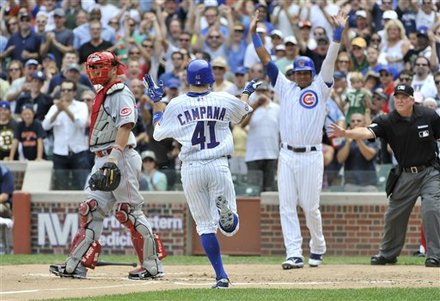
Campana's first-inning inside-the-park-homer, which also scored Starlin Castro, was the first home run of his career.  In fact I remember Len and Bob once remarking on a broadcast that it was as likely that Campana's first homer came in the park as it was over the wall.  It was just an amazing sight to behold and one of the most exciting plays in baseball, although near the end there was little doubt the little guy would make it.  The left fielder was a first baseman named Yonder Alonso who apparently hadn't adapted well to his temporary position, as he ran into the wall and let the ball skip right past him.

Tyler Colvin homered an inning later to make it 3-0.  Ryan Dempster ran into a bit of trouble in the 4th, allowing two runs, but the Reds never got the lead back despite a late homer by Ramon Hernandez which cut the lead to one.  Carlos Marmol saved the win, but Campana's clutch catch in the center field ivy (Sam Fuld-style) robbing Brandon Phillips of extra bases gets the real save.  A solid, solid victory.

On Saturday, the Cubs beat the Reds in blowout fashion.  Carlos Zambrano earned his ninth win of the season which could be his last win as a Cub.  Zambrano homered, Castro picked up four RBIs, and Carlos Pena picked up three in the 11-4 win.  On Sunday, Sean Marshall's midseason slump appeared to pack in one last stand as Marshall blew a one-run lead in the 8th, allowing the Reds to win 8-7.  The win snapped the Cubs' season-high seven-game winning streak.

Following the Monday rainout, the Cubs played the first of three against Chien-Ming Wang and the Nationals on Tuesday.  Wang stymied the Cubs offense, allowing hardly any baserunners and no runs while Matt Garza on the other side continued to receive the world's worst run support.  This one of Wang's first few starts in over two years, so the effort by the Cubs offense is pretty disappointing.  Golden boy Castro homered in the 8th, but the rest of the lineup stayed quiet in the 3-1 loss.

Batboy?  Nope, the dude in the middle is
the scrawny little Campana.
Homers by Reed Johnson, Geovany Soto, and Alfonso Soriano were enough to put away the Nats on Wednesday, thanks to a solid start by Rodrigo Lopez.  Although Lopez is just a short-term fix for this season's lack of rotation depth, it's good to see the Cubs be able to win with him on the mound.

Dempster again had great stuff in his Thursday start against the Reds, a 1-1 tie until homers by Aramis Ramirez and Carlos Pena made it 4-1.  A late rally nearly tied the game for the Reds, but a huge clutch performance by Carlos Marmol got the Cubs their third series win in a row and left them 9-2 in their last 11 home games.  Rick Ankiel hit an all-or-nothing blast to deep center that was caught near the warning track with the bases loaded and everything on the line with two outs in the 9th, giving the Cubs the win.

The phrase 'home cookin'' hasn't really applied to the Cubs this year or the last, but their 'road cookin'' in Pittsburgh carried over and kept on rolling back to Wrigley anyway.  This homestand just had a fun, positive feel to it which made it so fun to watch.  MVP honors goes to Dempster, who gave the Cubs everything in two very solid starts.  After the tough summer this has been for the Cubs and their fans, it's about time for some winning.  And according to Mike Quade, this could still be the year!


Friday, August 12, 2011

Four Nights in August

After the big 10-game road trip started off so terribly for the Cubs, dropping all three in Milwaukee and the first two in St. Louis, it seemed hopeless to think any positives could be taken from it.  But after a surprising win on national TV Sunday night in St. Louis, the Cubs came to Pittsburgh for a four-game series and did something they hadn't in over 50 years.

On the other side of Chicago, the story unfolding at the same time was nowhere near as bright.  In fact, some of the ugliest baseball the White Sox have played in quite some time.  The fact that the Yankees' only loss in Chicago in 2011 came against the Cubs is extremely rare; actually, that's never happened before.  The Sox were completely incompetent against the Yanks this season, and the series appeared to give the Sox little postseason hope remaining.

Outscoring the Pirates 24-15 and outhomering them 10-5, the Cubs took all four games for the first time since 1959 to incredibly break even on the trip.  While this series probably represents the only bright spot on an at-first atrocious 10-game swing, plenty of positives can be taken from it.

The Cubs beat the Bucs in all four games, they beat them in pretty much every fashion that a team can be beat.  On Monday the Cubs scratched together runs from sacrifice flies and fielder's choices and such, winning a tight battle 4-3.  On Tuesday, the Cubs blew them out in humiliating fashion with six homers in the first four innings!  Geovany Soto, Aramis Ramirez, Marlon Byrd, Tyler Colvin, and Alfonso Soriano (twice) all went yard as the Cubs won 11-6.  In all my years of watching baseball, I have never seen such an amazing power display.  On Wednesday, there were 16 total runs less scored than in the game before; just one.  A classic pitcher's duel between Matt Garza, the most under-appreciated starter on the planet and Charlie Morton, scrub, was destined for extra innings when Starlin Castro homered to help his cause for National League Player of the Week honors, which he ended up winning.  Final score: 1-0.  On Thursday the Cubs pulled out with an early lead, only to blow it and then make a marathon comeback in the 8th to win 7-6.

This compilation of victories is nothing short of a masterpiece, and will not soon be forgotten by this writer.  The term 'textbook' baseball applies.  This sweep effectively knocked the Pirates out of postseason contention, not just because of the four losses, but because of the drastic effect the losses must have had on the team morale.  The Pirates did go out and acquire Ryan Ludwick and Derrek Lee at the deadline, but these moves appear to have backfired and the NL Central is now a two-team race.

After the White Sox were swept by the Yankees, they handily swept the Twins in Minnesota.  In reaction, a panelist (and Sox fan) on CSN wondered why his team is 'doing this to me again', referring to the Sox blowing important games and look hopeless only to win games out of nowhere and be back in contention in no time.  The panelist just wished the Sox would lose and stop toying with their fans' minds.  When a team's own fans want the team to lose, the team has definitely been through some confusing and ridiculously aggravating stretches.

The Yankees series was one such stretch.  A lifeless stretch for the Sox saw all four starters get the loss in Jake Peavy, John Danks, Gavin Floyd, and Phil Humber.  The Yankees also played around with different variations of beatdowns, in the form of a blowout (18-7), a tight win (3-2), and simple superiority (6-0 and 7-2).  The series left the Sox in third place behind the Indians and Tigers by a total of 6.5 games.

As a Cubs fan, obviously I'm very pleased with the outcomes of both series.  Although this is probably not a harbinger (in that the Cubs will probably go back to consistently and the Sox back to hovering in a tentative in-contention holding pattern), it was fun while it lasted for sure.  And it probably isn't going to happen again anytime soon, so I am taking advantage of this for all it can be.  Not just the four-game sweeps on both sides of town (and winning on the right side, no less), but the authenticity of the the wins provides a lesson: in how many ways can a team beatdown another?  A comical and interesting question in the same, and it was definitely explored by our two Chicago teams last week.        

Thursday, July 28, 2011

Homestand Analysis: Florida, Philadelphia, Houston

Record: 5-5
Final Record: 42-60

Fresh off a trip to the All-Star Game, Starlin Castro returned to Chicago to rejoin his team for a four-game set against the Florida Marlins, who were making their last trip to Chicago under that name before they become the Miami Marlins next year.  The Marlins went out with a bang too, taking three of four games and outscoring the Cubs 27-13.

Two of the three losses should have been wins for the Cubs, and only one of those two was actually the Cubs' fault.  A typical Carlos Marmol ninth inning implosion blew the lead and the game in both teams' first game after the break on Thursday night.  After a win on Friday and a blowout loss Saturday, the Cubs were robbed of at least extra innings by second base umpire Lance Barrett, who blew the call on a pickoff play that would have gotten Kerry Wood out of a serious jam in the 8th.  Wood and the Cubs were livid, but there is no instant replay on those calls and they just had to deal with it.  Wood went on to walk in the go-ahead run and the Cubs would never get the lead back.

While losing three of four to Florida might have seemed bad, the Cubs had an even taller task ahead of them when the Phillies came to town on Monday.  But for the second year in a row, the Cubs beat Phillies ace Roy Halladay and opened off the series with a surprising win.  Aramis Ramirez and Carlos Pena added home runs in the game.

While Ramirez and Pena and known sluggers, it would still be a surprise to see one of them homer of Phillies southpaw Cliff Lee, widely regarded as one of the best pitchers in baseball known for his impeccable control.  But it was a kid with five career homers heading into the game who would homer off the veteran Lee on this night.  Castro's two-run first inning blast gave the Cubs a lead that would hold up until the 8th, when Sean Marshall blew it on a double by Chase Utley.  As I've mentioned in previous posts, Mike Quade has taken a lot of blame for leaving in pitchers too long.  Perhaps preparing for potential extra innings, Quade left in the demoralized Marshall to pitch the 9th, and a two-run double by Michael Martinez gave the Phillies a lead they wouldn't give back.  The mistake by Quade was inexcusable, and I was highly disappointed that this problem still plagues Quade.

After the Phillies finished their series win with a blowout in nothing-to-see-here fashion, the stumbling Houston Astros came to Wrigley Field.  The Astros had gone 9-3 in their last 12 games at Wrigley Field before this series, but that was certainly bound to change.  This year's version of the Astros is unprecedentedly bad and on pace for around 110 losses, which would be a franchise worst.  In fact, the Astros have never lost 100 games in the franchise's 50 year history, but that will change at this rate.  And a sweep from a fifth-place Cubs team definitely won't help them avoid it.

The Cubs took the Friday matinee by power, as Alfonso Soriano and Ramirez had key homers to take it 4-2.  Randy Wells, pitching for his life in the rotation, came through with just one run allowed Saturday and was allowed to stay in the rotation.  Marlon Byrd and Geovany Soto joined the homer party in support.  Speaking of homer party, Carlos Lee gave the Astros the lead 4-3 on Sunday with a shocking two-run homer in the 8th.  Lee, a notorious Cub killer, has 36 career homers against the Cubs, which is 17 more than he has against any other opponent!  But my immediate reaction to Lee's homer on Sunday was, 'Isn't this guy too old for this now?!'  Lee's homer, just his eighth of the season, was quickly forgotten by Cubs fans, however, as a Soriano single tied the game just a half-inning later.  In the 10th, Jeff Baker singled to left to win the game and begin the walk-off celebration.

And just like that, the Cubs took their first three-game sweep of the season.  Oh, and that was also their first three-game winning streak in nearly four months of baseball.  See, it wasn't that hard guys.  Does it really count against a team like the Astros?  For our purposes, yes.

For how ugly the homestand started, you have to give the team credit for rebounding and sweeping the Astros.  But the Cubs should have taken three of four from the Marlins and two of three from the Phillies, counting the game that Marshall and Quade unintentionally colluded to blow.  Counting the sweep of the Astros, that would've been an 8-2 homestand.  But the past is the past, and as the all-mighty Da Coach says, the past is for cowards.  Point being the Cubs have to take the positives and work forwards to have any chance of a late-season rebound like last year's.  

Tuesday, July 5, 2011

Homestand Analysis: Colorado, San Francisco, Chicago (AL)

Record: 4-4
Final Record: 35-50

Against the Rockies, the Cubs finally got their first series sweep of the season.  Unfortunately, it was a one-game series, as in a makeup game for the rainout back in April.  This means the Cubs have yet to sweep a three-game series, and also haven't even won three in a row.  But play later in the week was encouraging for the Cubs.

Behind two homers each by Aramis Ramirez and Carlos Pena, the Cubs rolled past the Rockies 7-3.  The four homers would be the first four of 12 homers on the eight-game homestand.  Something was definitely in the water, as even backup Koyie Hill added one to the tally.  The annual weather swing has struck Wrigley, with that summer wind blowing out to the bleachers.

In the Colorado game, starter Matt Garza gave up a deep fly ball to left field by Carlos Gonzalez.  Alfonso Soriano went back to the track at his typical, lackadaisical pace.  Soriano eventually just pulled up and stopped, facing the wall, waiting for the ball to drop.  Garza, standing on the mound and thinking Soriano couldn't see the ball, raised his arms and said, "What are you doing?!"  Sure enough, the ball landed in the bleachers for a home run.  Garza, like most of the rest of the players, was shocked.  This evidence of the bandbox that Wrigley Field becomes in the summer has to come as a big surprise to the newcomers like Garza, who thought this ball would be a routine flyout.

The jetstream helped the Cubs for the rest of the homestand.  Ramirez hit six homers on it, en route to a well-deserved National League Player of the Week award.  But even that couldn't help the Cubs from looking absolutely dreadful in the doubleheader against the Giants on last Tuesday.  The Cubs were blown out by baseball's worst offense, reminiscent of their similar drubbing of the Cubs at Wrigley Field last year.  For the Cubs, Doug Davis and Rodrigo Lopez started the two games and the results are history.

Thankfully, the Cubs salvaged the last two games in impressive fashion.  A 1-0 ninth inning lead was blown by Carlos Marmol, but Ramirez singled home the winning run just a half-inning later on Wednesday night.

On Thursday afternoon, the Cubs put together one of their most complete wins since 2008.  Marcos Mateo pitched five incredible innings of relief after Carlos Zambrano's injury allowed him just one inning.  Ramirez erased a 1-0 deficit on a 95 mph fastball off Giants closer Brian Wilson.  Darwin Barney hit a huge clutch double in the 13th inning to tie the game at two after the Giants took the lead in the top half.  Geovany Soto stepped up and, two pitches later, ended the game with a three-run walk-off homer that was one of the most amazing moments the Cubs have had in the last decade.  The game was intense throughout and the Cubs trailed twice facing a loss, coming back both times.

In their millionth attempt to win a third game in a row, the Cubs were again denied, this time by the White Sox.  The Cubs didn't commit any errors on Friday in the series opener, according to the box score.  A mental error by manager Mike Quade cost the Cubs the lead in a tie game.  Quade has been sharply criticized this season for leaving in starters too long, and although much of this criticism is unfair, there's a case for this game to be examined.  Randy Wells gave up the two-run lead he had in the seventh, increasing his runs allowed total to four.  After Alex Rios reached base, Quade allowed Wells to pitch to Juan Pierre who lined a two-run triple to gave the Sox a lead they wouldn't give back.  Quade's mental error wasn't something major on his part, but I believe it was just the wrong decision.

A blown call at second base on a double play ball prevented the Cubs from tying Saturday's game at one, and the Cubs lost 1-0.  Garza threw a complete game despite losing, a sign I love to see.  Back in the Lou Piniella days, Garza would've been yanked after eight regardless of his low pitch count and the fact that his performance had earned him another inning.  Garza has been the beneficiary of some serious bad luck this season, and his value to the team has been far underrated thus far.

The Cubs finally got a win on Sunday, which salvages all Cubs fans everywhere from having to hear those Sox fans yappin' their yappers about how they swept us in our own park, yadda yadda yadda.  Thank God.  A Starlin Castro RBI triple and Ramirez two-run homer built a small lead, and although Kerry Wood allowed the bases loaded in the 8th, the Cubs escaped, avoiding the sweep.  The Sox now lead the Crosstown Series 12-6 since 2009.

On this homestand, Cubs pitchers really started throwing strikes.  In the case of Wells, Lopez, and Davis, who was released after his latest shellacking, this tactic didn't work so well.  In the case of Garza and Ryan Dempster, this worked very well.  Keeping a lower pitch count should allow the starters to go later in games, which is something the Cubs need.  Garza's performance on Saturday was incredible; but not as incredible as the fact that he lost.    

Tuesday, June 21, 2011

Homestand Analysis: Milwaukee, NY Yankees

Record: 4-3Final Record:  29-42

Although the Yankees slowed down the Cubs in the last two games of this homestand, the Cubs overall played much better baseball, even in the losses.  Fans also arrived in sellout or near-sellout fashion on this homestand and the Cubs definitely benefited from it.  The Cubs are still only 16-22 at home, but their play at Wrigley could heat up with the weather and fans.  

A pumped Carlos Marmol pumps his fist
after getting the save Friday against the Yankees
Against Milwaukee, team chemistry was evident as the team came through with two clutch wins in a row.  Ryan Dempster shut down one of the top offenses in baseball in the Brewers' offense, and Darwin Barney scored the only run of the game in the first game and the Cubs won 1-0.  On Tuesday night, the Cubs trailed late but rallied and won 5-4 on Starlin Castro's walk-off single.  Although the Brewers took one on Wednesday, the Cubs offense came back and put on a show Thursday, scoring 12 including homers from Carlos Pena, Kosuke Fukudome, and Alfonso Soriano.  These three wins sent the first place Brewers to Boston having barely hung on to first, and shocked at these losses.

The Yankees came to town on Friday for the first time since 2003 and second since the 1938 World Series.  The rare matchup attracted national attention, just like the Cubs-Red Sox series in May.  And the series couldn't have begun any better for the Cubs, who put together their most complete win of the season in the opener with Doug Davis surprising everyone including himself in limiting the most powerful offense in the league to just one run over seven plus innings.  Early runs were put on the board, and Reed Johnson saved the day with an amazing diving catch robbing Robinson Cano of extra bases late.

However, the Cubs would lose tight games in the late innings on both Saturday and Sunday.  Perhaps the lack of being able to close these games is due to the fundamental difference between these teams.  The Yankees were just teetering on the edge of breaking the game wide open pretty much the entirety of Sunday night, it seemed.  Putting in rookie Chris Carpenter to face Nick Swisher with two men on in the 8th was just what the Yanks needed to finally come through.  Not the greatest call on Mike Quade's part.  Swisher homered for the first three of six runs that allowed the Yankees to pull away in the 8th and 9th inning on national TV.

Curtis Granderson follows through on an
extra-base hit late Sunday at Wrigley.
Overall, signs of progress have to be looked for from this homestand.  Although the Cubs should have won six instead of just four games, the last two games against the Yankees were no pieces of cake, either.  So the fact that the Cubs played competitively for most of the game is a good sign.

Attendance for the three game series totaled over 126,000, which set an all-time Wrigley record for attendance in a three game set, beating the previous record of almost 125,000 set in July 2007 against the Astros.  Friday and Saturday's attendance both were over 42,000, a mark that hasn't been reached since the 2007 and 2008 playoffs.  But Saturday's attendance, 42,236, surpasses all three of the home playoff games from those two seasons.  Because the bleacher expansion of 2006 added about 3,000 seats to the ballpark, that number also surpasses all of the 2003 playoff games.  This means that Saturday's attendance could be the largest in decades, although I don't know how many.

The improved play came just in time for the series with those evil White Sox, who lost the first game last night 6-3.  Watch for the next couple weeks to decide the season for the Cubs, who will need to determine trade deadline status soon.

Wednesday, June 15, 2011

Road Trip Analysis: St. Louis, Cincinnati, Philadelphia

Record: 2-8
Final Record: 25-39

As the Cubs finished this road trip, they watched their spot in the standings drop to becoming one of the NL's worst teams.  The last loss to Philadelphia Sunday afternoon left them 3-13 in their last 16 games.

Albert Pujols didn't help the Cubs in their quest to return to .500 at all.  Walk-off home runs on back-to-back days at Busch Stadium propelled the Cardinals to a sweep.  The first homer, off Jeff Samardzija, was a well executed changeup below the knees.  The pitch was a ball, but Pujols homered anyway.  A moment like this mandates a sportsmanlike tip of the cap.

But on Sunday, Pujols had a much easier path to victory.  Rodrigo Lopez left him a fastball right down the middle, and Pujols had no issues driving it out of the park to become just the second player since Ron Santo in 1966 to hit walk-off homers in back-to-back games.  The Cubs were just simply beaten at the end of the day, although having been beaten in such a preventable manner was disturbing.  If Pujols can hit Cubs pitching that well, imagine the damage he could do in batting practice if he came to play for the Cubs.  Not that he will or anything, but an interesting thought.

The team showed a variety of ways to lose on this trip while the injury bug continues to infect the entire roster.  The Cubs were without Alfonso Soriano for the entirety of the trip, and weren't too impressed with the continued return of Randy Wells.  Giving up grand slams to scrubs like Miguel Cairo can never be a good thing.  And the only two bright spots on the entire trip were the highlights of the two wins.  Ryan Dempster shut down the Reds in seven innings, Carlos Pena launched a 443 foot blast to right field in Cincinnati, and Tyler Colvin hit what should have been the go-ahead homer in the opener of the Philly series, breaking an unbelievable 0-for-34 slump.

Besides these things, there weren't many positives that came out of this trip for the Cubs.  So I won't bore with complaints about the losing, because it's become more routine.  At least we know what we're getting here.  Nowadays, the phrase goes 'bad teams find a way to lose'.  With this brand of baseball, it appears Cubs fans will just have to Wait Till Next Beer yet again.  

Monday, June 6, 2011

Homestand Analysis: New York, Pittsburgh, Houston

Note: technical difficulties have prevented me from posting in the last week.  I apologize for this and guarantee more posts are coming, and soon.  Thank you for being patient.

Record: 3-6
Season Record: 23-31
Games Behind First: Irrelevant at the moment

Well so much for that.  This was supposed to be the point where the Cubs kicked it into gear, hosting three of the worst teams in the National League.  Not only was the homestand bad, it progressively got worse.  The Cubs routed the Mets in two of three in the first series, and their only loss was a wild one that showed plenty of effort from the Cubs.

In one of the weirdest things I have ever seen, Justin Berg came in in relief during that game with two men on and one out and promptly walked the next three batters, forcing in two runs.  Not only did he walk these hitters, he walked them on 12 pitches, meaning he didn't throw a single strike.  After the third walk he was taken out and sent to the minors immediately.

The Cubs were basically shut out in the first two games against the Pirates, not including a ninth inning two-run bomb by Alfonso Soriano that didn't hold much significance.  The Pirates, meanwhile, put up 14 runs between the two games, including a homer parade from former Cub shortstop Ronny Cedeno, first baseman Lyle Overbay, catcher Chris Snyder, and center fielder Andrew McCutchen.  The Cubs won the Sunday matinee 3-2 on a homer from Aramis Ramirez (about time, don'tcha think?) and a pair of sac flies.

The Astros, jealous of their fellow NL Central team the Pirates, decided to jump on the bandwagon and create a homer parade of their own at Wrigley Field, which is just this magical place for opposing power hitters.  I think the media is sticking with the story that the wind blows in during the spring despite the fact that visitors seem to have no trouble homering.  The Astros' homer parade consisted of second baseman Clint Barmes, right fielder Hunter Pence, catcher J.R. Towles (really?), and shorstop Jeff Keppinger.  They cruised to a 12-7 win.

As manager, Mike Quade can't just come to a press conference and blame the entire loss on one player because of the media frenzy and drama that would follow.  Luckily, I am not bound to such restrictions.  Tuesday's loss was almost entirely the fault of Carlos Marmol.  Almost entirely.  As usual, the Cubs left a million runners on base and could have scored plenty more, but Marmol comes in a 3-1 game in the ninth and gives up six.  And here's the one part I just don't understand.

Marmol comes in, blows the lead, and then puts two men on base with a 4-3 Astros lead.  He clearly didn't have good stuff out there that day, and had his morale blown after blowing the lead.  But Mike Quade leaves him out there to pitch to Hunter Pence, who homers off him.  A closer, especially one as emotionally pumped as Marmol, should never be left in a game after blowing a lead and letting the other team go ahead.  A pathetic waste of a game.

The Cubs would lose the next afternoon too, ending the homestand at 3-6.  Weren't they supposed to have their big winning swing on this homestand?  No one on the Cubs actually got the memo.  And not only that, the Cubs, as they have the last two years, looked completely disinterested.  There's no anger here besides that of Carlos Zambrano (stay tuned on that).

I say it all the time; if the Cubs aren't going to beat the bad teams, they'll have to beat the good ones.  Because you can't turn around the season without winning games.  And the Cubs don't seem to be too interested in doing that these days.  That is precisely the most frustrating thing about watching the Cubs.  The Cubs just got swept by the Cardinals, and now head to Cincinnati and Philly.  With all these injuries, underperformers, and losses, this is probably rock bottom for this team.  If it isn't, the Cubs will probably lose 100 games this season.