Showing posts with label ludwick. Show all posts

Saturday, November 5, 2011

400-Foot Fly Outs No More

The 'Black Monster' of Citi Field will be obsolete
in 2012, replaced by a Mets-blue wall closer
to home plate and half the height.
The Mets are making the right call in moving in Citi Field's fences; it's time for the Padres to do the same at Petco Park


Citi Field's fences will be dramatically shorter and close to the plate in 2012.  After three years of far too many 400-foot flyouts, the Mets will abandon the 16-foot wall in left and place an 8-foot wall in front of it.  The weird indentations in the outfield walls in right field will be smoothed over, too, and those walls will be dramatically shortened.  And in a move that will make the park a whole lot less depressing looking even when the Mets lose, as they seem to do inevitably now, the wall will be painted blue all the way around.

According to the Mets, the adjustments reduce the in-play surface area of the field by two percent, a notable figure for a ballpark.  When ESPN reached David Wright for comment, he told them that he'd be lying if he told anyone he enjoyed hitting at Citi Field.  He seemed pleased with the changes, but he's probably been anticipating them for some time.  He hasn't been the first to criticize the overly-spacious new park.  Even I became frustrated with the walls when playing a Mets franchise on MLB 10: The Show.  It was awfully hard to get anything over those walls, much less a David Wright fly ball.  Plus, this provides the Mets with new revenue opportunities.  What's not to like?

Citi Field's dimensions are changing
for nearly the entire outfield.
Is there really a need to drastically change the playing conditions so much?  Yes.  No doubt.  In 2011, Citi Field only gave up 1.33 total home runs per game, third-least in MLB behind only Petco Park and AT&T Park.  The face of the franchise, Wright, hit 50 home runs at Shea Stadium combined from 2006-08.  In his first three years at Citi Field, however, he has only hit 22, including only five to the opposite field.

In 2008, playing half their games at Shea Stadium, the Mets hit 172 home runs as a team., good for a respectable 14th place in MLB.  In 2009, playing half their games at Citi Field, they hit 95.  Carlos Delgado or no Carlos Delgado, teams just don't do that.  Teams don't see their home run total cut in half from one year to the next.  As nice as Citi Field has been for the fans, power hitters have yet to catch a break in the cavernous stadium.  In fact, no left-handed hitter has ever hit an opposite-field home run there.  No home run from any hitter has ever hit the apple in straight center, nor has one hit the tarp to the left of it or even the first section of seats there.

Citi Field's new and old dimensions.
Not only will the new wall eliminate all of the weird angles and corners in right field, it gives the ballpark a better feel.  Citi Field is the only park in MLB in which the home run poles and line are not yellow.  At Citi Field they are orange, but with the black walls that looks really ugly.  The Mets have been a disappointing and somewhat depressing team the last three seasons.  Even when fans did show up there was little excitement.  The wall in left is a Black (or soot, depending on how you view the color) Monster - a take on Fenway's Green Monster - except that it's not like 10 feet from home plate like its green counterpart.  That is the wall of which no lefty has ever hit a homer over.  Looking at the field diagram above, it might not look like much, but that change makes a world of difference.

Give it up for Cameron Maybin, who
led all 2011 full-season Padres with
an underwhelming nine homers.
Now in case study number two, the San Diego Padres hit only 91 home runs in 2011, worst in MLB and the lowest single-season total by any team in over a decade.  Their home ballpark, Petco Park, only allowed a combined 1.23 home runs per game, second lowest in MLB behind only AT&T Park.  Of the 100 home runs hit there, only 42 were hit by the Padres.  This means the Padres hit seven more homers on the road than at home, and they won more games on the road than they did at home.  Basically, their home field advantage was nullified.

Since Petco Park opened in 2004, the organization has prided itself on creating contenders based on pitching and defense.  They did steal the most bases in MLB with a second-best 79% success rate, and their pitching staff had the third best ERA of the 30 teams, but clearly the formula didn't work as the Padres finished at 71-91.  The team was led in home runs by Ryan Ludwick, who was traded to Pittsburgh midseason.  Of full-season players, Cameron Maybin led the group with nine (but only two at home)!

Granted, the Padres currently aren't a team built for power.  When they moved into Petco, however, there were a couple guys not quite as bashful (pun intended) as the rest of the team.  Ryan Klesko and Phil Nevin had made nice livings as power hitters at Qualcomm Stadium before both saw decreases in power numbers upon moving.  Klesko especially struggled with the new digs, hitting only three homers at Petco in '04 after 21 total the year before.  No matter how a team is constructed, however, no team in this day and age will ever make the playoffs without hitting 100 home runs in an 162-game schedule.  Even hitting 120 would be a stretch.

Petco Park: Although the field is too big,
it's a shrine of a baseball stadium.
I believe I have made a compelling case.  As you can see in the photo, the park has a very modern style.  The dimensions, however, are kind of old school, and this park probably was the one that started the over-obsessive pitchers'-park-dimensions-in-new-stadiums fad, which has been copied by Target Field, Citi Field, and more.

From the fan's perspective, however, it is an excellent ballpark.  Besides Wrigley, it's my favorite place to see a baseball game, and I've only been there once.  It's the only ballpark in the league that allows the baseball fan to satisfy his or her play-in-a-sandbox cravings, which he or she can do in front of the right field bleachers.  But if 'the beach' were expanded a bit in right (which would move the fences in), home games would feel even more like a sunny day at the beach for fans of the team with ocean waves on its home jersey.

What if Petco Park looked like this (proposal in blue)?
To put this plan into motion, I've created a prototype dimension blueprint.  The black line with red numbers represents Petco Park's current dimensions and the blue line with blue numbers represents the proposed design.  It may not seem like much, but this move would drastically change the way the ballpark plays.  It wouldn't just become a neutral park; it would be a hitters' park.  I don't have a problem with that, and neither should the Padres.  After all, in runs scored, they've finished in the bottom six of the 16 NL teams six of the eight years they've been playing at Petco.

This is the first time I've ever created something like this.  However, I don't see the Padres ownership doing anything like it.  It would could be completed in one offseason but would require construction costs.  However, they could add more seats which would create more revenue, so the project would actually pay for itself eventually.

From a playing field standpoint, though, this is a necessary move.  The Padres are a small-market team that builds from within, so they boast good young arms in the rotation and bullpen.  In 2010 the Padres had the best bullpen in MLB.  But they're getting help from these obnoxious dimensions, and far too much of it.

If the Padres ever want a competent and balanced offense that can keep up with its pitching staff and not have win games 3-2 all the time, they're going to have to do something about the dimensions.  With all the extra room in the power alleys, it's no coincidence the Padres led the league in triples this season (the Mets were 4th).  They're going to have to recognize the issue for what it is, an issue, and act.  That's what the Mets have done, and the improvement will be seen next season.  I hope someday soon we'll never see another 400-foot fly out in either of these parks.    


Wednesday, August 17, 2011

Changing Landscape on the Central Front

The Milwaukee Brewers are 19-2 in their last 21 games and now hold a seven-game lead in the NL Central over the Cardinals, a 12.5-game lead on the Reds and 14-game lead on the Pirates, but the story was drastically different not even that long ago.  On July 24, all four teams were within four games of first place in what was MLB's tightest division.  Now, however, the trade deadline seems to have separated the leaders significantly.

The Brewers, who acquired Francisco Rodriguez most notably before the deadline, are the obvious favorites to win the division now.  The Cardinals swung Colby Rasmus to the Blue Jays in a three-way trade that landed them Edwin Jackson.  In my opinion, this was a very bad move.  While Jackson could be  great rotation depth for a team that has lacked it this season and seasons past, Rasmus was too good to be traded, whether he gets along with manager Tony La Russa or not.  The Cards also acquired Rafael Furcal as a rental to start over Ryan Theriot.  The Pirates released Lyle Overbay after he was replaced by Derrek Lee and acquired Ryan Ludwick in two moves that appear to have backfired as they have dropped out of contention.  The Reds did pretty much nothing at the deadline and have dropped out of contention.  

What does all this mean?  It means that the Brewers should be the only team of the four to make the playoffs.  But if the Brewers don't make it far into the playoffs this season, they might not get another chance.  In case you haven't heard, Prince Fielder will be a free agent after this season, and the Brewers have little to no chance of resigning him.  According to sabermetrics, teammate Ryan Braun is actually slightly more valuable now to the Brewers than Fielder is (since 2007, Braun's 24.8 WAR beats Fielder's 19.1).  But sabermetrics, or any kind of metrics for that matter, can't measure clubhouse influence.  Fielder has played in Milwaukee since 2005 (two years before Braun arrived) and is the heart of soul of an underrated Brewers team.  Fielder showed real promise as a rookie in 2006, then broke out in 2007 with 50 homers, nearly winning MVP and putting his team in contention most of the season.  He nearly single-handedly woke up the Brewers from their early-to-mid-2000s slumber, and his loss to this team would be huge.

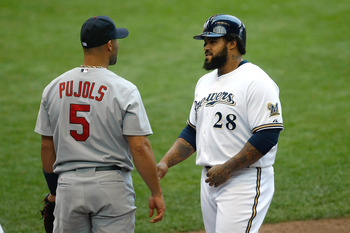
Just seven hours down the road is St. Louis, home of Albert Pujols and the Cardinals.  Pujols' WAR since 2007 is 38.0, making Braun and Fielder look mediocre.  Pujols is the longest-tenured player on the Cardinals and probably has been the best player in baseball since entering the league in 2001.  His consistent power and plate discipline for an entire decade has gone untouched until this year, when he landed on the DL in June.  But Pujols is still the best player on the team and one of the best in the league, and his upcoming free agency is a bigger story than Fielder's.  

Although the Cardinals have a better chance to sign Pujols than the Brewers do to sign Fielder, something tells me that Pujols has not been totally pleased with the loyalty shown to him by his front office in recent years.  The exclusive free agent period open for resigning players is not very long after the World Series, and I highly doubt a deal with any team will be done before he's officially open on the market.

The future of the NL Central will be dictated to a certain extent by where Pujols and Fielder land.  If they both walk in free agency, their teams will take a big hit and the power balance in the division will shift.  But the question is, who will be ready to take it?  The Cardinals will still have Matt Holliday and Lance Berkman to control the power department, while the Brewers will still have Ryan Braun and Casey McGehee, but the key cog would be missing on both teams.

Meanwhile, the rest of the division has an opportunity here.  The Astros don't have any talent ready to win, so they won't be taking advantage.  The Pirates got too many unexpected seasons from their pitchers to expect to compete again next year, unless they get some major help from the minors or free agency.  The Reds were supposed to be much better this year behind the power duo of reigning MVP Joey Votto and Jay Bruce.  If they could just add some pitching, they could take the division back next season.  That leaves just the Cubs, who aren't expected to contend next season but could if they sign Fielder or Pujols and add the correct mix of youngsters to the group.

The bottom line is that with Fielder and Pujols possibly on the move this fall, the NL Central, baseball's unfairest division, will be slightly evened out, at least for a couple years.   


Friday, August 12, 2011

Four Nights in August

After the big 10-game road trip started off so terribly for the Cubs, dropping all three in Milwaukee and the first two in St. Louis, it seemed hopeless to think any positives could be taken from it.  But after a surprising win on national TV Sunday night in St. Louis, the Cubs came to Pittsburgh for a four-game series and did something they hadn't in over 50 years.

On the other side of Chicago, the story unfolding at the same time was nowhere near as bright.  In fact, some of the ugliest baseball the White Sox have played in quite some time.  The fact that the Yankees' only loss in Chicago in 2011 came against the Cubs is extremely rare; actually, that's never happened before.  The Sox were completely incompetent against the Yanks this season, and the series appeared to give the Sox little postseason hope remaining.

Outscoring the Pirates 24-15 and outhomering them 10-5, the Cubs took all four games for the first time since 1959 to incredibly break even on the trip.  While this series probably represents the only bright spot on an at-first atrocious 10-game swing, plenty of positives can be taken from it.

The Cubs beat the Bucs in all four games, they beat them in pretty much every fashion that a team can be beat.  On Monday the Cubs scratched together runs from sacrifice flies and fielder's choices and such, winning a tight battle 4-3.  On Tuesday, the Cubs blew them out in humiliating fashion with six homers in the first four innings!  Geovany Soto, Aramis Ramirez, Marlon Byrd, Tyler Colvin, and Alfonso Soriano (twice) all went yard as the Cubs won 11-6.  In all my years of watching baseball, I have never seen such an amazing power display.  On Wednesday, there were 16 total runs less scored than in the game before; just one.  A classic pitcher's duel between Matt Garza, the most under-appreciated starter on the planet and Charlie Morton, scrub, was destined for extra innings when Starlin Castro homered to help his cause for National League Player of the Week honors, which he ended up winning.  Final score: 1-0.  On Thursday the Cubs pulled out with an early lead, only to blow it and then make a marathon comeback in the 8th to win 7-6.

This compilation of victories is nothing short of a masterpiece, and will not soon be forgotten by this writer.  The term 'textbook' baseball applies.  This sweep effectively knocked the Pirates out of postseason contention, not just because of the four losses, but because of the drastic effect the losses must have had on the team morale.  The Pirates did go out and acquire Ryan Ludwick and Derrek Lee at the deadline, but these moves appear to have backfired and the NL Central is now a two-team race.

After the White Sox were swept by the Yankees, they handily swept the Twins in Minnesota.  In reaction, a panelist (and Sox fan) on CSN wondered why his team is 'doing this to me again', referring to the Sox blowing important games and look hopeless only to win games out of nowhere and be back in contention in no time.  The panelist just wished the Sox would lose and stop toying with their fans' minds.  When a team's own fans want the team to lose, the team has definitely been through some confusing and ridiculously aggravating stretches.

The Yankees series was one such stretch.  A lifeless stretch for the Sox saw all four starters get the loss in Jake Peavy, John Danks, Gavin Floyd, and Phil Humber.  The Yankees also played around with different variations of beatdowns, in the form of a blowout (18-7), a tight win (3-2), and simple superiority (6-0 and 7-2).  The series left the Sox in third place behind the Indians and Tigers by a total of 6.5 games.

As a Cubs fan, obviously I'm very pleased with the outcomes of both series.  Although this is probably not a harbinger (in that the Cubs will probably go back to consistently and the Sox back to hovering in a tentative in-contention holding pattern), it was fun while it lasted for sure.  And it probably isn't going to happen again anytime soon, so I am taking advantage of this for all it can be.  Not just the four-game sweeps on both sides of town (and winning on the right side, no less), but the authenticity of the the wins provides a lesson: in how many ways can a team beatdown another?  A comical and interesting question in the same, and it was definitely explored by our two Chicago teams last week.