Showing posts with label quade. Show all posts

Sunday, April 8, 2012

Two Chances, Two Chokes

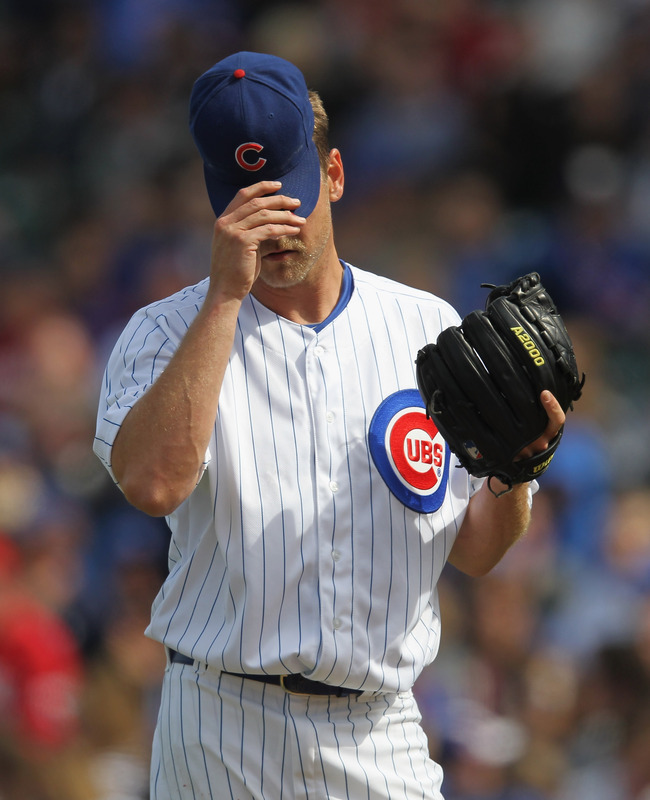
The game-tying runs allowed in the 8th inning
of the first two games of the season
were allowed by a frustrated Kerry Wood.
Is this the new "Cubs Way" of playing baseball?!  Let's hope not.

You've heard about it all winter.  'Sustained success', 'the right way', 'development', and 'building from within' are just a few phrases that have highlighted a winter of change for the Chicago Cubs.  It may all just be empty talk, but the new Cubs brass even put it in writing with their fundamentals manual, The Cubs Way, which is being distributed throughout the Cubs minor league system.  The effort looks to standardize the way in which prospects are being taught the game throughout all levels of the Cubs system to maximize potential of all prospects and maintaining disciplinary consistency.  However, if the young prospects want to see for their own eyes how the game is played correctly, they ought to stay away from Wrigley Field.  If the first two days are any indication, the major league Cubs will struggle to avoid lines of hypocrisy in 2012.  

Hopefully this will not be the case.  Clearly Dale Sveum was more equipped with the leadership and motivation tools to start his full-time managerial career than Mike Quade was a year ago, and these qualities showed in Spring Training.  So far he has gotten the team much more involved in working on simple yet overlooked fundamentals, including baserunning drills which declared exactly which part of the base the Cubs are supposed to hit when rounding them.  He also got some competition going on to get players more involved. 

Casey Coleman and David DeJesus may not win an award of any type during the rest of either of their careers, but the two gained immediate team respect as they faced off in the final round of the 64-participant bunting tournament in camp.  Coleman swept his way through the pitchers' bracket, while DeJesus did the same in the position players' bracket.  DeJesus ended up winning, but the major reward from this exercise was a sense of accomplishment coming from a fundamental the Cubs needed work on.  
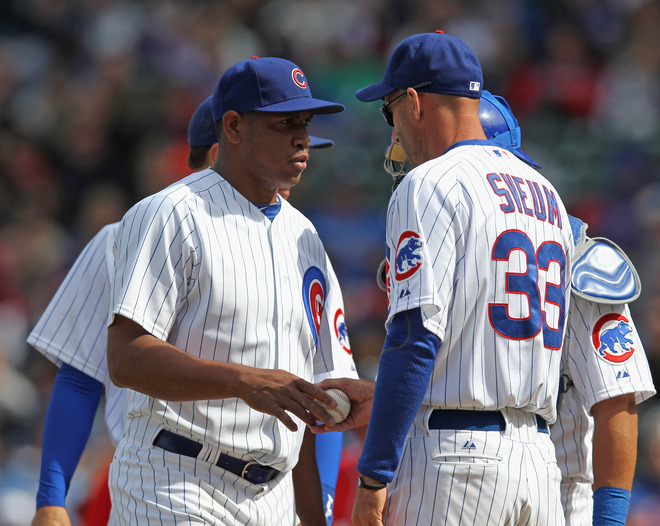
"You're already making me look bad out here.
Vamonos ahora."
After all, these are athletes; they appreciate any added competition to spice things up.  Before it all got started, Tony Campana proclaimed himself as a favorite to win the entire tournament.  He was eliminated in the first round.

The added concentration paid off, as the Cubs brought a winning Spring Training record home with them.  However, the results did not show at all in the first two games of the regular season.  

In the home opener Thursday against the Washington Nationals, Ryan Dempster was finishing up a gem of a performance when he was abruptly yanked with one out to get in the 8th and Ian Desmond on first base.  Enter fan favorite Kerry Wood to hold the 1-0 lead.  A host of problems followed.  Desmond stole second.  Wood walked the next batter, Ryan Zimmerman.  A wild pitch moved Desmond to third and Zimmerman to second.  Wood walks another batter, Adam LaRoche.  After a mound visit, Wood loses another batter in Jayson Werth, whose base on balls forced in the tying run.  

Three consecutive walks spelled doom in the form of lost momentum in this ball game.  Dempster had been living dangerously all day by using the homer-unfriendly winds in his favor, but at least he had controlled the base on balls.  Wood lost it.  Not surprisingly, Carlos Marmol didn't make things any better.  After getting two quick outs in a now-tied ball game in 9th, Marmol allowed a double to Chad Tracy and a go-ahead single to Desmond, scoring Tracy's pinch-runner.  The Nationals took the lead for good.
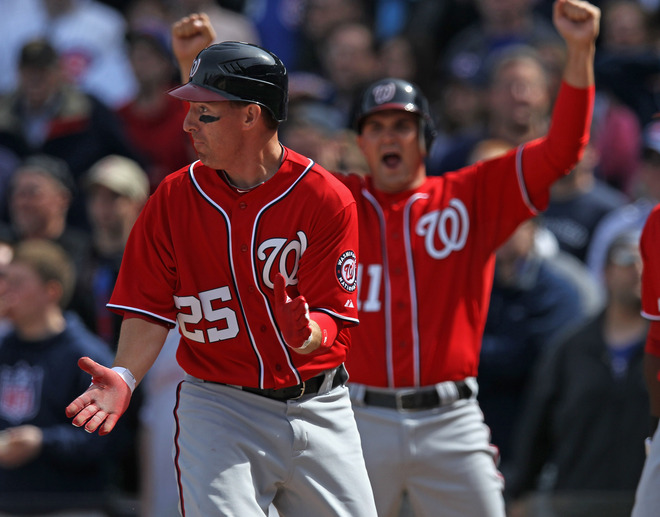
Don't let the hollering fool you.  The Cubs beat
themselves more than the Nationals beat the Cubs.
A day off on Friday gave the team an entire day to stew about blowing the Opening Day not only of 2012, but of the Theo era.  Apparently it got in their heads, because Saturday's game was hardly any better.  The Cubs again held the Nationals down for most of the game until the 8th in a 4-2 game, when Mr. Wood got the first two outs before allowing a solo homer to Danny Espinosa, bringing the deficit down to one.  Then Zimmerman singled, then LaRoche singled, and then Wood was yanked to avoid further damage.  Who was brought in to replace him?  Marmol.  Remember, this is still all with two outs.  Marmol walks Werth, loading the bases.  Finally, Tracy puts the Cubs out of their misery and sucks the life out of the stadium with a two-run go-ahead single.  

These three rallies - two of them when the Nationals were batting with two outs - are pretty much the trademark of the last year's team.  The bullpen was a strength last year, but the hovering frustration of a lack of focus was the most bothersome aspect of last year's team.  Wood immediately took the blame for blowing Opening Day and cited zero excuses, but then it happened again.  We love ya, Kerry, but that's not gonna get 'er done.  Whether it was keeping their eyes on the ball or throwing to the right base, the Cubs lacked in baseball mental fitness last year.  The new management regime made this their primary goal in the offseason, but the early results have disappointed.  Let's hope this doesn't become a trend.


Saturday, August 20, 2011

Jim Hendry Walks On; Randy Bush New Interim GM

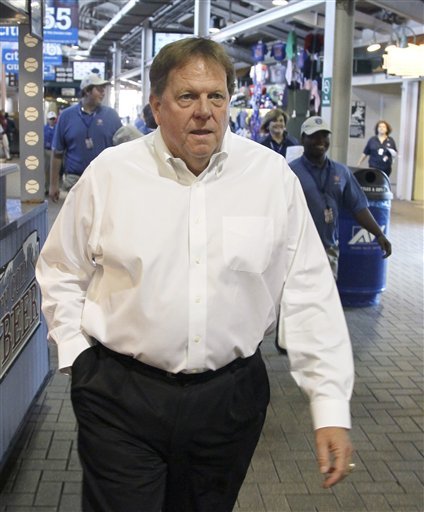
Jim Hendry walks the concourse for the last
time as general manager of the Cubs.
Late August has become a time of change for the Cubs the past two years.  Last August, Mike Quade replaced Lou Piniella as manager.  In a move I never thought would actually happen in season, GM Jim Hendry was officially fired yesterday, ending his 9-year stint with the Cubs.  Assistant GM Randy Bush has taken over on an interim basis but will not be considered for the full-time job as the organization searches for someone outside the organization, said chairman Tom Ricketts at the press conference.

Being general manager of a big market team requires standing up to a lot of scrutiny.  Sometimes you have to make move, regardless of whether you want to or not.  But Hendry was in a very odd spot.  Ricketts told him that he would be fired in mid-July but that it wouldn't be announced until August, after the deadline to sign draft picks and after the non-waiver trade deadline.  So Hendry had to sign all the remaining picks, including top pick shortstop Javier Baez, and make a trade in the Kosuke Fukudome trade, while knowing he was going to be fired.  Now that's loyalty.

Hendry was choked up during his interview at the podium, and he shouldn't be ashamed.  The Cubs under Hendry went 749-748 during his tenure, but he was still their most successful GM in over half a century, building them to three division titles with essentially two different teams.  He brought in two high profile managers in Dusty Baker and Piniella, both of whom had a sizzling start in their first two seasons but faded in their next two.  Hendry, with Baker, came five outs from getting the Cubs to the World Series in 2003.

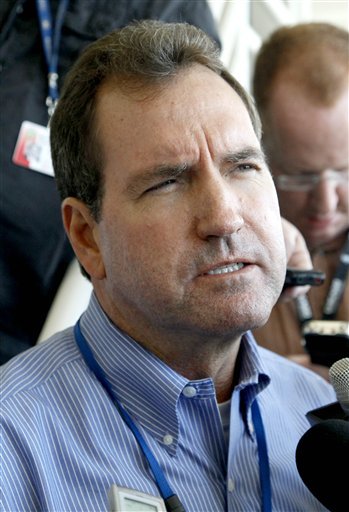
Interim GM Randy Bush
Despite all the success Hendry had, many fans thought it was time for him to go and the team to get a fresh start.  I can see understand the viewpoint, and although I didn't necessarily agree, I think the move sent waves in the form of a wake up call through the organization, specifically the players.  The next GM will be a high profile guy as well, which is a good thing.

The reason I didn't think they should remove Hendry is because, seeing the tough position Hendry was in the last two offseasons because of the large payroll, the Cubs have a bright future.  Of course, the payroll was Hendry's fault, but the draft class this year is one of the deepest they've ever had and lots of ending contracts should make this a bullish offseason.  Hendry was also prepared for the big free agent frenzy also, possibly going after Albert Pujols or Prince Fielder.  But if Hendry had to go, now is the right time.

Right now is a crucial time to get the Cubs back on the winning track, at least at the GM's desk.  With the draft picks signed, it's up to the GM (Bush, for now), scouting director Tim Wilken, VP of player personnel Oneri Fleita, and all of their staff to develop them and get 'em to the bigs as soon as they're ready.  While that is the focus for the next few years, the Cubs obviously have the opportunity to add more this winter in free agency and a new GM will want to prove himself by making a big splash such as a Pujols or Fielder.  Success or failure in these moves will decide the Cubs' success over the early 2010s.

Now the big question everyone wants the answer to is who the next GM will be.  Lists of candidates have already been thrown out there in the media and blogosphere.  Although Ricketts made clear in the press conference that the evaluation process will not be public at all, he did say he wants an experienced executive who comes from a winning culture.  This could include, but is not limited to, Josh Byrnes, Padres VP of baseball operations and former Diamondbacks GM who impressively built the 2007 NLCS team, Jerry DiPoto, Diamondbacks Senior VP of scouting and player development, or Rich Hahn, White Sox Assistant GM.  But if it was up to me, I'd go a different route.

Rays GM Andrew Friedman:
scouting and development master
The turnaround of the Tampa Bay Rays was been constructed by scouting and development.  They went from a 66-96 team to a 97-65 team overnight, and at the helm was GM Andrew Friedman.  In the process, Friedman mastered the art of winning from scouting upwards.  That combined with the free agent buying power and overall resources that the Cubs have, and Friedman could be the best in the business in no time.

Friedman is still the GM of the Rays, but reports have stated that, with the restrictions of the limited revenue sources the Rays have, he wants out.  Time to pounce!  

Sunday, August 14, 2011

Homestand Analysis: Cincinnati, Washington

Record: 4-2
Final Record: 51-67

Fresh off that major sweepage in the Steel City, the Cubs returned home to face a reeling Cincinnati team that had pretty much knocked themselves out of postseason contention.  The underperforming Reds, expected by many to battle the Cardinals and Brewers for the division all season long, came into Friday's game at 57-61 and 10 games behind division-leading Milwaukee.  The Cubs wouldn't make it any easier for them either, as the Cubs, or Tony Campana rather, motored past the Reds in a 4-3 win to open the series.

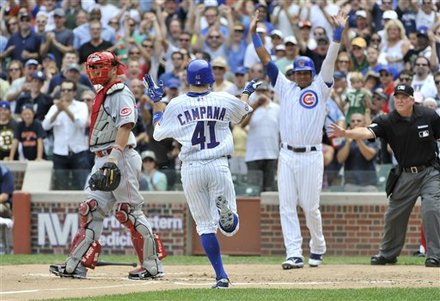
Campana's first-inning inside-the-park-homer, which also scored Starlin Castro, was the first home run of his career.  In fact I remember Len and Bob once remarking on a broadcast that it was as likely that Campana's first homer came in the park as it was over the wall.  It was just an amazing sight to behold and one of the most exciting plays in baseball, although near the end there was little doubt the little guy would make it.  The left fielder was a first baseman named Yonder Alonso who apparently hadn't adapted well to his temporary position, as he ran into the wall and let the ball skip right past him.

Tyler Colvin homered an inning later to make it 3-0.  Ryan Dempster ran into a bit of trouble in the 4th, allowing two runs, but the Reds never got the lead back despite a late homer by Ramon Hernandez which cut the lead to one.  Carlos Marmol saved the win, but Campana's clutch catch in the center field ivy (Sam Fuld-style) robbing Brandon Phillips of extra bases gets the real save.  A solid, solid victory.

On Saturday, the Cubs beat the Reds in blowout fashion.  Carlos Zambrano earned his ninth win of the season which could be his last win as a Cub.  Zambrano homered, Castro picked up four RBIs, and Carlos Pena picked up three in the 11-4 win.  On Sunday, Sean Marshall's midseason slump appeared to pack in one last stand as Marshall blew a one-run lead in the 8th, allowing the Reds to win 8-7.  The win snapped the Cubs' season-high seven-game winning streak.

Following the Monday rainout, the Cubs played the first of three against Chien-Ming Wang and the Nationals on Tuesday.  Wang stymied the Cubs offense, allowing hardly any baserunners and no runs while Matt Garza on the other side continued to receive the world's worst run support.  This one of Wang's first few starts in over two years, so the effort by the Cubs offense is pretty disappointing.  Golden boy Castro homered in the 8th, but the rest of the lineup stayed quiet in the 3-1 loss.

Batboy?  Nope, the dude in the middle is
the scrawny little Campana.
Homers by Reed Johnson, Geovany Soto, and Alfonso Soriano were enough to put away the Nats on Wednesday, thanks to a solid start by Rodrigo Lopez.  Although Lopez is just a short-term fix for this season's lack of rotation depth, it's good to see the Cubs be able to win with him on the mound.

Dempster again had great stuff in his Thursday start against the Reds, a 1-1 tie until homers by Aramis Ramirez and Carlos Pena made it 4-1.  A late rally nearly tied the game for the Reds, but a huge clutch performance by Carlos Marmol got the Cubs their third series win in a row and left them 9-2 in their last 11 home games.  Rick Ankiel hit an all-or-nothing blast to deep center that was caught near the warning track with the bases loaded and everything on the line with two outs in the 9th, giving the Cubs the win.

The phrase 'home cookin'' hasn't really applied to the Cubs this year or the last, but their 'road cookin'' in Pittsburgh carried over and kept on rolling back to Wrigley anyway.  This homestand just had a fun, positive feel to it which made it so fun to watch.  MVP honors goes to Dempster, who gave the Cubs everything in two very solid starts.  After the tough summer this has been for the Cubs and their fans, it's about time for some winning.  And according to Mike Quade, this could still be the year!


Thursday, July 28, 2011

Homestand Analysis: Florida, Philadelphia, Houston

Record: 5-5
Final Record: 42-60

Fresh off a trip to the All-Star Game, Starlin Castro returned to Chicago to rejoin his team for a four-game set against the Florida Marlins, who were making their last trip to Chicago under that name before they become the Miami Marlins next year.  The Marlins went out with a bang too, taking three of four games and outscoring the Cubs 27-13.

Two of the three losses should have been wins for the Cubs, and only one of those two was actually the Cubs' fault.  A typical Carlos Marmol ninth inning implosion blew the lead and the game in both teams' first game after the break on Thursday night.  After a win on Friday and a blowout loss Saturday, the Cubs were robbed of at least extra innings by second base umpire Lance Barrett, who blew the call on a pickoff play that would have gotten Kerry Wood out of a serious jam in the 8th.  Wood and the Cubs were livid, but there is no instant replay on those calls and they just had to deal with it.  Wood went on to walk in the go-ahead run and the Cubs would never get the lead back.

While losing three of four to Florida might have seemed bad, the Cubs had an even taller task ahead of them when the Phillies came to town on Monday.  But for the second year in a row, the Cubs beat Phillies ace Roy Halladay and opened off the series with a surprising win.  Aramis Ramirez and Carlos Pena added home runs in the game.

While Ramirez and Pena and known sluggers, it would still be a surprise to see one of them homer of Phillies southpaw Cliff Lee, widely regarded as one of the best pitchers in baseball known for his impeccable control.  But it was a kid with five career homers heading into the game who would homer off the veteran Lee on this night.  Castro's two-run first inning blast gave the Cubs a lead that would hold up until the 8th, when Sean Marshall blew it on a double by Chase Utley.  As I've mentioned in previous posts, Mike Quade has taken a lot of blame for leaving in pitchers too long.  Perhaps preparing for potential extra innings, Quade left in the demoralized Marshall to pitch the 9th, and a two-run double by Michael Martinez gave the Phillies a lead they wouldn't give back.  The mistake by Quade was inexcusable, and I was highly disappointed that this problem still plagues Quade.

After the Phillies finished their series win with a blowout in nothing-to-see-here fashion, the stumbling Houston Astros came to Wrigley Field.  The Astros had gone 9-3 in their last 12 games at Wrigley Field before this series, but that was certainly bound to change.  This year's version of the Astros is unprecedentedly bad and on pace for around 110 losses, which would be a franchise worst.  In fact, the Astros have never lost 100 games in the franchise's 50 year history, but that will change at this rate.  And a sweep from a fifth-place Cubs team definitely won't help them avoid it.

The Cubs took the Friday matinee by power, as Alfonso Soriano and Ramirez had key homers to take it 4-2.  Randy Wells, pitching for his life in the rotation, came through with just one run allowed Saturday and was allowed to stay in the rotation.  Marlon Byrd and Geovany Soto joined the homer party in support.  Speaking of homer party, Carlos Lee gave the Astros the lead 4-3 on Sunday with a shocking two-run homer in the 8th.  Lee, a notorious Cub killer, has 36 career homers against the Cubs, which is 17 more than he has against any other opponent!  But my immediate reaction to Lee's homer on Sunday was, 'Isn't this guy too old for this now?!'  Lee's homer, just his eighth of the season, was quickly forgotten by Cubs fans, however, as a Soriano single tied the game just a half-inning later.  In the 10th, Jeff Baker singled to left to win the game and begin the walk-off celebration.

And just like that, the Cubs took their first three-game sweep of the season.  Oh, and that was also their first three-game winning streak in nearly four months of baseball.  See, it wasn't that hard guys.  Does it really count against a team like the Astros?  For our purposes, yes.

For how ugly the homestand started, you have to give the team credit for rebounding and sweeping the Astros.  But the Cubs should have taken three of four from the Marlins and two of three from the Phillies, counting the game that Marshall and Quade unintentionally colluded to blow.  Counting the sweep of the Astros, that would've been an 8-2 homestand.  But the past is the past, and as the all-mighty Da Coach says, the past is for cowards.  Point being the Cubs have to take the positives and work forwards to have any chance of a late-season rebound like last year's.  

Tuesday, July 5, 2011

Homestand Analysis: Colorado, San Francisco, Chicago (AL)

Record: 4-4
Final Record: 35-50

Against the Rockies, the Cubs finally got their first series sweep of the season.  Unfortunately, it was a one-game series, as in a makeup game for the rainout back in April.  This means the Cubs have yet to sweep a three-game series, and also haven't even won three in a row.  But play later in the week was encouraging for the Cubs.

Behind two homers each by Aramis Ramirez and Carlos Pena, the Cubs rolled past the Rockies 7-3.  The four homers would be the first four of 12 homers on the eight-game homestand.  Something was definitely in the water, as even backup Koyie Hill added one to the tally.  The annual weather swing has struck Wrigley, with that summer wind blowing out to the bleachers.

In the Colorado game, starter Matt Garza gave up a deep fly ball to left field by Carlos Gonzalez.  Alfonso Soriano went back to the track at his typical, lackadaisical pace.  Soriano eventually just pulled up and stopped, facing the wall, waiting for the ball to drop.  Garza, standing on the mound and thinking Soriano couldn't see the ball, raised his arms and said, "What are you doing?!"  Sure enough, the ball landed in the bleachers for a home run.  Garza, like most of the rest of the players, was shocked.  This evidence of the bandbox that Wrigley Field becomes in the summer has to come as a big surprise to the newcomers like Garza, who thought this ball would be a routine flyout.

The jetstream helped the Cubs for the rest of the homestand.  Ramirez hit six homers on it, en route to a well-deserved National League Player of the Week award.  But even that couldn't help the Cubs from looking absolutely dreadful in the doubleheader against the Giants on last Tuesday.  The Cubs were blown out by baseball's worst offense, reminiscent of their similar drubbing of the Cubs at Wrigley Field last year.  For the Cubs, Doug Davis and Rodrigo Lopez started the two games and the results are history.

Thankfully, the Cubs salvaged the last two games in impressive fashion.  A 1-0 ninth inning lead was blown by Carlos Marmol, but Ramirez singled home the winning run just a half-inning later on Wednesday night.

On Thursday afternoon, the Cubs put together one of their most complete wins since 2008.  Marcos Mateo pitched five incredible innings of relief after Carlos Zambrano's injury allowed him just one inning.  Ramirez erased a 1-0 deficit on a 95 mph fastball off Giants closer Brian Wilson.  Darwin Barney hit a huge clutch double in the 13th inning to tie the game at two after the Giants took the lead in the top half.  Geovany Soto stepped up and, two pitches later, ended the game with a three-run walk-off homer that was one of the most amazing moments the Cubs have had in the last decade.  The game was intense throughout and the Cubs trailed twice facing a loss, coming back both times.

In their millionth attempt to win a third game in a row, the Cubs were again denied, this time by the White Sox.  The Cubs didn't commit any errors on Friday in the series opener, according to the box score.  A mental error by manager Mike Quade cost the Cubs the lead in a tie game.  Quade has been sharply criticized this season for leaving in starters too long, and although much of this criticism is unfair, there's a case for this game to be examined.  Randy Wells gave up the two-run lead he had in the seventh, increasing his runs allowed total to four.  After Alex Rios reached base, Quade allowed Wells to pitch to Juan Pierre who lined a two-run triple to gave the Sox a lead they wouldn't give back.  Quade's mental error wasn't something major on his part, but I believe it was just the wrong decision.

A blown call at second base on a double play ball prevented the Cubs from tying Saturday's game at one, and the Cubs lost 1-0.  Garza threw a complete game despite losing, a sign I love to see.  Back in the Lou Piniella days, Garza would've been yanked after eight regardless of his low pitch count and the fact that his performance had earned him another inning.  Garza has been the beneficiary of some serious bad luck this season, and his value to the team has been far underrated thus far.

The Cubs finally got a win on Sunday, which salvages all Cubs fans everywhere from having to hear those Sox fans yappin' their yappers about how they swept us in our own park, yadda yadda yadda.  Thank God.  A Starlin Castro RBI triple and Ramirez two-run homer built a small lead, and although Kerry Wood allowed the bases loaded in the 8th, the Cubs escaped, avoiding the sweep.  The Sox now lead the Crosstown Series 12-6 since 2009.

On this homestand, Cubs pitchers really started throwing strikes.  In the case of Wells, Lopez, and Davis, who was released after his latest shellacking, this tactic didn't work so well.  In the case of Garza and Ryan Dempster, this worked very well.  Keeping a lower pitch count should allow the starters to go later in games, which is something the Cubs need.  Garza's performance on Saturday was incredible; but not as incredible as the fact that he lost.    

Tuesday, June 28, 2011

Road Trip Analysis: Chicago (AL), Kansas City

For analysis of the White Sox series, see the game recap posts below.

Sloppy series earns just one win; Royals bullpen shuts down Cubs offense late


Record: 2-4
Final Record: 31-46

A series that began mildly well for the Cubs ended highly disappointingly as the Cubs dropped the final two games of the series against a dismal Kansas City squad.

The Friday night opener was a win, but the Cubs didn't do much well in it.  Four baserunners were thrown out on the basepaths, although Mike Quade later said he had no problem with the aggressiveness.  Ryan Dempster allowed two through six innings, but an error allowed two more.  Luckily, the bullpen didn't allow anything after that.

The stories on Saturday and Sunday were very much the same.  Back-to-back home runs from Aramis Ramirez and Geovany Soto were the only runs for the Cubs on Saturday, and Chris Getz drove in the winning run in the 8th inning for a 3-2 Royals win.  On Sunday, a valiant comeback effort in the 3rd and 4th innings fell short and the Cubs trailed the entire game.  After the comeback fell short at 4-3, the Royals would add two more runs later and go on to win, 6-3.

The problem in this series was too many hittable pitches given up by Cubs pitchers.  They kept the ball down, allowing only one home run in the series, but walked at least four in each game, which set up countless RBI singles.  The offense was also mostly minimal in the two losses, stymied by an underrated KC bullpen.

With an eight game homestand that began Monday against Colorado, the Cubs were scheduled to play four games in three days against three different opponents.  Monday, originally scheduled to be a day off, was scheduled for the Cubs-Rockies rainout back on April 27.  Tuesday, originally scheduled to be just one game against the Giants at night, was scheduled to be a day-night doubleheader.  This totals to the Cubs playing the Royals Sunday afternoon in Kansas City, the Rockies Monday afternoon at Wrigley Field, and the Giants in the afternoon and at night on Tuesday at Wrigley.  

Tuesday, June 21, 2011

Homestand Analysis: Milwaukee, NY Yankees

Record: 4-3Final Record:  29-42

Although the Yankees slowed down the Cubs in the last two games of this homestand, the Cubs overall played much better baseball, even in the losses.  Fans also arrived in sellout or near-sellout fashion on this homestand and the Cubs definitely benefited from it.  The Cubs are still only 16-22 at home, but their play at Wrigley could heat up with the weather and fans.  

A pumped Carlos Marmol pumps his fist
after getting the save Friday against the Yankees
Against Milwaukee, team chemistry was evident as the team came through with two clutch wins in a row.  Ryan Dempster shut down one of the top offenses in baseball in the Brewers' offense, and Darwin Barney scored the only run of the game in the first game and the Cubs won 1-0.  On Tuesday night, the Cubs trailed late but rallied and won 5-4 on Starlin Castro's walk-off single.  Although the Brewers took one on Wednesday, the Cubs offense came back and put on a show Thursday, scoring 12 including homers from Carlos Pena, Kosuke Fukudome, and Alfonso Soriano.  These three wins sent the first place Brewers to Boston having barely hung on to first, and shocked at these losses.

The Yankees came to town on Friday for the first time since 2003 and second since the 1938 World Series.  The rare matchup attracted national attention, just like the Cubs-Red Sox series in May.  And the series couldn't have begun any better for the Cubs, who put together their most complete win of the season in the opener with Doug Davis surprising everyone including himself in limiting the most powerful offense in the league to just one run over seven plus innings.  Early runs were put on the board, and Reed Johnson saved the day with an amazing diving catch robbing Robinson Cano of extra bases late.

However, the Cubs would lose tight games in the late innings on both Saturday and Sunday.  Perhaps the lack of being able to close these games is due to the fundamental difference between these teams.  The Yankees were just teetering on the edge of breaking the game wide open pretty much the entirety of Sunday night, it seemed.  Putting in rookie Chris Carpenter to face Nick Swisher with two men on in the 8th was just what the Yanks needed to finally come through.  Not the greatest call on Mike Quade's part.  Swisher homered for the first three of six runs that allowed the Yankees to pull away in the 8th and 9th inning on national TV.

Curtis Granderson follows through on an
extra-base hit late Sunday at Wrigley.
Overall, signs of progress have to be looked for from this homestand.  Although the Cubs should have won six instead of just four games, the last two games against the Yankees were no pieces of cake, either.  So the fact that the Cubs played competitively for most of the game is a good sign.

Attendance for the three game series totaled over 126,000, which set an all-time Wrigley record for attendance in a three game set, beating the previous record of almost 125,000 set in July 2007 against the Astros.  Friday and Saturday's attendance both were over 42,000, a mark that hasn't been reached since the 2007 and 2008 playoffs.  But Saturday's attendance, 42,236, surpasses all three of the home playoff games from those two seasons.  Because the bleacher expansion of 2006 added about 3,000 seats to the ballpark, that number also surpasses all of the 2003 playoff games.  This means that Saturday's attendance could be the largest in decades, although I don't know how many.

The improved play came just in time for the series with those evil White Sox, who lost the first game last night 6-3.  Watch for the next couple weeks to decide the season for the Cubs, who will need to determine trade deadline status soon.

Monday, June 6, 2011

Homestand Analysis: New York, Pittsburgh, Houston

Note: technical difficulties have prevented me from posting in the last week.  I apologize for this and guarantee more posts are coming, and soon.  Thank you for being patient.

Record: 3-6
Season Record: 23-31
Games Behind First: Irrelevant at the moment

Well so much for that.  This was supposed to be the point where the Cubs kicked it into gear, hosting three of the worst teams in the National League.  Not only was the homestand bad, it progressively got worse.  The Cubs routed the Mets in two of three in the first series, and their only loss was a wild one that showed plenty of effort from the Cubs.

In one of the weirdest things I have ever seen, Justin Berg came in in relief during that game with two men on and one out and promptly walked the next three batters, forcing in two runs.  Not only did he walk these hitters, he walked them on 12 pitches, meaning he didn't throw a single strike.  After the third walk he was taken out and sent to the minors immediately.

The Cubs were basically shut out in the first two games against the Pirates, not including a ninth inning two-run bomb by Alfonso Soriano that didn't hold much significance.  The Pirates, meanwhile, put up 14 runs between the two games, including a homer parade from former Cub shortstop Ronny Cedeno, first baseman Lyle Overbay, catcher Chris Snyder, and center fielder Andrew McCutchen.  The Cubs won the Sunday matinee 3-2 on a homer from Aramis Ramirez (about time, don'tcha think?) and a pair of sac flies.

The Astros, jealous of their fellow NL Central team the Pirates, decided to jump on the bandwagon and create a homer parade of their own at Wrigley Field, which is just this magical place for opposing power hitters.  I think the media is sticking with the story that the wind blows in during the spring despite the fact that visitors seem to have no trouble homering.  The Astros' homer parade consisted of second baseman Clint Barmes, right fielder Hunter Pence, catcher J.R. Towles (really?), and shorstop Jeff Keppinger.  They cruised to a 12-7 win.

As manager, Mike Quade can't just come to a press conference and blame the entire loss on one player because of the media frenzy and drama that would follow.  Luckily, I am not bound to such restrictions.  Tuesday's loss was almost entirely the fault of Carlos Marmol.  Almost entirely.  As usual, the Cubs left a million runners on base and could have scored plenty more, but Marmol comes in a 3-1 game in the ninth and gives up six.  And here's the one part I just don't understand.

Marmol comes in, blows the lead, and then puts two men on base with a 4-3 Astros lead.  He clearly didn't have good stuff out there that day, and had his morale blown after blowing the lead.  But Mike Quade leaves him out there to pitch to Hunter Pence, who homers off him.  A closer, especially one as emotionally pumped as Marmol, should never be left in a game after blowing a lead and letting the other team go ahead.  A pathetic waste of a game.

The Cubs would lose the next afternoon too, ending the homestand at 3-6.  Weren't they supposed to have their big winning swing on this homestand?  No one on the Cubs actually got the memo.  And not only that, the Cubs, as they have the last two years, looked completely disinterested.  There's no anger here besides that of Carlos Zambrano (stay tuned on that).

I say it all the time; if the Cubs aren't going to beat the bad teams, they'll have to beat the good ones.  Because you can't turn around the season without winning games.  And the Cubs don't seem to be too interested in doing that these days.  That is precisely the most frustrating thing about watching the Cubs.  The Cubs just got swept by the Cardinals, and now head to Cincinnati and Philly.  With all these injuries, underperformers, and losses, this is probably rock bottom for this team.  If it isn't, the Cubs will probably lose 100 games this season.

Saturday, April 2, 2011

Darwin Barney: The Right Man for the Job

Cub fans, meet Darwin Barney.  Many of you have already been acquainted last season, but still many of you are still getting to know the former Oregon State University Beaver.  Getting to know the guy will come quite in handy, as he's here to stay.  If Barney is sent back down to the Minors even once this season, it will come as a surprise to me.  He played so well in Spring Training that he pole vaulted right over the two above him in the depth chart in Blake DeWitt and Jeff Baker.  Becoming the first rookie to start on Opening Day since Kosuke Fukudome in 2008, Barney has already entered the Cubs' record books.

Not only does Barney bring energy; he's a hardball, max-effort type player.  These kind of guys are very fun to watch and also conducive to winning, which is obviously a plus.  The max-effort skills of players like Derek Jeter and Ichiro Suzuki have contributed to their widespread popularity probably more than anything else.  This status means that the player will hustle on every single play, work as hard as possible on fundamentals, and play the game 'the right way'.  Barney didn't show up in the Majors just to wave to the TV cameras and bask in popularity; he's here to win.  And he's going to prove that this season.

Barney is also Mike Quade's type of player.  Right away from the Carlos Silva incident, Quade took a no-nonsense attitude.  Barney's just here to play.  The fact that Quade even allowed a rookie to hop over a six year Major League veteran in Baker and a 'valuable' trade return in DeWitt shows that Quade is going to play whoever is going to get the Cubs the win on a certain day.  And as of Opening Day, that man is Darwin Barney.  Although Baker and DeWitt will be getting starts at second base as well, Barney could have the position locked up in just a month or so.      

Sunday, March 13, 2011

2011 Profiles: Marlon Byrd

Can Marlon Byrd find his role in the Cubs offense?


Writer's Take: Yes and no.  It's hard to talk bad about a guy who's third in the Cactus League with 15 hits and a .500 average.  But good average hitting was something we saw with Byrd in the first half of 2010, and it made him the Cubs' most All-Star worthy player before an ugly drop off in the second half.  At 9 homers, 40 RBIs and a .317 average in the 2010 first half, I didn't think he was actually All-Star worthy neither then nor now.  But he was the most consistent offensive player on that team and the Cubs' one automatic All-Star selection went to him.

Don't expect him to be an All-Star again this year, but he still will probably have a better year overall.  At the end of 2010, his average sat at .293 which isn't bad by hardly any stretch, but he only managed three homers in the second half.  To be fair, this wasn't a guy the Cubs signed for his power.  But it's hard to make yourself relevant in a lineup when you aren't stealing bases, aren't hitting homers, aren't drawing many walks, or hitting for a great average.

On each of his 12 home runs, his home run 'trots' were actually sprints.  He should use some of this hustle to steal a few bases.  Mike Quade has already indicated that he wants his team running more this season, and Byrd looks to be a candidate.  Stealing won't effect his batting average, but would definitely affect the production of the hitters behind him in the lineup.  Byrd hits near the bottom of the lineup most of the time, and getting production out of those 7-8-9 hitters is a sign of a really strong offense.  Production from that part of the lineup may have been the single most important factor in how the Cubs led the NL in runs in 2008.  With a consistent Byrd who gets on base and gets aggressive on those basepaths, this Cubs offense has the tools to put up big numbers.

Ideal Production: .300, 15 steals, 18-20 homers, 70 RBIs, 45 walks    

Expert Opinion: Byrd has a different mindset in 2011, writes Bruce Levine of espnchicago.com.  A more prominent leadership role is something we could see from him this season with many of last year's veterans gone.

Sunday, February 6, 2011

2011 Cubs: Bold Predictions

This season's edition of the Cubs should be an interesting one.  With this season's fate to be most likely decided upon the play of unpredictable young players, it could really go anywhere.  I think these Cubs could win 90 games; I also think they could lose 100.  But the difficulty of these predictions is what makes them fun; one must visualize their own results, play it out in their own mind.  When I see these Cubs, here's what I see.  The following ten predictions, some more realistic than others, are in no particular order.

1. Starlin Castro will steal 25 bases.
Castro, known for his raw speed, didn't have much luck stealing bases at the Major League level in 2010.  Being thrown out eight out of 18 tries and being picked off multiple times, it was clear Castro has some work to do when it comes to knowing when to run and how to recognize pitcher pickoff moves.  This is something Mike Quade and his staff will surely work on in Spring Training, however, because Castro's speed may be the only real speed on this team.

2. The 2011 season will be Marlon Byrd's last as a Cub.
Byrd is known for his great clubhouse chemistry and attitude towards the game, and his fielding range in center field is outstretched by very few.  Clearly this sets a great example for young teams looking for a leader.  And although Byrd's contract with the Cubs runs through 2012, I see him being traded in most scenarios the Cubs could run into this season.  If the Cubs are well out of contention, he will be dealt at the deadline in July.  If the Cubs hang around and hover near .500, he will last the season but be traded in the offseason to beef up the pitching or veterans in the field.  If the Cubs win the division and play very well all season long, he will probably stick around.  But as we know, that's highly unlikely.  Why would the Cubs want to trade Byrd?  Because center fielder Brett Jackson, the Cubs' 2009 1st Round Draft Pick, is rapidly on his way towards the Majors.  Jackson's five tool ability makes him the perfect fit for the center field at Wrigley Field.  There probably isn't room for both Jackson and Byrd in this town.

3. Carlos Zambrano, Ryan Dempster, and Matt Garza will combine for 45 wins.
In the rotation for a full season barring injury, all three are locks for 10 wins.  Garza will be moving to the National League and out of the hitter-happy AL East, meaning he should only get better.  Considering he already wins 15 games in that AL East, there's no reason why he shouldn't in the NL Central.  Ryan Dempster also had a 15-win season in 2010, his first since 2008 but only the third in his career.  Dempster has never had a stretch of three seasons as dominant as the last three in his career, and actually posted a career high in K/9 innings at his 2010 age of 33.  He should be able to get there.  Carlos Zambrano for 15 wins?  I know it sounds like a stretch.  But Zambrano learned how to pitch last season; like actually learned to locate.  His fastball might top out at 90mph on a given night, but unlike earlier years, he can still win with that. Keep that in mind heading into this season, and I see these three being an a-okay trio at the top of the rotation.

4. The 2012 Cubs will make the playoffs.
It's as simple as that.  Although Carlos Pena is a free agent after 2011, this could mean the Cubs will want him back on a long term deal or, more likely, the Cubs will go after free agent Prince Fielder.  Either move should give the Cubs enough to contend in 2012.  2009 1st Round Draft Pick Brett Jackson should be in the Majors at some point in 2012, and he will be a special player who should make an impact immediately.  Another year of progression for Starlin Castro, who should be a star by then, will also help.  The Cubs' strong farm system, still strong despite dealing three of its top ten prospects to Tampa Bay in the Garza trade, has many pieces that will be contributing soon.

5. When the Cubs jokingly said they would have to retaliate by throwing at Cardinals shortstop Ryan Theriot for his criticism of the Cubs, they weren't kidding.
The scrappy Theriot isn't hard to miss, but his radio appearance on a St. Louis radio show was.  Theriot, just sucking up to Cardinals fans upon arrival, said that it felt great to "finally be on the right side" of the Cubs-Cardinals rivalry.  While it was no specific attack on the Cubs, Cubs players took offense to it.  Mike Quade is going to get his squad more emotionally pumped than Lou Piniella did, and retaliation to Theriot's comments could be an excuse for these Cubs to give the Cardinals a wake-up call and send a message that it isn't just St. Louis and Cincinnati for the division title.

6. By a wide margin, Kosuke Fukudome will lead the lead in bench warming, even if he is traded at the deadline. 
Tyler Colvin didn't show us all of his potential in 2010 and became less effective at the plate as the season went on.  Colvin will continue to develop and have an even better season in 2011.  While Fukudome can get on base, this is pretty much all he offers offensively.  That is a highly-regarded trait at the Trade Deadline, however, so he could be moved for his defense and on-base percentage.  Colvin's play will demand starting everyday while Reed Johnson actually offers more defensively than Fukudome does, making Fukudome dispensable.

7. These Cubs will prove that they actually do have emotions, and will show them.
This ties in to #5 as well.  The 2010 Cubs, for most of the season, appeared to be many of the 'living dead'.  The Cubs were on pace to lose well over 90 games, and yet with the exception of Carlos Zambrano there was no frustration to be seen on or off the field from the players.  This showed the fan base that the players didn't care enough, and the fans responded by not coming to games.

8. The current tandem at second base, Blake DeWitt and Jeff Baker, will fail.  Neither will be starting at second at the end of this season.
It's already clear that second base will be a major offensive weakness for the Cubs, and two below average hitters won't cut it.  The plan is to play DeWitt against righties, Baker against lefties.  It won't work because DeWitt can't hit enough to sustain a starting job (or platoon for that matter) and Baker's power contributions probably will be few and far between.  For a hitter like Baker who can hit for power when he gets in a roll, it's hard to build an base of consistency when you play around every other day but could go five days without playing.
 
9. You will have a sudden urge to splurge for that $15 replica helmet stuffed to the brim with loaded nachos.
See?  Your mouth is watering already.  Whether the Cubs are winning or not, there's nothing like a nice distraction.  The food options at Wrigley Field are, slowly, getting better.  And if you haven't tried this monster bowl yet, do it just once.  It's more experience than food, and hey, it's a darn good conversation starter.

10. The Cubs will finish at .500 or above, but miss the playoffs. 
The Cubs have talent there; the key will be getting a swagger back.  The whole 'Sweet Lou' and 'It's Gonna Happen' swagger of 2008 took a huge hit with the playoff loss to the Dodgers and was gone after a depressing 2009 season.  There was little to no swagger of the 2010 Cubs and this is something every winning team needs.  These Cubs will be younger than teams before, and young players bring energy.  This energy could by what the Cubs are fueled by.  The talent the Cubs do have is not stronger than that of the Reds, Cardinals, or even Brewers.  But we haven't seen the potential of hardly any of the prospects yet, and these Cubs could go anywhere.  If I have to make a prediction, I say they're a .500 team.

Sunday, November 28, 2010

The Ricketts Report

It's been more than a full year since Tom Ricketts and family took over as owners of the Chicago Cubs.  In the first year, the Ricketts have made noticeable changes.  They have made numerous changes to make the Cubs and Wrigley Field better, all while maximizing revenue.  They have received credit for the improvements, coming from a fan base tired of general statements from Chicago Tribune spokespeople and press secretaries.  There have also been criticisms of the Ricketts, especially due to the unusual and unique situation of owning the Cubs, certainly a franchise different than any other.

In the opening press conference on the day the sale of the Cubs was completed, in fall 2009 shortly after the end of the regular season, Tom Ricketts stated that if anyone in the Cubs organization believed that the franchise was cursed, he would move them to a 'lesser-cursed' team.  Among many philosophies, the Ricketts instilled from Day 1 that there is no curse surrounding the team.  This highlighted a politically correct press conference, playing conservative and saying nothing unexpected, and would set the tone for the offseason.  A new marketing campaign was launched upon, dubbing the new slogan, 'Year One'.

The 2009-10 offseason was not an aggressive one for the Cubs, who were just glad to be rid of the cancer known as Milton Bradley.  Marlon Byrd was the only positional starter signed, while the other veteran bats in Xavier Nady, Chad Tracy and Kevin Millar were intended for the bench.  A solid pickup in Byrd, but not one that could turn the Cubs into a playoff team.  The Ricketts announced change would be coming to Wrigley Field in 2010, and this could be found in the ballpark.  While not immediately noticeable, the changes include a better variety of food options including popular new nachos served in a replica helmet for $15.  Some bathrooms were remodeled (womens only; no wonder neither you nor I noticed).  Ticket prices were raised to add more revenue, improvements were made to the Captain Morgan Club outside the stadium, a new exclusive club called the PNC Club, created in the space of six former skyboxes, opened in midseason with a full bar, lounge area, seats outside, and a hefty admission tag.  Most importantly, the Cubs hired 'fan relations' staff whose job it was to learn what fans thought of the changes, and what could be done to improve further.  I was quite surprised when a fan relations staff member approached and asked me many thorough questions about the changes at the ballpark.  Of course, all of the efforts made by the Ricketts in this paragraph were all to help accomplish one goal; increase revenue.

While the Ricketts have attempted to get in touch with the fan base, many aren't sure they're listening.  It has been just one calendar year since the completed sale of the team, so withheld judgment may be necessary, but some attempts to increase revenue have not sat well with the fan base.  For example, raising ticket prices before the 2010 season was not a great idea, considering how prices have raised faster than dollar inflation in recent years.  The Cubs overtook the Red Sox in 2010 with the highest average ticket price of any MLB team at $52.56.  That figure was 10.1% increase over 2009 and a drastic comparison to the Arizona Diamondbacks' league lowest rate of $14.31.  In this current offseason of 2010-11, the Ricketts announced a proposal to the government of Illinois, a publicly-funded renovation plan of Wrigley Field.  Under the plan, fans would pay a majority of funds for the renovation through extra taxes at the ballpark and on tickets, merchandise, and the like.  Somehow, the White Sox were able to command government money to build a new stadium in the early 90s after they nearly moved to Tampa.  But now, when the Cubs decide to renovate Wrigley Field, which should be the equivalent of building a new stadium but with the same structure, we, the public, have to pay for it.  Despite the economy, the government needs to understand the vitality of this project due to the projected economic growth to the area (read on).  The renovations include the construction of the infamous Triangle Building to the immediate west of Wrigley.  The building will connect to Wrigley and have shops, restaurants, fan entertainment, a Cubs Hall of Fame, underground batting cages for the players, administrative offices, and more.  While the renovations look to create jobs and economic growth for the area (a projected $3 billion over the next 35 years), it will cost the fans plenty of money in the new taxes.  Execution of the plan is still in jeopardy, because if the Cubs continue to lose and attendance continues to drop, the revenue stream for the plan could fail.

This brings up another topic of conflict with the Ricketts ownership: winning.  The Cubs didn't do it much in 2010 and Cub fans were disappointed in the Ricketts' attempts to fix the team.  While they may be concerned about revenue first now, the team needs to win to keep fans happy.  At the moment the Cubs are being held down by bad contracts (Alfonso Soriano, Kosuke Fukudome) and are short on financial flexibility.  The problem, though, is that the Ricketts are afraid to take an aggressive move this early in the ownership to win.  For example, the hiring of Mike Quade over Ryne Sandberg was the politically correct move.  Actually, both would have been politically correct, but the hiring of Quade and letting go of Sandberg is more justifiable than the vice versa option.  Quade went 24-13 at the end of the season, was supported by virtually every player on the roster, and was backed strongly by Lou Piniella.  Sandberg had paid his dues in the minors and had done everything he could to win the job, but didn't win out because his hiring would have meant a smack in the face to the entire organization that had come to like Quade.  I'd expect more aggressive moves this season, but it may not be enough.  The players and staff need to understand that the Cubs will not put up with a lack of effort or failure.

In conclusion, the Ricketts shouldn't have started their ownership of the franchise with passive action.  Renovations and improvements to the fan experience hold promise to make the Wrigley Field environment a more enjoyable one, but the methods of achieving this goals continue to raise eyebrows and uncertainty.  This team has missed the playoffs in two straight seasons, by a relatively wide margin, while failing expectations both seasons.  Neither have been good for the franchise, and winning is the crucial fix to many problems.  Winning can set up a chain reaction through a revitalization of the team meaning more revenue, that same original goal.  The Ricketts showed a disinterest in winning compared to revenue growth in 2010, a pattern that needs to change going forward.          

Thursday, October 21, 2010

Cubs Hire Mike Quade As Manager

Apparently, there's enough room in Chicago for two 'Coach Q's.  The second, Mike Quade, was hired by the Cubs as manager on Tuesday.  Quade went 24-13 as the interim manager of the Cubs in 2010, one of the leading factors for the Cubs to choose him over Ryne Sandberg in a tight battle.  Quade was definitely the favorite among the players although many, especially those who had come through the minor league system, had good to say about Sandberg, too.  Quade earned a two-year deal after 17 years coaching in the minor leagues and the last four seasons spent as the Cubs third base coach.  This means he is very familiar with the Cubs organization and the players that play for it.  He also did not rule out bringing on Sandberg to the major league level to be a coach.

This decision could be a mistake.  Had the Cubs gone .500 under Mike Quade's interim trial, I would bet we would be sitting here talking about the hiring of Sandberg.  The main reason I have come up with for the team's vastly improved play in September is because the players were excited for a change.  Not that Lou Piniella wasn't doing the job, but just that the players woke up a little.  2010 was a dull season until Piniella retired and that was the first sign of change for after the season.  Players realized that now was the time to make their impression for 2011 because the fact that change would take place next year just got a lot more realistic.

I like Quade's attitude and baseball smarts; Cub fans now get a manager who completes his sentences and thoughts without seeming like he's daydreaming all the time.  The Cubs will be more open to change under Quade, this has already been brought up from what I've heard about the Cubs going for the low profile, in house replacement rather than going out and getting a guy like they did with Dusty Baker and Lou Piniella.  There will be no adjustment time on or off the field; the players already know Quade and most hold a high respect for him. This was the case for Baker and Piniella, as both said at one time that they 'didn't know what they were getting into' when they took the job.  Chicago is a lot to handle, but only if you aren't used to it.

Sandberg also knows almost all the players because at one point they have probably played in one of his four minor league teams, most recent Iowa (AAA) in 2010.  Sandberg also is a changed man since his playing days, as his understudies could tell you.  As a player, Sandberg is a Hall of Famer but was never a vocal leader, and kind of just settled into his role and did a fantastic job every year.  He always gave it everything, but didn't hold many negative opinions or criticisms about anything in general.  Now he criticizes what he doesn't like, a good trait of a manager.  You need somebody to be brutally honest if they are going to be a manager.  This sounds mean, but you can't let personal affection (player as a friend) get in the way of organizational decisions.  Sandberg had the traits to do it, but didn't get his name called.  Tough luck.  Sandberg will be managing in the majors within three years, I can absolutely guarantee that.  Mike Quade has a team to toy with, so Cub fans, we'll see what happens.

Friday, October 15, 2010

Update on Cubs Managerial Search


The front runners remain Mike Quade and Ryne Sandberg, reports Paul Sullivan of the Tribune (http://articles.chicagotribune.com/2010-10-12/sports/ct-spt-1013-cubs-manager-chicago--20101012_1_mike-quade-chairman-tom-ricketts-manager-search).  That is a no doubter, but it will be interesting to see which one they choose because whichever they do choose will be negative effects on a greater group of people.  As a new ownership group, Tom Ricketts and family have to be conservative.  Especially, especially in a big market like Chicago with our tradition.  If they came out aggressive changing traditions and such at Wrigley, the people would react negatively because the public just isn't that used to change that quick.  However, if Quade is hired as manager then the question becomes what to do about Ryne Sandberg.  He could become the bench coach, but it makes for sense for him to continue managing.  Sandberg has done a great job in four minor league seasons with the Cubs, and other teams are interested.  The absolute worst case scenario for the Cubs is him being hired by someone else and catching on there, turning the team into a winner.  So if the Cubs hire Quade, they will really want Sandberg to be the bench coach.  If the Cubs hire Sandberg, then there might be some unrest within the team.  The players have spoken out unanimously saying they want Quade, which is surprising because he only was an interim manager for a month and a half and the Cubs are looking at some more high profile candidates.  I think they will go with Sandberg, but I don't know what this means for Quade.  The other candidates are long shots.  Bob Brenly ruled himself out for reasons he doesn't want to admit, and Eric Wedge was given a courtesy interview but doesn't have any experience in the Cubs system.  I see no reason for Joe Girardi to leave the Yankees, and just because he played catcher for the Cubs in the early 2000s doesn't mean he would want to come back here.  Cubs officials have been watching Girardi for any signs determining his desire or not to leave New York.  Basically, they've been watching him advance in the postseason once again and manage his bullpen over a chalupa (see video).  Not much to suggest he wants to leave.