Showing posts with label pierre. Show all posts

Sunday, October 2, 2011

Road Trip Analysis: St. Louis, San Diego

It's been a tough season for the Cubs, but you won't hear
National League hit king Starlin Castro complaining.
Record: 2-4
Final Record: 71-91

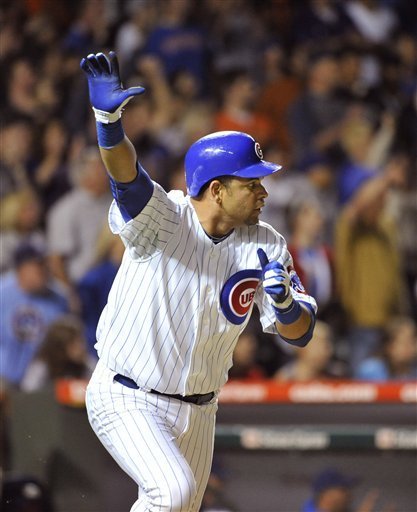
Starlin Castro just narrowly missed his 200th hit of the season at home, but he didn't waste any time in St. Louis as he singled to center to lead off Friday's game, making him the youngest Cub ever to get 200 hits and only the second Cub to do it since Ryne Sandberg in '84 (Juan Pierre also did it in '06).  Castro finished this season with 207 hits, tying him for the 9th-most hits in a single-season by a Cub.  He is the third Cub in seven seasons to be the NL hit king after Derrek Lee in '05 and Pierre in '06.

Ryan Dempster kept the Cubs in that game which was a 1-1 tie in the 8th when Alfonso Soriano blasted a three-run homer into the left-center bullpen off Kyle McClelland.  Castro, not to be overshadowed on his special night, hit an RBI single in the 9th.  The Cubs won 5-1, putting a big dent in the Cardinals' wild card hopes, but as we found out later, it wouldn't matter.

The win did matter for the Brewers, however, who watched the end of the game with their fans on the scoreboard at Miller Park.  With Carlos Marmol closing out the game, the Brewers won the NL Central.  The Brewers don't often root for the Cubs, but this was a worthy exception.  I thought it was pretty cool that we were the team to down the Cards and basically give the Brewers their division championship.  I guess that's our one gift to them in exchange for our fans invading their ballpark to watch the Cubs crush the Brewers on their home turf for most of the last decade.

On Saturday, the Cardinals were down to their final strike multiple times in the bottom of the 9th against Marmol and down 1-0.  Marmol walked three, walking in the tying run and allowing the winning run to score on a wild pitch.  A loss for the Cardinals would have meant the end of their season in all likeliness, and looking at the way things played out, if Marmol had just thrown strikes and gotten the save, the Braves would have been won the Wild Card.  So in a way, the Brewers and Cardinals are both indebted to the Cubs for helping them out with their postseason aspirations.  I just wish they could've slammed the door on the charging Cardinals to get some pride back, because they have basically walked all over the Cubs this season, winning the season series 10-5.

Two clutch homers late off Randy Wells helped
the Cardinals get into the postseason.
Albert Pujols still hasn't said anything significant on whether or not he will resign with the Cardinals this offseason.  Just in case he leaves, the Busch Stadium fans gave him a standing ovation before his first at-bat Sunday, which could have been the final Cardinals home game of the season.  It wasn't, however, so more standing ovations will come in the playoffs.

For the second straight day, the Cubs blew a late lead.  This time it was on the starter, Randy Wells, who gave up a game-tying homer to Yadier Molina in the 7th and a go-ahead shot to Rafael Furcal in the 8th.  These inexplicable meltdowns on two consecutive days the Cardinals need to win provided all the evidence I require: I can now undoubtedly say that the baseball gods are frowning upon Cubdom, and are punishing its players and fans with the humiliation of letting the Cardinals into the playoffs.  I'm not a very religious guy, but in baseball, I might as well be evangelical.  Play the game right, and the baseball gods shall reward.

The Cubs were shut out by Mat Latos on Monday night in for the 10th and final time on the season, down from 15 times in 2010.  Mike Quade played "the kids" in the lineup, featuring Tony Campana, Bryan LaHair, Steve Clevenger, D.J. LeMahieu, and Tyler Colvin namely.  Seeing as the Padres allowed two hits all night long, the results speak for themselves.

Alfonso Soriano flips the bat watching
his 26th and last homer of the season
Tuesday night in San Diego.
On Tuesday night the Cubs got their 71st and final win of the season.  Matt Garza got back to .500 at 10-10 and Soriano and Aramis Ramirez both hit their 26th homers of the season in the 6-2 win.  Although Garza deserved better, 10-10 is a solid record off which he can build next season.  It was nice to see one final, complete win where the Cubs thoroughly beat the opponent with clean baseball (they committed no errors).

The last game of the season is always an emotional affair for me.  No matter how bad the Cubs are in a season, I have to watch most, if not all, of the season finale.  There's a certain sense of finality in baseball that I don't see in other sports - not a bad thing, but interesting.  Baseball's 162-game season is such a long grind, it's really incredible to sit there on my couch and think about how this team right in front of me has played 161 games already this season.  Even though this season finale was a blowout loss (a season-ending loss for the Cubs for the fifth year in a row) and I was distracted by the historic Wild Card Wednesday, that doesn't mean I enjoyed it any less.  On the last day of the season, I focus on the nuances of the Cubs players and I just listen to Len and Bob, taking in all in the sights and sounds of my team to last me a long and cold Chicago winter.

Smiling in the dugout always means something good
but there wasn't enough of it in 2011.
The game itself was a nice sendoff for the Padres, who decided to break out the bats despite scoring the second-least runs in the National League in 2011.  Nick Hundley's three-run homer and Wil Venable's grand slam were more than enough to finish the Padres season on a winning note.  Interesting enough, the Padres win totaled their season record at 71-91.  What was the Cubs' record?  Guess.

Now that the regular season is over, my coverage of the postseason will dominate blog entries this month.  Not to be overlooked, however, will be my 2011 Cubs: Season In Review and the 2011 Cubs Awards posts coming up in the next few weeks.  For all of those who have been reading my rants and babbles and complaints and thoughts and whatever other noun you can come up with to summarize my posts on the Cubs this season, I thank you all!  Record readership is a signal to me that I must've done something right.  While you have the spare time, check out my latest creation on Sporcle!

Tuesday, July 5, 2011

Homestand Analysis: Colorado, San Francisco, Chicago (AL)

Record: 4-4
Final Record: 35-50

Against the Rockies, the Cubs finally got their first series sweep of the season.  Unfortunately, it was a one-game series, as in a makeup game for the rainout back in April.  This means the Cubs have yet to sweep a three-game series, and also haven't even won three in a row.  But play later in the week was encouraging for the Cubs.

Behind two homers each by Aramis Ramirez and Carlos Pena, the Cubs rolled past the Rockies 7-3.  The four homers would be the first four of 12 homers on the eight-game homestand.  Something was definitely in the water, as even backup Koyie Hill added one to the tally.  The annual weather swing has struck Wrigley, with that summer wind blowing out to the bleachers.

In the Colorado game, starter Matt Garza gave up a deep fly ball to left field by Carlos Gonzalez.  Alfonso Soriano went back to the track at his typical, lackadaisical pace.  Soriano eventually just pulled up and stopped, facing the wall, waiting for the ball to drop.  Garza, standing on the mound and thinking Soriano couldn't see the ball, raised his arms and said, "What are you doing?!"  Sure enough, the ball landed in the bleachers for a home run.  Garza, like most of the rest of the players, was shocked.  This evidence of the bandbox that Wrigley Field becomes in the summer has to come as a big surprise to the newcomers like Garza, who thought this ball would be a routine flyout.

The jetstream helped the Cubs for the rest of the homestand.  Ramirez hit six homers on it, en route to a well-deserved National League Player of the Week award.  But even that couldn't help the Cubs from looking absolutely dreadful in the doubleheader against the Giants on last Tuesday.  The Cubs were blown out by baseball's worst offense, reminiscent of their similar drubbing of the Cubs at Wrigley Field last year.  For the Cubs, Doug Davis and Rodrigo Lopez started the two games and the results are history.

Thankfully, the Cubs salvaged the last two games in impressive fashion.  A 1-0 ninth inning lead was blown by Carlos Marmol, but Ramirez singled home the winning run just a half-inning later on Wednesday night.

On Thursday afternoon, the Cubs put together one of their most complete wins since 2008.  Marcos Mateo pitched five incredible innings of relief after Carlos Zambrano's injury allowed him just one inning.  Ramirez erased a 1-0 deficit on a 95 mph fastball off Giants closer Brian Wilson.  Darwin Barney hit a huge clutch double in the 13th inning to tie the game at two after the Giants took the lead in the top half.  Geovany Soto stepped up and, two pitches later, ended the game with a three-run walk-off homer that was one of the most amazing moments the Cubs have had in the last decade.  The game was intense throughout and the Cubs trailed twice facing a loss, coming back both times.

In their millionth attempt to win a third game in a row, the Cubs were again denied, this time by the White Sox.  The Cubs didn't commit any errors on Friday in the series opener, according to the box score.  A mental error by manager Mike Quade cost the Cubs the lead in a tie game.  Quade has been sharply criticized this season for leaving in starters too long, and although much of this criticism is unfair, there's a case for this game to be examined.  Randy Wells gave up the two-run lead he had in the seventh, increasing his runs allowed total to four.  After Alex Rios reached base, Quade allowed Wells to pitch to Juan Pierre who lined a two-run triple to gave the Sox a lead they wouldn't give back.  Quade's mental error wasn't something major on his part, but I believe it was just the wrong decision.

A blown call at second base on a double play ball prevented the Cubs from tying Saturday's game at one, and the Cubs lost 1-0.  Garza threw a complete game despite losing, a sign I love to see.  Back in the Lou Piniella days, Garza would've been yanked after eight regardless of his low pitch count and the fact that his performance had earned him another inning.  Garza has been the beneficiary of some serious bad luck this season, and his value to the team has been far underrated thus far.

The Cubs finally got a win on Sunday, which salvages all Cubs fans everywhere from having to hear those Sox fans yappin' their yappers about how they swept us in our own park, yadda yadda yadda.  Thank God.  A Starlin Castro RBI triple and Ramirez two-run homer built a small lead, and although Kerry Wood allowed the bases loaded in the 8th, the Cubs escaped, avoiding the sweep.  The Sox now lead the Crosstown Series 12-6 since 2009.

On this homestand, Cubs pitchers really started throwing strikes.  In the case of Wells, Lopez, and Davis, who was released after his latest shellacking, this tactic didn't work so well.  In the case of Garza and Ryan Dempster, this worked very well.  Keeping a lower pitch count should allow the starters to go later in games, which is something the Cubs need.  Garza's performance on Saturday was incredible; but not as incredible as the fact that he lost.    

Wednesday, June 22, 2011

Crosstown Showdown: White Sox 3, Cubs 2

Rain nearly ends close game prematurely, but Cubs return from delay flat

Series tied 1-1

After the Cubs took a surprising win in the first game of the series, the Cubs came back and played another competitive game Tuesday night.

Matt Garza was unable to contain Paul Konerko and for the fifth night in a row, Konerko homered, tying a franchise record.  Garza also gave up a run in the 3rd on a sacrifice by Juan Pierre.  The Sox had an early 2-0 lead, but the Cubs came back again.  Carlos Pena homered in the fifth to get the Cubs on the board, and the Cubs loaded the bases in the 6th when the weather began to change unfavorably.  Jeff Baker, batting with no outs and those loaded bases, needed to just put the ball in play somewhere and hope to get the tying run home from third to tie the game, no matter how he did it.

On the Cubs telecast on WGN, Len Kasper even said the Cubs would be happy with a double play ball just to get that one run home before the delay could possibly end the game.  Because if Baker wasn't able to get that run home, the game could be ended as a rain-shortened final score of 2-1 through six innings.  And the way the wind was wreaking havoc didn't suggest the storm was going to let up anytime soon.  Baker struck out looking, and the umps went straight to delay before Aramis Ramirez could have a chance to bat.

Luckily for the Cubs, Ramirez got his chance nearly two hours later and drove in the tying run with a sacrifice fly.  But it only took an inning for the Sox to get the run right back, Brent Morel driving it in with a sac fly.  There was no comeback this time, and the Sox evened the season series at one apiece.  

The Cubs played a hard game, although they certainly got lucky after Baker's strikeout could have cost them the game.  The pitching has done a great job of containing a powerful offense thus far, although stopping Konerko has definitely been a problem thus far.  But the Cubs offense was alarmingly aggressive, and only made Mark Buehrle throw 70 pitches into the 6th inning and didn't a single walk the entire game.  The Sox bullpen was even less unforgiving, allowing only two hits, no walks and no runs over 3.2 innings.  Patience should be the key against hard-throwing righty Jake Peavy, fresh off the DL and possibly rattled.  The Cubs need to make him earn strikes, especially because it will take some time for his pitches to start getting the full movement on them.  For pride's sake, just win tonight, please.  

Tuesday, June 21, 2011

Crosstown Showdown: Cubs 6, White Sox 3

Three key Cubs step up big in win over streaking Sox

CHC leads 1-0

Last night the Cubs and Sox met for the first of six games this season.  The news coming up to game time and in the 1st inning was all about Carlos Zambrano and his temper tantrum last season at The Cell, which nearly led to him being kicked off the team.  But a different Zambrano emerged, despite another bad first inning.  He gave up three in that first inning before calming down and staying as cool as the other side of the pillow for most of the game.  Through 8 innings, Zambrano allowed only those three runs.

The blow up actually came from the other side as Ozzie Guillen was ejected arguing a fair or foul call on home plate.  These disputes are rare because such an instance was very rare but nonetheless the umpire called Alexei Ramirez out after Geovany Soto tagged him with the ball which the ump thought he had picked up off home plate.  The Sox claimed the ball had rolled off and Soto grabbed it in foul territory.  Guillen, in his frustration, kicked Soto's catcher's mask towards his own dugout, prompting eruptions of laughter and hysteria from the Cubs dugout.  Even Soto, standing near Guillen behind home plate, pointed and laughed along with his teammates.

The three keys to winning the game for the Cubs were Zambrano, Starlin Castro, and Carlos Pena.  Castro knocked in the first three runs with a two-RBI single and a solo homer, and Pena gave the Cubs the lead for good with a big three-run homer to the right field bleachers off a stumbling Gavin Floyd.

Carlos Marmol, who puts the fire in fireman, aka closer, gave up singles to catcher A.J. Pierzynski and center fielder Alex Rios just to give Cubs fans a headache before retiring Mark Teahen and left fielder Juan Pierre.

This win was huge in my opinion.  It proved that the Cubs' improved competitive play against the Yankees wasn't a fluke, and that they can hang around with an American League team.  Also, the current Chicago fad of hating on the Cubs takes a big hit with every win they get over the White Sox.  It's as if the bandwagon shrinks, if even just a little.

Friday, May 13, 2011

Steve Bartman: Painfully Innocent

Before you read this post, make sure to check out this amazing story written by ESPN detective/writer Wayne Drehs in 2005.  This is one highly informative piece of writing and pretty much the closest anyone has gotten to having a full interview with Steve Bartman.  This baseball comedy news website posted an interview with Bartman in 2008; this is fake, but interesting nonetheless.  There is some truth in that story, like the fact that Bartman was at Game 3 of the 2007 NLDS in Arizona.  Although not proven, it is believed by many that he was there.  ESPN will document the game in their 30 for 30 series; the episode comes out sometime this summer or fall. 

Steve Bartman is an innocent man.  And when I mean innocent, I mean just like any other guy at ballpark.  And here's why: if you were sitting where Bartman was during Game 6 of the 2003 NLCS against Florida and Luis Castillo's foul ball came flying to within three feet of you, what would have done?  You would have done the exact same thing that Bartman did; reach out for the ball.  Therefore, the fact that Bartman himself is an enemy at all is a matter of coincidence.  Bartman was just at the wrong place at the wrong time.  It's unfortunate that this had to happen to someone like Bartman, because as Drehs mentions in his article, Bartman is a diehard and devoted Cubs fan, even now while living in societally-imposed exile.  There's nothing you can do but feel bad for him, but then again we must remember; it was us, Cubs fans, who put him there in the first place.

I present to you the three reasons why the Cubs lost Game 6, none of which blame Steve Bartman:

3. Bernie Mac's Singing of the 7th Inning Stretch
It is an honor to sing the 7th Inning Stretch at Wrigley Field.  It is more of a honor there than any other ballpark in the Major Leagues because there is a celebrity conductor every single game.  Typically, the guest conductors keep it simple with 'Let's get some runs' after the singing.  But Bernie Mac had to go and take it to another level.  He had to go and change the words in the song to 'Root, root root for the Champs' and jeopardize the entire thing.

You would think that given the enormously pressured circumstances, Mac would have just not have tried something crazy like that.  But I guess not, and it couldn't have done anything to help the Cubs at all whatsoever.  With a 2-0 lead in the 7th inning, it wasn't even that sure of a thing that the Cubs didn't blow it anyway.  Overall, Bernie Mac screwed with the baseball gods, and as they always will if not treated with respect, they'll make you pay. 

2. Moises Alou's Reaction to Bartman
Any Cubs fan can probably replay the video again and again in their head.  There's Luis Castillo slicing the ball to the opposite field and tiptoeing out of the batter's box, followed by the Alou failing to catch the ball because of Bartman, and then there's Alou coming back down to the ground and slamming his glove on his knees and having a fit over not catching the ball.  As painful as a memory that is, it's important to remember whose blame it actually was instead of just scapegoating Bartman.

Not only did Alou's reaction contribute to the collapse that ensued for the rest of the Cubs, it effectively ended the public life of Steve Bartman.  And here we are, eight years later, and Alou has never apologized to Bartman.  If Alou had just walked away like a regular outfielder, Bartman's name would be unknown to the rest of the world.  But Alou reacted terribly, like some six year old throwing a fit because he lost.  Fans and the sports community have never blamed Alou nearly enough for what he did in that situation, but Bartman is the man who he is today solely because of Moises Alou.  Alou originally blamed Bartman for the incident, but took back his words in 2008, saying "You know what the funny thing is?  I wouldn't have caught it, anyways."  Alou's nonchalant attitude clearly shows he has no understanding of what he did.  This is because he either doesn't care or is too stupid to figure it out.  Most likely it's the latter, considering how dumb that reaction was in the first place.  Moises Alou, you owe that man an apology.  Man up and do it.

The negative mood that Alou left after the play definitely stuck around for the rest of the inning.  Because the player got upset, his teammates and the fans got upset.  Making his teammates upset and distracted probably also affected the next reason for the collapse.

1. Alex Gonzalez's Fielding Error
If not for Bartman, this play would be the play known for the collapse of the 2003 Cubs.  It would have been the 'error heard 'round the world'.  But Bartman had already taken all the attention by the time Gonzalez added to the Cubs' problems and his play has been all but forgotten.

The situation for the error was only a short while after Bartman entered the spotlight.  With one out and Juan Pierre on second, Luis Castillo fouled off the Bartman ball.  After the at-bat resumed, he walked on a wild pitch which sent Pierre to third.  Ivan Rodríguez followed with a single, scoring Pierre, bringing up a young Miguel Cabrera.  Now leading 3-1 and Marlins on first and second, it would be a perfect spot for a double play ball.  Sure enough, Prior got one.  The chopper reached Gonzalez, who could have turned it for an easy 6-4-3 double play, but Gonzalez angled his glove awkwardly and bobbled the ball.  He wasn't even able to get a single out and this left runners on every base with one out.  Derrek Lee would then tie it with a two-RBI double, and the rest is history.

Just try to imagine what getting this double play would have meant.  The 8th inning would have been over, sending the Cubs into the 9th with a 3-1 lead and Joe Borowski, who had blown only four saves all year, to close it out.  The Cubs would have gone to the World Series if Gonzalez had made this play.  There, I said it.  If Bartman hadn't gotten in the way of Alou, there's no way of knowing for sure if Alou would have even made the play.  I think the chances of Alou catching that ball were 50-50.  Gonzalez, on the other hand, made only 10 errors all season in 2003.  His defensive WAR was 0.8.  The error he committed right at that time is the most inexplicable thing I have ever seen in the game of baseball.  I guess the only answer is the baseball gods abhor the Cubs.  They gave us 2003 to toy with us, and now leave us with a frustrating franchise with little hope of getting back to where we were soon.  Any way you look at it, the 2003 Cubs infamously collapsed.  And it had nothing to do with the warranted villain of that collapse, Steve Bartman. 

Wednesday, December 22, 2010

Competitive Balance in Economics

There are 30 MLB teams.  By the rules and nature of baseball, all teams have an equal shot to win.  By the rules and nature of business, some teams are favored more than others.  In today's world, the industry that is professional sports is a business.  As unfortunate as it is, this means every team in MLB has different odds to win.  Since their is no salary cap in baseball, it's all about the revenue.  And a team's success or failure in generating revenue can and most likely will dictate their ability to win.  If you're a serious baseball fan, chances are you've heard of Billy Beane, GM of the Oakland Athletics.  The reason Beane is famous is because of his groundbreaking theories about baseball economics, revolutionary thoughts that have become relevant with the big contracts and free agency dogfights of modern baseball.  If Beane were the GM of the New York Yankees, he would not be characterized as the godfather of modern baseball economics.  Oakland is a tiny city compared to the other jumbo markets of baseball, making Beane's job much harder than a GM in a bigger city.

Small market teams have it tough.  Most small market teams put a strong emphasis on building from within their own system, putting a lot of work in the scouting and development department.  When these teams come up with big prospects they are unable to sign them to extensions and they are lost to the big market teams.  Even if they are able to sign the player to an extension, what happens if the team is losing?  The team has no choice but to rebuild, which means sending the prospect-turned-star to the big market teams.  There are a few ways for it to happen, but in the end, the star ends up with the big market teams more often than they should.

Prime examples of this can be found on the current big market teams.  Remember that super rotation the Phillies will put out on the mound in 2011?  Let's see where those guys came from.  Roy Oswalt was a huge star in Houston, nearly setting the franchise wins record before being traded.  Roy Halladay was a big star in Toronto, a well-publicized one at that.  Halladay took home the 2003 AL Cy Young Award, while Cliff Lee took home the same award in 2008 with Cleveland.  While Lee struggled with injuries during times in Cleveland, it was clear even before 2008 that he had the capability to be an elite pitcher.  Cole Hamels, the fourth man in this super rotation, is the only product of the Phillies system.

Red Sox GM Theo Epstein, clearly in control of a big market team, snagged two of baseball's best players from small markets this offseason.  Acquiring Adrian Gonzalez out of San Diego and Carl Crawford from Tampa Bay, he has now dealt a huge blow to both franchises.  Without Gonzalez, the Padres are no longer a playoff contender and without Crawford, the Rays aren't either.  The word 'disappointment' can't even begin to describe how fans must feel this winter in San Diego and St. Petersburg, respectively.

Let's read down the current Yankee lineup.  At catcher we have Russell Martin, just acquired from the Dodgers.  At first base we have Mark Teixeira, big time power first baseman for the Rangers before being dealt to two pit stops in between.  Teixeira isn't the only name here with an enormous contract.  At second base and shortstop, we have Robinson Cano and Derek Jeter, respectively.  There are two genuine Yankees; good for them.  At third is, and I know its been a while, the most hyped prospect in the history of baseball- with the 1995 Seattle Mariners.  In right field we have Nick Swisher, who got his fame launching bombs out of the Oakland Coliseum.  In center, the five tooled Curtis Granderson came from Detroit.  In left is Brett Gardner, one final genuine Yankee.

The Yankees World Championship team of 2009 featured only two full season homegrown starters, while the top two (C.C. Sabathia and A.J. Burnett) came from Cleveland and Toronto, respectively.  The Yankees, not surprisingly, have been to the World Series more than any other team and have won more than any other team.  From 2001-2010, a ten year stretch, 15 different teams made the World Series, with only the Yankees, Giants, Phillies, Red Sox, and Cardinals having been more than once.  Many baseball experts interpret this to mean that competitive balance in baseball is higher than it ever has been, but I don't think this is exactly the case.  Don't get me wrong- competitive balance is certainly high and we've seen a lot of small market success stories recently, but the problem is sustaining the team that got them there.

The surprising but lovable 2003 Marlins team that upset the Yankees to win the World Series was an example of how these teams can win, but can't be sustained in a market like Southeast Florida.  The 2003 heroes of ace Josh Beckett, center fielder Juan Pierre, second baseman Luis Castillo, starter Brad Penny, starter Carl Pavano, first baseman Derrek Lee, and third baseman Mike Lowell were all off the Marlins by 2006, signing with or being traded to the Red Sox, Cubs, Twins, Dodgers, Yankees, Cubs, and Red Sox respectively.  Franchise faces from 2003 third baseman Miguel Cabrera and ace Dontrelle Willis would both be gone just a season later in a trade to Detroit.  In fact, Cabrera and Willis were the only players on the 2006 Opening Day roster remaining from the 2003 team.

The Marlins have become known for frequently executing a relatively modern tactic known as the firesale.  The firesale is an instant rebuilding strategy, seen in small markets who have an excellent young core of winning players with low salaries who have yet to cash in a big contract.  The small market team must commit to a firesale because, with lower revenue the market generates than big market teams like the Yankees, the team is not in a financial position to keep the players long term once they become free agents and demand large contracts.  If the players are traded before they hit free agency, then the team can rebuild using the prospect returns from those trades instead of getting nothing back.  The disassembling of the 2003 squad was the second most famous such firesale, the most famous being after the 1997 World Champion Marlins were disassembled to become an 108-loss team just the very next season, setting a record for the most losses in a season following a championship.

No team can execute a firesale better than the Florida Marlins, but this raises a question.  How many other teams would need to execute a firesale?  The answer is not many.  The 1997 Marlins won the World Series with the 5th highest payroll in the league, a very rare figure for them, and fell to 27th the very next year.  The Marlins started new players at all eight position player spots!  Meanwhile, the 1996 Yankees won the World Series with some of the key players being shortstop Derek Jeter, closer Mariano Rivera, and ace Andy Pettitte.  The Yankees next won the World Series in 1998, and by then power hitting catcher Jorge Posada had joined the key players.  In 2009, eleven years and around $488 million later, Jeter, Rivera, Pettitte, and Posada all remained despite Pettitte's three year trip to Houston.  That's alarmingly close to the $581 million the Marlins have spent on players in the entire 18-year history of the franchise!  The Marlins clearly can't compete with that.

An overarching point here is that while many teams have made the World Series in recent years, the small to medium market teams aren't able to sustain the success.  Dynasties are not a thing that can be built by teams like the Marlins.  So it should be not surprise that the team that won six out of eight American League pennants from 1996-2003 was the New York Yankees.  Imagine if the Marlins had signed Moises Alou to a big contract extension after he helped them win the 1997 World Series, and the Marlins were able to take advantage of Alou's 225 career homers after 1997.  Who knows what the Marlins could have done with him as the center foundation for all of their young talent?  Unfortunately, we will never know.

The Florida (soon-to-be Miami) Marlins have hope.  In 2012, the gleaming new retractable roof stadium in Miami's Little Havana neighborhood will open, reinventing the entire franchise.  The new stadium will the kind of revenue the Marlins have never seen, and they will finally be able to sign at least one franchise player for a long time.  For other teams, like the other Florida team in the Tampa Bay Rays, such hope is not so easy to come by.  So for the other financially struggling small to medium market teams out there (the Pirates, Reds, Padres, Royals, Brewers, Diamondbacks, Mariners, Blue Jays, Athletics), I have some advice.  Don't trust the system; you can't just lay back, play a bunch of rookies and expect a turnaround.  Especially for the Royals and Pirates, a big change is needed if the young players are all duds.  A reinvented scouting and development department is in order, and the team should not be satisfied with the prospects until they are making a difference at the major league level.  For some teams, like the A's, a lack of revenue is hurting the franchise's potential.  In this case, every effort must be done to make the team relevant in the community.  This means having unique promotions to get the fans in the current ballpark and get the fans excited about the team's future.  Also, an increased focus on community outreach from the players should be involved; the community needs to know this isn't an organization utilizing the city, it's an organization representing the city.  Eventually, enough attention should be focused so that the government will help fund a new stadium.

To all small market teams out there, good luck.  Because although winning out of a small market may not be a huge challenge, sustaining it sure as hell is.  And although the Marlins have made the playoffs only twice and have never won their division but won the World Series twice since 1993, I hold more respect towards those accomplishments than I do for the Yankees' 17 playoff appearances and five championships during the same time frame.  After reading all this, I hope you do too.          

Tuesday, June 29, 2010

Crosstown Classic: Round Two

This time the series shifted to the South Side for a three game set.  After a disappointing showing in the first series, the Cubs knew they had to win two here to split the series and maybe some figured out that, no matter what, the Cubs had to win Sunday to take the first BP Crosstown Cup.  For the Cubs to get that Cup, they would also need to win either Friday or Saturday.  If they won Friday and Saturday, they would still need to win Sunday because the tiebreaking rule in this Crosstown Cup is that the team who wins the last game takes the series for the year.

There was another big moment in the Crosstown Classic on Friday, this one going against the Cubs, but not from the White Sox.  Carlos Zambrano gave up four in the first, including a three-run homer to Carlos Quentin, and returned to the dugout attacking at first no one in particular and then Derrek Lee.  Apparently he wasn't pleased that Lee didn't dive down the line for Juan Pierre's leadoff double, because Pierre scored a run and Zambrano thought the team didn't go all out on defense.  He paced the dugout screaming after the 1st inning and came up to Lee and shoved him backwards a bit while verbally attacking him.  Zambrano was suspended indefinitely and placed on the restricted list, not to return until after the All-Star Break.  Some reports have mentioned that he won't return to the mound for the Cubs ever.  Jim Hendry says he will be back, but the public criticized Carlos' decision to go out to dinner with Ozzie Guillen at the Wit Hotel and the night after his blowup.

Paul Konerko hit his 19th homer in the 8th to be the go-ahead run as the Cubs offense was slowed by Freddy Garcia who allowed just two over seven innings.  As the story of Carlos Zambrano swirled around the Chicago sports media community, this game went somewhat unnoticed for a Cubs-Sox game.  Aramis Ramirez hit a home run in this one, his first since June 5th and his longest out of his six home runs this year, flying 418 feet to center.  Sox won 3-2.

The Cubs offense came out stronger Sunday putting up eight runs in their 8-6 victory avoiding a sweep.  A three-run bomb by Tyler Colvin and doubles by Derrek Lee and Geovany Soto made it 6-2, followed by another Paul Konerko homer.  The Cubs extended their lead thanks to an Alfonso Soriano homer and Tyler Colvin RBI single but their comfortable lead wasn't as comfortable after a bunch of hits brought the Sox within two in the bottom of the 9th.  The Cubs closed it, however, and improved to 2-4 on the season against the Sox.

The Cubs have lost the season series two straight years against the Sox and haven't won it since 2007, but the Cubs took away some positives even after being beaten badly Friday and Saturday.  Not that the Cubs could possibly hold any momentum, as they were beaten by the Pirates 2-1 on Monday.

Monday, June 14, 2010

Crosstown Classic: Round One

There have been plenty of skeptics the last two years of the relatively dull popularity of the Cubs-Sox series.  However, I believe this series really revitalized it once again.

On Friday, the buzz returned to Wrigley Field as the Sox fans marched in.  They had plenty to cheer about with Alex Rios and AJ Pierzynski both collecting four hits and a homer each.  Carlos Quentin poured on the score with a homer along with a bunch of hits in the late innings, and the Sox rolled 10-2.  The only highlight and scoring for the Cubs came in the second when Alfonso Soriano hit a two run homer, the 300th of his career just two days after Derrek Lee got his in Milwaukee. 

Carlos Silva had reason to be frustrated Saturday.  More problems with Xavier Nady cost the Cubs another win.  Paul Konerko hit an RBI single early on that would have been caught with Tyler Colvin or Kosuke Fukudome in right.  However, Nady pulled up instead of going all out.  There wasn't any scoring until the top of the 8th, when Konerko hit an RBI single to the same spot and once again Nady pulled up.  The Cubs pushed across a run in the 9th, and the tying run was on base at the end of the game.  If Nady had gotten both of those like Fukudome or Colvin would've, the Cubs had a win.  I'm aware that Nady is basically a DH, but I really think that for him to be making over three million dollars to be a fifth outfielder/backup first baseman he needs to be diving at every opportunity.  Guys like him aren't playing all-out ball.

Sunday night was what has made this series a big deal again.  This was the definition of a pitchers duel.  Ted Lilly and Gavin Floyd both threw 6.2 IP of no hit baseball, but Alfonso Soriano doubled ending Floyd's no hitter.  On the next pitch, Chad Tracy brought him home with a single up the middle.  That was all the scoring the Cubs would need, but Ted Lilly lost his no hitter in the top of the 9th in shocking fashion against former Cub Juan Pierre.  Carlos Marmol loaded the bases, but got Carlos Quentin to pop out to end the ballgame.  Ted Lilly pitched by far the best game of his career.  The only thing that consistently bothered me was Jon Miller's constant mentioning of the no hitters in progress.  Joe Morgan even mentioned later that it "used" to be an unwritten rule not to mention it on the air.  They just said that because they realized that fans weren't too happy about what they were doing.

This series is changed.  You can bet this won't be the last time the media reminds you of what happened this weekend, especially with Ted Lilly.  I'm just putting it out there that if the Cubs follow the regular rotation with Lilly, he will get the first start of the second Sox series.  If both the Cubs and Sox are done for the season, which the upcoming two weeks of interleague play could decide, enjoy the next Crosstown Classic series in two weeks as the only playoff atmosphere either team will have in 2010.    

Saturday, May 8, 2010

(Marlon) Byrd's the Word

Guaranteed amusement comes from the famous Family Guy episode where Peter Griffin basically has a seizure about the Bird is the Word.  If you haven't seen it a million times, there's a first for everything: http://www.youtube.com/watch?v=2WNrx2jq184.  The Cubs have a Byrd in center field.  He swoops over the grass and takes flight to catch fly balls, animal instincts few center fielders possess.  I was thrilled at a Qdoba Restaurant in Madison, Wisconsin when the ESPNEWS ticker informed me a linebacker had just been signed by the Cubs. 

Marlon Byrd, all 6'0", 245 lbs. of him, became a popular figure in Cubdom from his first Cubs at-bat by hitting a three-run homer, just like Starlin Castro.  He has been very consistent and very important in the 29 games since then.  Byrd has already bonded well with Fukudome and Soriano in the outfield and has proven himself so far to a fan base that, because of hotheaded outfielders past, has become quick to pounce on and criticize outfielders.  His 23 RBI and .339 BA in 30 games make up a big part of the following stats in the next paragraph.

Despite the inconsistencies of the team altogether, the Cubs have gotten their offense closer to 2008 levels than 2009 levels.  The Cubs have (MLB rank followed by NL rank): 148 runs scored (10th of 30, 5th of 16), 280 hits (7th, 4th), 37 HR (5th, 2nd), 455 Total Bases (5th, 3rd), 146 RBI (7th, 4th), .273 BA (7th, 3rd), .348 OBP (6th, 2nd), .444 SLG PCT (6th, 3rd), and 113 BB (9th, 4th).

I mentioned in an earlier post that center field is the most important position on the field, in my opinion.  The Cubs haven't really had great leaders at center the last few years (Corey Patterson, Juan Pierre, Jacque Jones, Felix Pie, Jim Edmonds, and Kosuke Fukudome), even if some were good players.  Byrd is an aggressive player and undoubtedly the commander the outfield.  When you have a guy like that, it spreads and everyone wants to be in on the fun.  Tyler Colvin must be getting a lesson from him and regulars Fukudome and Alfonso Soriano must be enjoying themselves more than before.  Marlon is such a positive influence I bet he would increase 'Fun' for the Cubs if that was a baseball stat.  Go Cubs! 

Friday, January 22, 2010

Half-Decade In Review: Outfielder Breakdown!


Have you ever noticed anything about most of the Cubs' big signings in the last half-decade? I have. Mostly outfielders, the Cubs pour money into these guys imagining they will be 10 year mainstays at their position with no controversy. This couldn't be farther from what happens almost every time. In fact, every year since 2005 has seen a change in the regular starter in at least one outfield position. Here is my breakdown of each acquisition:

Jeromy Burnitz, RF, 2005: This quickly-aging veteran was signed to erase memories of Sammy Sosa, whom the city had turned its back on. Burnitz had received MVP votes after clubbing 37 homers in 2004, which led Cub fans to believe they were getting a high-level slugger. Burnitz was a slight disappointment, as was most of that 2005 team, by hitting only 24 homers and a .322 OBP. Right Move? It might have been the right move because he didn't have a bad injury record (had played at least 126 games each year after first becoming a starter in 1997), was still a power threat, and was a durable lefty who regularly batted more than 600 ABs. However, his rising age (36 in 2005) should have added some red flags by his name.

Jacque Jones, RF, 2006: Jones was one of the most under-appreciated players of the 2006 season. Jones was highly-criticized for his lackluster defensive play in right especially early in the season, but he finished the year with 27 homers (tying a career high) and a .285 BA. Right Move? Yes. After Burnitz left town, the Cubs once again needed a right fielder. Jones added pop and around 10 stolen bases a year, which was preferred over Burnitz' all-or-nothing style of play. Jones struggled offensively early in 2007 but became one of baseball's best hitters in the second half despite never getting his power back. He was traded to the Tigers for 2008 and then the Marlins, having not appeared in an MLB game since.

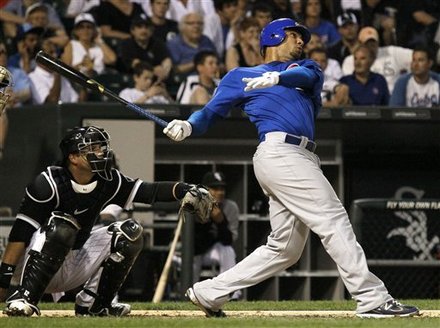
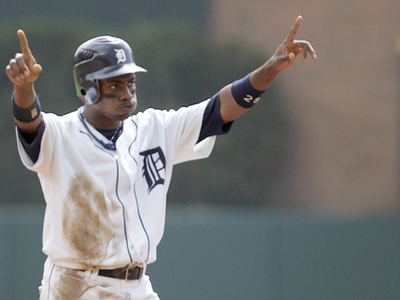
Juan Pierre, CF, 2006: Derrek Lee's monster 2005 campaign complete with a batting title (.335 BA) and home run bash fest (46) came with one disappointing and confusing figure. He had just 107 RBI because the hitters ahead of him did a horrible job of getting on base. Enter Pierre. Pierre was a stolen-base machine, 167 bases in just three seasons in Florida. The plan worked because he led MLB in at-bats (699), hits (204), and games played (162). Lee missed 112 games due to a wrist injury however, and Pierre now was on base with not enough to drive him in. Right Move? Absolutely! The Cubs were very lucky to land this speedster and it was very unfortunate his all-out play was only seen in the Cub uniform during the lost season of 2006. Pierre moved on to the Dodgers where he became a critical part of their outfield rotation.

Alfonso Soriano, LF, 2007: Soriano was likely the best player available on the free agent market in this offseason after cranking up a 40-40 season with the Washington Nationals even playing in cavernous RFK Stadium. He was given the biggest contract in Cubs history, with good reason. It was clear after 2006 that more offense was need and better defense should be a bigger emphasis with a big roster turnover including the change at manager. The converted infielder's unconventional play in left was fine as long as he was making plays, which he was. His arm was a cannon and he was among the league leaders in assists. Right Move? Remains to be seen. Soriano has shown big flashes of the player he was, but here we are in Year Four and Cub fans have yet to see a full, healthy season from him. Missing over a month in 2007, he still hit 33 homers. However, his homers and average have decreased since then, and he has not even hit 20 steals in any season with the Cubs. Much pressure on this man should be expected in 2010, and rightly so after the Cubs put a no-trade clause in his contract making him stuck to the Cubs for eight years, or four more after 2010.

Kosuke Fukudome, RF, 2008: Another right fielder, this time imported from Japan. Fukudome, the former MVP with the Chunichi Dragons, was profiled as a mix between an Ichiro and a Hideki Matsui. He was the Cubs' first Japanese player. Right Move? Yes. This one took some thinking. Offensively, the main reason the Cubs broke open and scored the most in the NL was because of their new-found patience at the plate. Fukudome inspired the rest of the team with his natural patience, and the Wrigley Field crowd went crazy for Kosuke through the first half of 2008. However, his season ended badly in 2008 and he was more consistent after being moved to center field in 2009. Contrary to popular belief, he statistically plays better defense in center rather than right, but he has admitted to being more comfortable in right and he can make more big plays in right.

Jim Edmonds, CF, 2008: A midseason acquisition in May, Edmonds came from the rival Cardinals and fans were intrigued to see his performance on the other side of the I-55 Rivalry. Edmonds had always been a smart ballplayer, good power hitter, and great defender. He had won eight Gold Gloves, including six consecutively from 2000-2005. Right Move? Yes. Good thinking on Jim Hendry's part to look past his age and poor early performance with the Padres to see what he could bring to Chicago. Worst case scenario would have been a platoon role with Felix Pie and Reed Johnson, making CF a weak spot but not terrible. On that 2008 team, there was no need for production out of that position. Edmonds was a free agent in 2009 but is targeting a comeback in 2010.

Milton Bradley, RF, 2009: Bradley (above, #21) had a few repeating themes in his career: tirades, gifted hitting ability, team jumping, a bad clubhouse influence, injury problems, and more off-field issues. Bradley was an injury risk for sure when he was signed, and many Cub Nation questioned why the Cubs couldn't have signed Raul Ibanez or Pat Burrell instead of a big risk. Bradley, however, led the AL in OBP in 2008 and was always a patient hitter with pop. Right Move? NO. Another move of this caliber will have Jim Hendry fired. Bradley got in trouble from his first at-bat in Wrigley Field, getting suspended for making contact with an umpire while arguing a third strike in a crucial pinch-hit situation against the Cardinals April 16th. The rest of the season was filled with slamming quotes, broken bats, and benching. Lou Piniella had to confront Bradley and sent him home during the middle of a game against the White Sox due to bad behavior. Offensively and defensively he was a big disappointment, hitting only 40 RBI and he will live on in Chicago sports lore for one of the worst defensive plays of the decade. He famously threw the ball into the stands with one out which allowed a run to score and another runner to move up after forgetting how many outs there were to the disgust of the sold-out crowd at Wrigley Field including me.

Marlon Byrd, CF, 2010: Fukudome gets to move back to his natural position after Byrd (above, #22) was signed from Texas on New Year's Eve. Byrd had somewhat of a breakout year in 2009, collecting 155 hits, 43 doubles, 20 homers, 89 RBI, 599 PA, and 262 total bases, all career highs. He can steal a few bases and play great defense. Right Move? YES! I have always known Byrd would be a great fit for the Cubs. The Cubs are now looking for a fourth outfielder like Jermaine Dye, Xavier Nady, Johnny Gomes, etc...and a role with Byrd is exactly what the Cubs need. Rudy Jaramillo will continue to make him a more patient hitter, and Jaramillo's magical ways will win over these hitters. The Cubs are looking to improve on defense, and Byrd helps that in the outfield (especially with Soriano now turned into a liability on defense) as well as being a plus clubhouse influence.

The bottom line is although the Cubs have learned plenty of lessons about outfielders, they look pretty set for 2010 with three able dudes. Byrd is a team chemistry guy, and I foresee a bond between him, Fukudome, and Soriano.