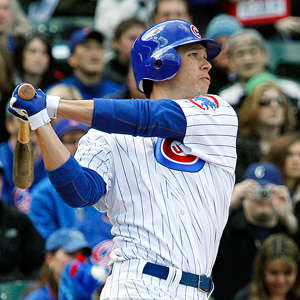
Showing posts with label dejesus. Show all posts

Sunday, April 8, 2012

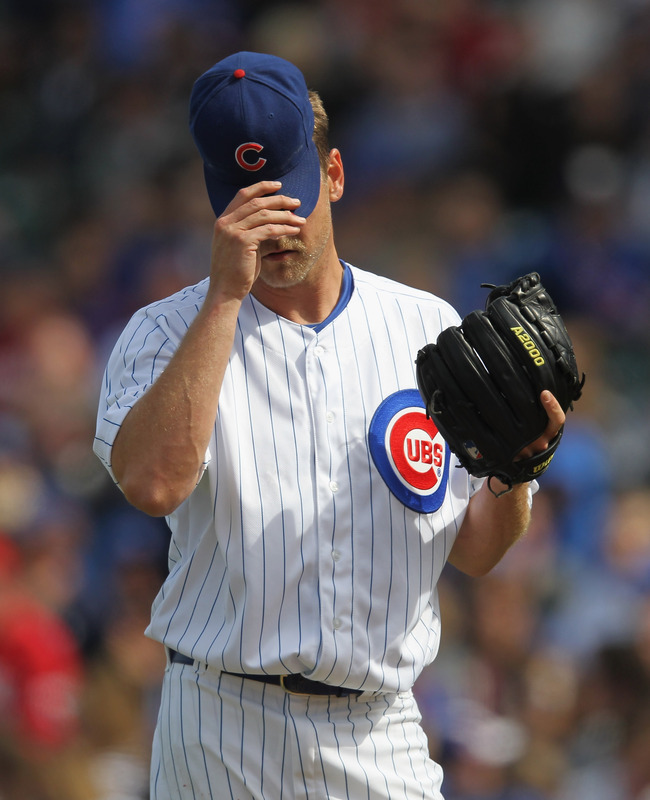
Two Chances, Two Chokes

The game-tying runs allowed in the 8th inning
of the first two games of the season
were allowed by a frustrated Kerry Wood.
Is this the new "Cubs Way" of playing baseball?!  Let's hope not.

You've heard about it all winter.  'Sustained success', 'the right way', 'development', and 'building from within' are just a few phrases that have highlighted a winter of change for the Chicago Cubs.  It may all just be empty talk, but the new Cubs brass even put it in writing with their fundamentals manual, The Cubs Way, which is being distributed throughout the Cubs minor league system.  The effort looks to standardize the way in which prospects are being taught the game throughout all levels of the Cubs system to maximize potential of all prospects and maintaining disciplinary consistency.  However, if the young prospects want to see for their own eyes how the game is played correctly, they ought to stay away from Wrigley Field.  If the first two days are any indication, the major league Cubs will struggle to avoid lines of hypocrisy in 2012.  

Hopefully this will not be the case.  Clearly Dale Sveum was more equipped with the leadership and motivation tools to start his full-time managerial career than Mike Quade was a year ago, and these qualities showed in Spring Training.  So far he has gotten the team much more involved in working on simple yet overlooked fundamentals, including baserunning drills which declared exactly which part of the base the Cubs are supposed to hit when rounding them.  He also got some competition going on to get players more involved. 

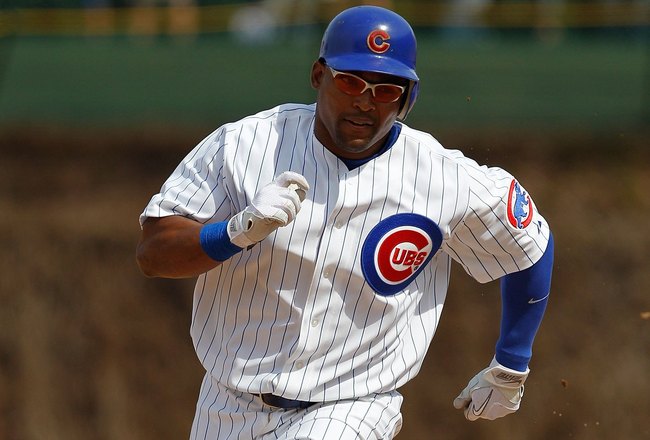
Casey Coleman and David DeJesus may not win an award of any type during the rest of either of their careers, but the two gained immediate team respect as they faced off in the final round of the 64-participant bunting tournament in camp.  Coleman swept his way through the pitchers' bracket, while DeJesus did the same in the position players' bracket.  DeJesus ended up winning, but the major reward from this exercise was a sense of accomplishment coming from a fundamental the Cubs needed work on.  
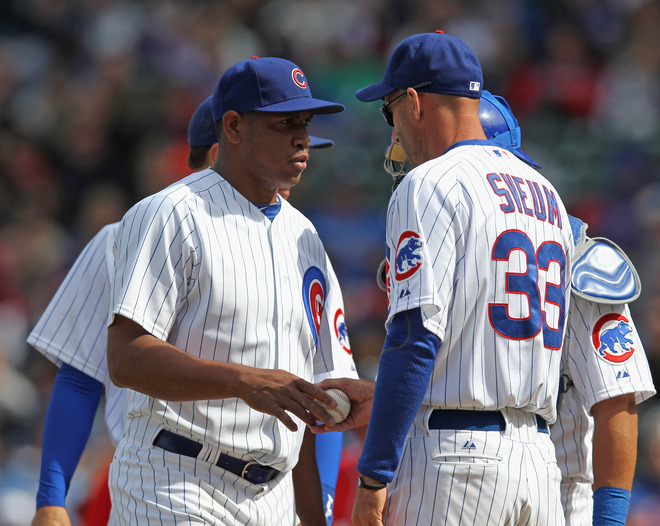
"You're already making me look bad out here.
Vamonos ahora."
After all, these are athletes; they appreciate any added competition to spice things up.  Before it all got started, Tony Campana proclaimed himself as a favorite to win the entire tournament.  He was eliminated in the first round.

The added concentration paid off, as the Cubs brought a winning Spring Training record home with them.  However, the results did not show at all in the first two games of the regular season.  

In the home opener Thursday against the Washington Nationals, Ryan Dempster was finishing up a gem of a performance when he was abruptly yanked with one out to get in the 8th and Ian Desmond on first base.  Enter fan favorite Kerry Wood to hold the 1-0 lead.  A host of problems followed.  Desmond stole second.  Wood walked the next batter, Ryan Zimmerman.  A wild pitch moved Desmond to third and Zimmerman to second.  Wood walks another batter, Adam LaRoche.  After a mound visit, Wood loses another batter in Jayson Werth, whose base on balls forced in the tying run.  

Three consecutive walks spelled doom in the form of lost momentum in this ball game.  Dempster had been living dangerously all day by using the homer-unfriendly winds in his favor, but at least he had controlled the base on balls.  Wood lost it.  Not surprisingly, Carlos Marmol didn't make things any better.  After getting two quick outs in a now-tied ball game in 9th, Marmol allowed a double to Chad Tracy and a go-ahead single to Desmond, scoring Tracy's pinch-runner.  The Nationals took the lead for good.
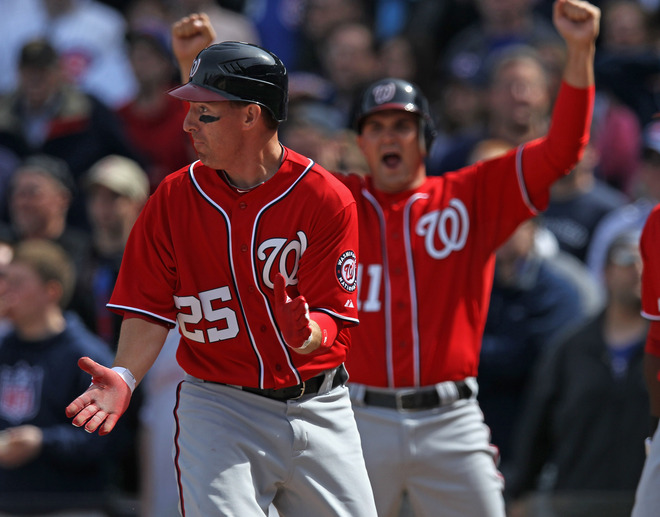
Don't let the hollering fool you.  The Cubs beat
themselves more than the Nationals beat the Cubs.
A day off on Friday gave the team an entire day to stew about blowing the Opening Day not only of 2012, but of the Theo era.  Apparently it got in their heads, because Saturday's game was hardly any better.  The Cubs again held the Nationals down for most of the game until the 8th in a 4-2 game, when Mr. Wood got the first two outs before allowing a solo homer to Danny Espinosa, bringing the deficit down to one.  Then Zimmerman singled, then LaRoche singled, and then Wood was yanked to avoid further damage.  Who was brought in to replace him?  Marmol.  Remember, this is still all with two outs.  Marmol walks Werth, loading the bases.  Finally, Tracy puts the Cubs out of their misery and sucks the life out of the stadium with a two-run go-ahead single.  

These three rallies - two of them when the Nationals were batting with two outs - are pretty much the trademark of the last year's team.  The bullpen was a strength last year, but the hovering frustration of a lack of focus was the most bothersome aspect of last year's team.  Wood immediately took the blame for blowing Opening Day and cited zero excuses, but then it happened again.  We love ya, Kerry, but that's not gonna get 'er done.  Whether it was keeping their eyes on the ball or throwing to the right base, the Cubs lacked in baseball mental fitness last year.  The new management regime made this their primary goal in the offseason, but the early results have disappointed.  Let's hope this doesn't become a trend.


Saturday, February 25, 2012

2012 Cubs Preview: Outfield

You're not doing it right, Alfonso.  When they
say, 'use your head', they don't mean it like that.
Aging bunch to be aided and eventually replaced by younger players

Although the past decade has seen all kinds of changes in the Wrigley outfield, 2012 will not bring drastic changes.  At least, not right away.

For the fifth consecutive season, veteran Alfonso Soriano will man left field (he started 2007 in center).  Soriano takes a lot of criticism for not living up to his gargantuan contract, and most of it is fair.  It was a bad contract to begin with and there's little hope that he'll ever return to the form the Cubs thought they were getting.

In his outstanding 2006 season with the Nationals, his walk year, he became only the fourth player ever to have a 40-40 season with 46 homers and 41 steals.  In five seasons since with the Cubs, he has totaled 54 steals.  In his first two seasons with the Cubs he hit .291 with 62 homers and 38 steals while missing significant time to leg injuries both years.  A reduction in steals was understandable, and the offense was definitely there so Cubs fans remained hopeful.  However, a miserable 2009 showed that he had lost a considerable amount of talent from his glory days with New York and Texas.  From 2009-11 he hit only .248 and averaged about 23 homers per season, a far cry from the 36 he averaged between 2004-06.  He had lost virtually all speed, stealing just 16 bases between 2009-11.

Add all of those offensive woes to his already bad defense, and you've got an average to below-average player making $20 million per year now.  Soriano flashed early power least season before again fading into the mediocrity Cubs fans have become accustomed to.  It was almost a tease, but he could do it again and give the Cubs a legitimate power threat.  He's not hard to get out because he still chases the sliders too much.  26 homers and 88 RBIs, however, aren't that bad if you ignore the average, contract, and defense.  That's only one home run less than Adrian Gonzalez's total of 27, and as many RBIs as Justin Upton produced last season.

Center fielder Marlon Byrd
Despite all the negatives around Soriano, he represents the biggest power threat in this outfield.  The starting center fielder, Marlon Byrd, enters his third season with the Cubs and the final one on his contract.  Byrd is 34 and definitely declining offensively, bringing disappointing power and speed skills for a center fielder.  He is a fan favorite for his effort and defensive hustle, and those may get even better this season.  You see, Byrd lost about 40 pounds this offseason so the size comparisons to an NFL linebacker will most definitely not be heard anymore.  That's all good and well, but it won't make him any more valuable offensively where, frankly, he's lacking.

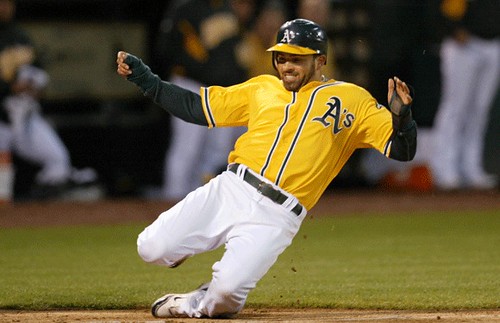
The starting right fielder will be newcomer David DeJesus.  DeJesus, like Soriano and Byrd, is on the wrong side of 30 although he is the youngest of the group at 32.  If there's one thing that has defined his career so far, it's been his ability to get on base.  He has a career .356 OBP with a career high of .384 from 2010.  Playing all but one year of his career with the Royals, he has virtually no winning experience.  Not even a year with Oakland in 2011 could change that.

Right fielder David DeJesus
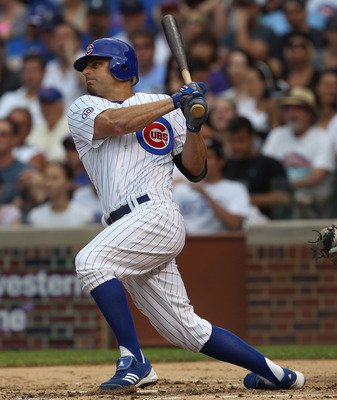
DeJesus does not have great size at 5'11", 190 lbs., but he's a nice, athletic player defensively.  I'm unsure about his arm, and I hope to see more during Spring Training.  Offensively, his power is about a tick below Byrd's, but I would take DeJesus over Byrd because DeJesus is a lefty who makes better contact (never striking out more than 87 times in a season), is more patient, and has a more compact, fluid swing.  DeJesus is a low ball hitter who spreads line drives to all fields well.  I was skeptical at first because DeJesus is somewhat average in all five tools for outfielders, but he's a solid lefty bat with enough skills defensively to play a respectable right field.  I'm content with him in right.

Now for the backups, part-timers, and call-ups.  Bryan LaHair will presumably get some innings if not a few starts in the outfield after he started most of his major league games in right field last September.  For a breakdown of his play, see the post below as he's also the starting first baseman.  Ahead of him on the depth chart, however, are Tony Campana and Reed Johnson.

Speedy fourth outfielder Tony Campana
Campana, 25, has apparently changed his jersey number to #1 for this season and beyond after Kosuke Fukudome's departure left the number vacated.  Although Campana isn't actually '#1' as in most valuable on this team, he could prove to be pretty close to it by the end of the season.  Manager Dale Sveum said at the Cubs Convention that he wants to have a more athletic team that steals more bases.  Well, Dale, it's going to be hard to do that looking at the roster here, as the Cubs finished 2011 with the third-fewest steals in the league.  Campana, however, accounted for 24 of the Cubs' 69 team steals.  He was also only caught twice, giving him one of the best stolen-base ratios in the league.

The dude is seriously undersized at 5'8", 165 lbs., but he does play superb defense and hustles like no one else on the roster.  His 'baseball kid' character shines through in a way reminiscent of former outfield utilityman Sam Fuld, but Campana brings the blazing speed Fuld didn't have on the basepaths.  In the minors, Campana has stolen up to 66 bases.  If he wants to use that speed in the majors, however, he'll have to prove he can get on base consistently.

Johnson, 35, never had speed anywhere close to Campana's.  If you've seen Johnson chase down a dropping fly ball in left field, however, you might not have known that.  Reed is also a definite fan favorite for his commitment to defensive play.  It's not even that Johnson has some rocket arm he can show off to the fans; rather, he just hustles to every fly ball and looks like a complete natural diving for the ball, showing no fear.  This kind of effort is what the fans want to see, and it was lacking on the 2011 team; especially from the player Johnson usually replaced in the late innings, Soriano.

Backup outfielder Reed Johnson
Johnson had a great offensive season in 2011, hitting .309 and even throwing in a walk-off homer.  He's a great high-ball hitter who hits fastballs and changeups well, and he uses the entire strike zone.  He is, however, a dead righty pull hitter.  The lefty Campana uses the entire field with more regularity despite the fact that Johnson is a more experienced hitter overall.  In a post over a month ago I disagreed with the decision to resign Johnson, preferring Campana to be the primary fourth outfielder.  Now that the Cubs have signed him, however, they're bound to give him at least a bit of playing time.

Unless Soriano or Byrd are traded midseason, there is little chance that Johnson and Campana both remain on the major league roster all season.  That's because top prospect Brett Jackson will probably debut sometime this season.  Jackson was the organization's top draft pick in 2009 and so far the high status has paid off as he's been great in the minor leagues.  The lefty-batting Jackson has 20-20 potential with solid defensive skills, projecting as the Cubs' future starting center fielder.  I discussed Jackson more in-depth in my post on top prospects recently, read more about him here.

There's no doubt the outfield for the Cubs is an aging group right now.  It's going to change a lot in the next few years, however, as I think Soriano and Byrd will both be gone by this time next season.  Jackson should be the starting center fielder for years to come, and prospects Matt Szczur and Reggie Golden, neither of whom will debut in the majors this season, will play major roles in for the big league Cubs in a few years barring trades or free agent signings.  The key question for the current group of Soriano, Byrd, and DeJesus is how much value is still left in these aging veterans?  Can Soriano hit for a high enough average to make himself valuable in the trade market?  Can Byrd stay healthy and prove his weight loss expands his abilities and delays his aging process?  Can DeJesus fully recover from a bad season in Oakland last year?

Tuesday, January 17, 2012

Why Reed Johnson Should Have Gone Out On Top

I'm probably not on the same page as most other Cubs fans on this issue, but I think there's something to be said against the resigning of Reed Johnson, which took place a couple weeks ago.  So far I've been complementing the Cubs on pretty much all of their offseason moves, including the signings of Manny Corpas and Andy Sonnanstine and the trades of Sean Marshall and Tyler Colvin.  I did have reservations on the David DeJesus deal, but there are some things I like there, like his versatility and consistent approach.  The Johnson deal, however, simply doesn't make sense to me.  I'll explain why.

Johnson will be 35 in 2012, entering his fourth out of five seasons with the Cubs (he played with the Dodgers in 2010).  An unquestioned fan favorite who has a knack for clutch offensive skills and all-out, aggressive defense, he is a fundamentally strong baseball player.  Of the five tools, only his contact hitting and defense stand out.

I was formally introduced to Johnson in June 2005 as he hit a three-run homer at Wrigley Field with the Toronto Blue Jays.  He made a much bigger name for himself, however, once he came to a market that would truly appreciate his talent in the North Side of Chicago.

I have always been a Reed fan myself; it's hard not to be when he's the only one who operates at 110% of his ability on defense.  However, the Cubs just recently had a logjam in the outfield in 2010 as Kosuke Fukudome and Tyler Colvin battled for at-bats in right field.  Seems like the Cubs are asking for another one.  Sure, Johnson doesn't need many at-bats or hardly any starts, but he also shouldn't warm the bench for a week straight.

Personally I'd rather see Tony Campana, who was projected as the fourth outfielder, to fill the role that Johnson will in 2012.  Campana, although raw and unknown in potential, is young and has something to prove, unlike Johnson.  Campana's speed factor, which produced 24 steals in very limited playing time last year, is very valuable to a roster that seriously lacks it.  While Johnson plays hard on defense to the naked eye, his defense stats tell that he doesn't field it like he used to.  Johnson's range factor and fielding percentage were both below league average, not to mention a -.1 defensive wins above replacement compared to Campana's .9, even though Johnson got more playing time.

I don't need any statistics, however, to tell you that Theo and Jed are exercising a youth movement.  New Cubs regulars will include Ian Stewart, Travis Wood, and Bryan LaHair/Anthony Rizzo, all of whom are younger than those that they replaced in Aramis Ramirez, Rodrigo Lopez, and Carlos Pena, respectively.  Even though Johnson is a role player, his role is a misfit to me.      


Friday, December 9, 2011

Cubs Trade Tyler Colvin to Rockies; Acquire Ian Stewart

New Cubs third baseman Ian Stewart
The Cubs are shuffling the outfield deck for the second time in a week.  On Thursday afternoon, just as the world was in the midst of Albert Pujols shock, the Cubs and Rox closed the Winter Meetings with a deal that sends Colvin and infielder D.J. LeMahieu to Colorado for Stewart and right-handed reliever Casey Weathers.  The deal comes approximately a week after the Cubs made their first major move of the offseason in signing David DeJesus who is now undoubtedly going to be the everyday right fielder.

At first I was very skeptical of this trade, and I sure didn't expect Colvin to be traded out of our surplus of outfielders.  Before this trade, there were four outfielders that demanded regular playing time: Colvin, Tony Campana, Marlon Byrd, and Alfonso Soriano.  That also doesn't include infrequent visits from Blake DeWitt and prospects soon to arrive like Brett Jackson, who will demand playing time upon arrival.  However, it was Colvin who was dumped.

Ian Stewart has been the Rockies third baseman for about four years, but injuries derailed his 2011 season. At his best in 2009 and 2010, Stewart hit 25 and 18 home runs, respectively, but for a very low average.  He does strikeout plenty but also walks a decent amount, raising his OBP around 80 points higher than his batting average.  He hit only .156 in his 122 at-bats last season without a home run, very similar to Colvin's demise.

Which player will recover more effectively?  I couldn't answer this question, and neither could my quick research, so I turned to the media of all places for some reaction.  MLB Network's Clubhouse Confidential show, which examines the offseason and players via sabermetrics, declared Stewart the better player and more likely to rebound because of his better career walk rate in the minors (.373 career minors OBP compared to Colvin's .315).

The Cubs' top draft pick in 2006, Tyler Colvin's Cubs
career is finished after just 221 games.
Now that we've got that figured out, let's get to the bottom of the minor pieces.  LeMahieu, still only 23, took only two years from being drafted in 2009 to reach the Majors in 2011.  He didn't show much in his brief trial, but his minor league records are more notable.  A .317 career hitter in the minors, his 11% strikeout rate opened plenty of eyes.  Even though he has been a great contact hitter in the minors, that often changes quickly in the Majors against power pitchers never faced before.  LeMahieu was projected to get some playing time at third or around the infield in 2012, but overall, not a big loss.

Weathers, on the other hand, could be a decent pickup for the Cubs.  The 27-year-old Weathers, who has never played under the big league lights before, had major control issues in 2011 at AA Tulsa for the first time in his professional career, walking the same amount he struck out.  He has terrific strikeout stuff, but continued control problems will not make him an asset at all.  The Cubs will just have to hope it was a fluke.  In my initial reaction to the trade, I figured Weathers would stay in AA and AAA for most of the season.  Apparently he's being invited to big league camp in Arizona and will compete for a bullpen spot on the Major League team.  We'll see what happens.

Overall, this is a good trade.  Theo & Co. like guys with a high OBP, and they got another one here.  Stewart plays a decent defensive third base (better than Aramis Ramirez), and his home run balls will reach Sheffield on multiple occasions.  When he really squares up an inside fastball and gulfs a home run, his swing looks pretty awesome.  The loss of LeMahieu isn't anything to stress about, and Weathers has lots of upside.  So we've got that goin' for us, which is nice.

Saturday, December 3, 2011

Cubs Sign David DeJesus

Note #1: Like Chicago Cubs Insider on Facebook!  I really haven't done anything with the page until now, but I plan to post it frequently.

Note #2: Through a special baseball seminar I'm taking, a fellow group of students and I got to Skype with Tampa Bay Rays President Matthew Silverman and Director of Baseball Operations Erik Neander.  They talked about how they've achieved such great success in the scouting and development fields (pun intended) and how they've done all of it with the limitations of a small market, including a questionable fan base.  About a possible move, they agreed the Rays "aren't going anywhere" for now and they will have to make the best of their situation.  I asked them a question; after seeing Jeremy Hellickson and Desmond Jennings have great success as rookies in 2011, is there any rookie in particular you are excited to see make an impact on the 2012 Rays?  They said Matt Moore should be a great pitcher especially after the clutch performance he put on late in the season and in the first game in the playoffs.  Interestingly enough, Silverman and Neander said that Moore was more prepared for the big leagues than David Price was when they brought him up for the stretch run in 2008.

And now onto the major Cubs news of the week, the signing of outfielder David DeJesus.  Don't know much about this 5'11", 190 lb. 31-year-old?  I can't blame you.  DeJesus was a mainstay in the Kansas City outfield from 2005 to 2009 before injury and a disappointing season in Oakland in 2011.  Although he has played 1,007 games in his career, none have been against the Cubs.  In fact, the Cubs are the only team he has never played against.  However, he has 40 career RBI against the White Sox (the fourth-most of any opponent) and a .336 career batting average against the Cardinals.  If we have nothing else to go off, there's a good start.

But I won't leave you hanging there.  I've done my homework on this dude.  DeJesus is not a power hitter or necessarily speedy, yet he remains a quality outfielder worthy of a starting job, a rare breed in today's flashy generation of outfielders.  DeJesus' career highs in homers and steals are 13 and 11, respectively, totals that will not open any eyes (not positively, at least).  But he does possess a career .284 batting average and .356 OBP.  In my eyes, he has a nice swing and is a great contact hitter.  He doesn't strike out much (13% of plate appearances), but he walks a decent amount (8%).

DeJesus is not going to fill up a highlight reel; he's rather a solid baseball player who stays relatively healthy and provides a moderate mix of the five main tools at a relatively low cost.  In this way I think he's a very Theo-like player (see: J.D. Drew, Jed Lowrie, etc.).  And on the 2012 Cubs, he projects to have a big role.  The official Cubs depth chart reads him as the starting right fielder, ahead of Tyler Colvin and Tony Campana.  But the real question is, is it a smart move?

In short, it was a necessary move but not necessarily a smart one.  Theo & Co. were right to add another outfielder; I'm not sure DeJesus was the right guy.  He's an odd fit in this outfield and his role is unclear, especially with Colvin still being viewed as the eventual starter if he can get back on track from an awful season.  DeJesus is a solid baseball player but does not shine anywhere.  I think the Cubs would have been better served to get a specific tool-threat, like the speed and defense of Coco Crisp.

Another thing to explore is whether or not DeJesus will replace a current outfielder.  I've said before that I don't see Marlon Byrd returning in 2012 even though he is under contract; I'm officially broadening the statement to either Byrd or Alfonso Soriano will not return.  I didn't think it was possible to unload Soriano before, but I have a very hard time seeing the new hotshot brain trust (Theo and Jed Hoyer) putting up with his lackadaisical defense and the like.  They could find a way to make it happen.  If one of the two were goners, DeJesus would probably move there, opening right field for Colvin and Campana.  Still, however, Crisp would have been the better move on a team desperate for speed like his.

DeJesus' wife is fired up about the whole Cubs thing.  Not only did they buy a house in Wheaton recently, she grew up a Cubs fan.  According to her Twitter, as a young girl she would tell everyone that someday she would marry Ryne Sandberg.  And 20 years later, here she is married to a Cub.  Let's just hope David brings the same enthusiasm along to the Windy City.