Showing posts with label castillo. Show all posts

Monday, April 16, 2012

A Rough Start

Gold-numbered jerseys?  Check.  Gold-logo emblazoned hats?
Check.  Mandatory around-the-neck gold bling?  None (yet).
Inconsistent offense, shoddy bullpen work highlight first 10 games


It wasn't surprising that many assumed that the 2012 Cubs would struggle on the field.  It probably was surprising, however, that they got off to such an early start at that.  The first homestand, which saw the Cubs host the Nationals for three games and the Brewers for four, started 1-5 for the Cubs as they struggled to find a winning formula.

The Monday night game was not without its highlights, such as Bryan LaHair's monster home run onto Sheffield Avenue early on, but Chris Volstad's shaky start and Shawn Camp's atrocious relief appearance (three earned runs in one inning) spelled doom in a 7-5 loss.  It was a competitive ballgame, however, as Starlin Castro batted in the bottom of the ninth with the tying and winning runs on base.  A John Axford slider then ended all hopes of a comeback.

Tuesday night was a different story.  Paul Maholm, who has now been torched in both of his starts, had allowed six runs by the third inning.  Even the platoon catcher, Jonathan Lucroy, hit a home run. This game left little chance for the Cubs.

Yovani Gallardo and Ryan Dempster had a surprisingly intense pitcher's duel in the Wednesday game.  Gallardo allowed only a first-inning sacrifice fly to Castro, while Dempster held the 1-0 lead until a two-run homer by the other platoon catcher, George Kottaras, gave the Brewers the lead for good in the seventh.

And just like that, the Cubs had lost the first three games of a four-game series and started the season 1-5.  Pretty depressing stuff.  But this, my friends, is the wonder of rebuilding.  The team will be bad, but there are sure to be signs of life.  One such sign came Thursday as the Cubs shut out the Brewers 8-0, a real team effort as six different Cubs knocked in runs.  Matt Garza was even one pitch away from a shutout.  In fact, he got his pitch - an easily-fielded comebacker to the mound - and he promptly fired it into the stands instead of making the easy, 45-foot throw to first base.  Manager Dale Sveum yanked him unnecessarily, and Garza was robbed of the Cubs' first complete game of the season.
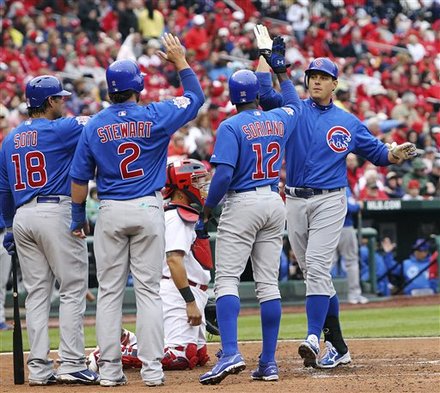
Bryan LaHair gets a round of high-fives after hitting the first
Cubs grand slam since October 2010.
The Cubs even broke out the bats for the second straight day in a row, and at a great time.  Those St. Louis Cardinals, decked out in gold-logo'd hats and gold-lettered jerseys just in case anybody forgot that they won the championship last season, were looking for an easy win over this weak Cubs team on their Opening Day.  They didn't get it.  First, rain rained on their parade.  Then, the Cubs rained on their parade.  After a lengthy rain delay of nearly two hours, any Cards fans that stayed looked foolish after a three-run homer by Ian Stewart and a grand slam by LaHair helped give the Cubs a 9-0 lead by the third inning.


Who gave up all these runs?  Why, it was Adam Wainwright.  That's the same Wainwright who, after nearly being the team's ace the last half-decade, missed the entire 2011 season due to injury.  This means he did nothing to contribute to their World Series run even though he is on the team.  So how ironic it was that he was the man to start the game in which they got their World Series rings, wore the glittery gear, and flaunted around pregame in celebratory fashion in front of the second-largest Busch Stadium II crowd ever.  But I digress.


Anyway, the point is that the Cubs did show the ability to score runs.  I like LaHair's power potential; he has two homers so far, one of which went opposite field and the other which left the stadium entirely.  I don't think strength will be an issue with this guy.

The Saturday and Sunday games were a mess.  Volstad imploded in the fourth inning of an otherwise sharp-looking start on Saturday, but the Cubs could never come back from the four allowed in the fourth.  The Cardinals did salvage one win in those odd-looking gold-numbered jerseys.  They had the wit to wear those things for a second game.  Who do they think they are, the New Orleans Saints?  While we're on the topic, is new manager Mike Matheny paying his pitchers to throw at opposing batters (in "kill the head" fashion)?  Probably not, but a concussion did end Matheny's playing career....  Also, in other weird-coincidence news, the Giants wore a similar gold-lettered jersey at their home opener last season as well to celebrate their 2010 World Series championship.  Which team did they host in their home opener?  The Cardinals.

Back to the Sunday game.  That second torching at the hands of Maholm took place on Sunday as Matt Carpenter, some kid who has made a lot of headlines so far, ended up five RBIs for the Cardinals.  The Cubs never really got to Cards starter Jake Westbrook, and the series ended with Friday being the lone Cubs win.  The series started off promisingly, but the end looked like the Cubs team we were expecting to see.

Through these first three series, the Cubs never really showed what their strengths are.  The last guy to make the rotation, Jeff Samardzija, is the only one with more than one win.  The offense scored 18 runs in the first six games then put up 17 runs in the next two.  Kerry Wood's bullpen failures from the first weekend were forgotten in place of a hodgepodge of dismal 'pen work from Camp, Lendy Castillo, and Carlos Marmol namely.  Not to mention Maholm's efforts, which have taken the Cubs out of games practically before they've started.  So far, not so good.  3-7 isn't the end of the world, however, and Sveum has the team playing hard.  The errors are down and the stolen bases are up.  The team certainly has a good swagger, too.

The Cubbies are down in Miami to check out the Marlins' new digs tomorrow night.  Ozzie Guillen will return from his five-game suspension to manage the game.  Just in case the game turns into a Marlins blowout, go online and count as many articles as you can find that mention both Guillen and Fidel Castro written within the last seven days.  Hopefully, though, we can just watch some winning baseball.        

Monday, February 27, 2012

2012 Cubs Preview: Bullpen

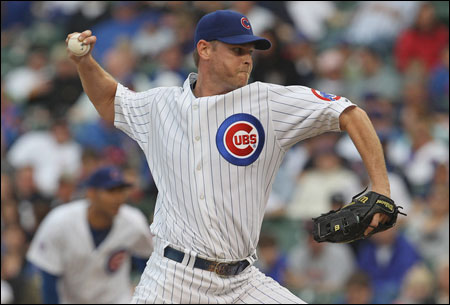
Kerry Wood
Young unit loses prime setup man but remains strong with hard-throwing core


The 2011 Cubs were simply not a good team at 71 wins, 91 losses.  The bullpen, however, was undoubtedly a team strength.  I believe that if the closer had been as good as he had for his entire career, this bullpen would have rivaled those of top contending teams.

That closer, of course, is the nasty Carlos Marmol, 29.  The side-arming right-hander pitched to a 2.86 ERA 61 saves, a 12.9 K/9 ratio, a ridiculous 4.8 H/9 ratio, but a 5.6 BB/9 ratio between 2008-10.  In 2011, however, he worsened to a 4.01 ERA with 10 blown saves, most in the National League.  In six of those blown saves, he also let up at least another run to lose the game.  He has the wildest delivery this side of Francisco Rodriguez but doesn't control it well as K-Rod does.

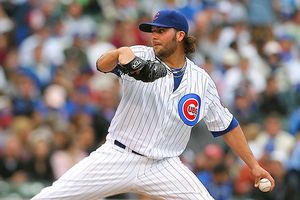
Carlos Marmol
Marmol throws far too many balls, especially to begin an at-bat.  It seems he always falls behind 2-0 before coming back with a slider over the middle of the plate for strike one.  The issues got so bad last season that he began throwing a cutter (or 'soft' slider) - without telling any coaches.  It didn't work, and manager Dale Sveum has already told him to knock it off.  No, Carlos, you're not Mariano Rivera.  Sorry, but the cutter just isn't that easy.  Marmol was given the ball with a lead to save 44 times last season, and he saved 34 of them.  Hypothetically, if given the same amount of chances this year, saving 40 should be a good goal for him.  It's certainly a challenge, but within his talent level.

Most of those leads handed over to Marmol had something to do with former setup man Sean Marshall.  Marshall, who, like Marmol, began his major league career as an unsuccessful starter, confirmed his status as one of the elite setup men in the game last year with a 2.26 ERA and 4.65 K/BB ratio.  Marshall was flipped to Cincinnati when his stock price was highest, meaning the primary setup man duties fall to Jeff Samardzija.

Jeff Samardzija
I talked briefly about Samardzija in the last post for the rotation, where he is being considered as the longest of longshots.  Truth be told, however, his loss would be a big blow to this 'pen.  His 2.97 ERA showed that he could be a good primary middle reliever, and now with Marshall's departure, he's ready for the next step.  He works lefties tough on the inside part of the plate.  Despite having the matchup advantage, they hit only .208 against the tall former Notre Dame wide receiver.  Righties didn't do any better, hitting .195 off him.  Too many batters got on base via the base on balls (50 of them, to be exact) but he still held hitters to a .220 average with men on base, which is hard to do considering the pressure on the pitcher at that point.  Some want to call his season a fluke, but I hope those factors of domination show that he's a changed pitcher and not just a lucky son-of-a-gun.

I haven't heard anyone call Kerry Wood's 2011 a fluke.  The 34-year-old pitched to a very respectable 3.35 ERA last season with 57 strikeouts in 51 innings.  As always, Wood brought the heat on a daily basis with that nasty curveball.  Wood is guaranteed a job with the Cubs for as long he likes, whether that means in the 'pen or front office.  For this season, however, he's a great option as a middle relief/setup man.

James Russell
Other primary names that will be in the mix include 26-year-old James Russell, 27-year-old Marcos Mateo, 26-year-old John Gaub, 24-year-old Rafael Dolis, 23-year-old Lendy Castillo and 27-year-old Scott Maine.  Clearly it's a very young group, but some have more potential than others.  Russell was tried in the rotation last year during the grand scramble for starting pitching, and he imploded.  Put back into middle relief though, he performed well.  I really like this kid's over-the-top delivery, it's very smooth and fundamentally correct; I hope to see him do well in this role this season.

Mateo is an less developed strikeout pitcher with a good fastball and slider.  He needs to work on his command to prove he can stay in the majors, but I like his raw stuff as it is right now.

John Gaub
Gaub throws some serious, serious heat.  In about 212 career minor league innings, he has struck out 298.  He made his major league debut last season and I believe will play a big role this year.  He's a lefty with a power slider, which already gives him value.  He walks about as many hitters as Marmol, however, so we'll see if his command has improved.

Maine was acquired before 2010 in the trade that sent former Cubs reliever Aaron Heilman to Arizona.  He has gotten tidbits of major league playing time over the past two years, but not enough to be judged upon.  In the minors he has a lifetime 3.34 ERA and recorded 12.6 K/9 last season at AAA Iowa.  He's ready for the major leagues, and I was hoping we'd see more of him last season.  I see him as a setup man as early as 2014 if not next year.

If nothing else, Dolis has a tremendous ability to keep the ball in the ballpark.  In 353.2 minor league innings, he's only allowed 14 homers.  This is good, but he's still going to allow runs if he continues to walk as many as he does in the minors.  If he makes the major league roster out of Spring Training, I'd call that a risky move.

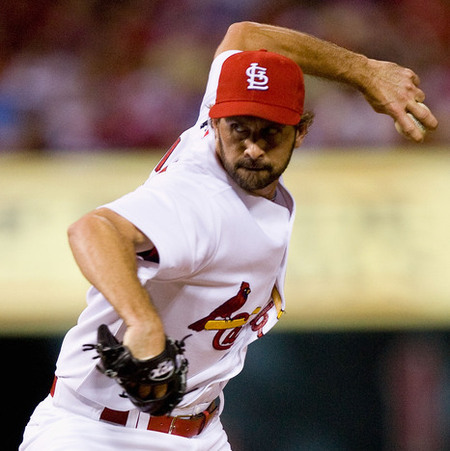
Trever Miller
Speaking of risky moves, Castillo qualifies; he was a Rule 5 pick from the Phillies - meaning he must be on the major league roster all season or else he'll have to be returned the Phillies.  The Cubs' last Rule 5 pick was reliever David Patton in 2009, and that didn't turn out so well.  Patton hasn't pitched in the majors since.  Castillo has a 2.43 career ERA in the minors and exactly one strikeout for every inning pitched on average to go with an impressive 1.15 WHIP.  These are all nice, but they might mean more if Castillo had ever pitched above A ball.  Look for him to be used in blowout games only to begin with (which was also Patton's role).

The Cubs bullpen is a very young group now.  The only free agent acquisition, left-hander Trever Miller, is also the only man over 30 heading into the season.  Out of the pool of middle relief candidates, I believe Gaub, Maine, and Russell will become the primary three by midseason especially because of their strong command.  Dolis, Castillo, and Mateo are slightly risky for different reasons and won't all be on the major league roster all year.  Wood, Samardzija, and Marmol are strong pieces at the back.  Despite losing the big prize in Marshall, the bullpen remains a strength for the Cubs despite the uncertainty of the younger pieces.


Thursday, February 23, 2012

2012 Cubs Preview: Catchers


Starting catcher Geovany Soto
 This is first of the six-post comprehensive season preview on the 2012 Chicago Cubs!  Each of the next six days will feature the next segment.  First we'll take a look at the Cubs' situation behind the plate.

Inconsistent Soto will again try to live up to potential; this time, he'll have a better supporting cast

The incumbent at the catcher position is 2008 NL Rookie of the Year Geovany Soto.  Since winning that award, however, Soto's career has not gone as envisioned.  The best season of his career was that rookie season and he hasn't come all that close since.  2012 will be Soto's fifth season in the major leagues and he's still looking for his second 55-RBI season, even though he was projected as a major run producer and drove in 86 in his rookie year.  Given, he only 207 games between 2009 and 2010, but there's another problem in itself.  

"I tell you, if he continues to swing the bat the way he has since his recall, this guy's going to have a great career both behind the plate and at the plate." -Cubs TV commentator Bob Brenly after Soto's first career homer in Pittsburgh, September 9, 2007.

Defensively, Soto is no standout behind the plate.  Last season he threw out a career high of 30% of attempted basestealers, raising his career average to 27%.  For comparison, he's still well behind his Cardinal counterpart in Yadier Molina, who, at a career 44%, is regarded as perhaps the best defensive catcher in the game.  Soto's South Side counterpart, A.J. Pierzynski, has never been well known for defense and has a career mark of 24% but was at his worst in 2011.  

Soto has a good arm, but his mobility is sometimes affected by his size.  Soto did lose about 20 pounds last offseason and looked better than Cubs fans had seen him about a year ago, but he regained the weight as the season went on, further hampering his ability to make quick moves.  Remember, Geo, physics constitutes that mass and acceleration are inversely proportional.  In simple terms, less mass = quicker acceleration.

Offensively, Soto has been all over the board.  First he tore up the Pacific Coast League with the AAA Iowa Cubs in 2007, hitting .353 with 109 RBIs to become the PCL MVP.  His performance was noticed by the big league brass, and Soto even started two of the three playoff games that year despite being a September call-up (Matt Moore, anyone?).  Then Soto helped power the Cubs to 97 wins on the NL's best team by calling the pitches for one of baseball's deepest pitching staffs.  He had it all; 23 homers, a .364 OBP, 86 RBIs, an All-Star appearance, and even two triples.  

It went quickly downhill from there.  In 2009 he played for Puerto Rico in the World Baseball Classic, approximately at which time he failed a drug test for marijuana; the results came out later in the season, but this must have hung over him the entire season.  When he wasn't injured, he was bad.  When I say bad, I mean he was being outhit by Koyie Hill.  Okay well not that bad.  Still, though, his average dropped 67 points to .218 and his slugging percentage was a measly .321.  

Then, a turn for the better.  Soto hit the DL again in 2010 but was far more effective as his walk rate was a career high and his .393 OBP is still a number unheard of for catchers.  He was definitely limited because of his injuries, but in a full season he would have been one of the best in the NL. 

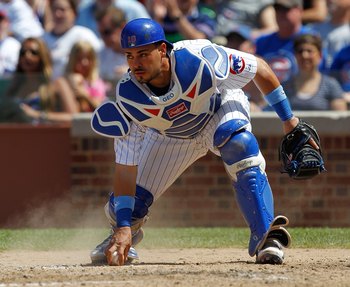
Backup catcher Welington Castillo
Of course, he regressed again in 2011.  The power was there; everything else wasn't.  Geo struck out more and walked less than ever, resulting in a career low .310 OBP.  Even that power took a long time to get 'in swing' (pun not intended), as perhaps he wasn't used to his slimmer self.  As I explained, he gained the weight back, and the power returned.  Could there be a correlation there?  Quite possibly.  

Luckily for Cubs fans, catcher should be a stronger position than usual this season even if Soto isn't on his game again.  Taking over the reigns as backup catcher is 25-year-old Welington Castillo.  Castillo got his first splash of major league action in 2010, playing in seven games and hitting his first career homer at Sun Life Stadium in South Florida.  Castillo got more attention, however, for his shattered bat that struck Tyler Colvin on the basepaths in that same series.  

Castillo barely got any playing time last season, but he will get plenty this season.  He's a stronger defensive catcher than Soto and a more fit figure overall.  He can also swing it, which is a nice change for Cubs fans.  Hill was good defensively, but it's hard to become a fan favorite when you can't hit water if you fell out of boat.  Castillo batted .287 with 16 homers and a .516 slugging percentage in only 75 games last season.  It's good to stay younger here so Castillo can learn and improve, instead of watching the 33-year-old Hill decline.

Third-string catcher Steve Clevenger
The wild card in this race is 26-year-old Steve Clevenger.  He got his first career hit, a double, at the end of last season in San Diego.  He's decent defensively although not as active as Castillo and he really struggled back there last season, throwing out only 11% of basestealers and committing eight errors in 96 games.  Offensively, though, he's a nice surprise.  He doesn't bring the power of Soto or Castillo, but he gets on base and is very, very patient for a catcher.  He walks almost as much as he strikes out; the John Jaso model, if you will.  In 448 plate appearances last season, he batted .319 with an incredible .383 OBP.  Clevenger will probably get some playing time later in the season but, barring injuries, I'd be shocked if he makes the club out of Spring Training

28-year-old Chris Robinson, the backup catcher in Iowa last season, could get some playing time in Chicago in the event of an emergency.  He's average defensively and has virtually no power, but he hits for a nice average.  A former third-round pick of Tigers in the 2005 draft, Robinson has yet to debut in the major leagues.

I've dished on and on about this position for long enough.  Let's bury the hatchet.  I have high hopes for Soto given his history in even-numbered years, and I've been calling for Castillo for over a year and a half now.  Even if Soto still can't find rookie form, Castillo will take up the slack and play well, especially defensively.  This position is definitely a strength on the 2012 Cubs.             

Friday, May 13, 2011

Steve Bartman: Painfully Innocent

Before you read this post, make sure to check out this amazing story written by ESPN detective/writer Wayne Drehs in 2005.  This is one highly informative piece of writing and pretty much the closest anyone has gotten to having a full interview with Steve Bartman.  This baseball comedy news website posted an interview with Bartman in 2008; this is fake, but interesting nonetheless.  There is some truth in that story, like the fact that Bartman was at Game 3 of the 2007 NLDS in Arizona.  Although not proven, it is believed by many that he was there.  ESPN will document the game in their 30 for 30 series; the episode comes out sometime this summer or fall. 

Steve Bartman is an innocent man.  And when I mean innocent, I mean just like any other guy at ballpark.  And here's why: if you were sitting where Bartman was during Game 6 of the 2003 NLCS against Florida and Luis Castillo's foul ball came flying to within three feet of you, what would have done?  You would have done the exact same thing that Bartman did; reach out for the ball.  Therefore, the fact that Bartman himself is an enemy at all is a matter of coincidence.  Bartman was just at the wrong place at the wrong time.  It's unfortunate that this had to happen to someone like Bartman, because as Drehs mentions in his article, Bartman is a diehard and devoted Cubs fan, even now while living in societally-imposed exile.  There's nothing you can do but feel bad for him, but then again we must remember; it was us, Cubs fans, who put him there in the first place.

I present to you the three reasons why the Cubs lost Game 6, none of which blame Steve Bartman:

3. Bernie Mac's Singing of the 7th Inning Stretch
It is an honor to sing the 7th Inning Stretch at Wrigley Field.  It is more of a honor there than any other ballpark in the Major Leagues because there is a celebrity conductor every single game.  Typically, the guest conductors keep it simple with 'Let's get some runs' after the singing.  But Bernie Mac had to go and take it to another level.  He had to go and change the words in the song to 'Root, root root for the Champs' and jeopardize the entire thing.

You would think that given the enormously pressured circumstances, Mac would have just not have tried something crazy like that.  But I guess not, and it couldn't have done anything to help the Cubs at all whatsoever.  With a 2-0 lead in the 7th inning, it wasn't even that sure of a thing that the Cubs didn't blow it anyway.  Overall, Bernie Mac screwed with the baseball gods, and as they always will if not treated with respect, they'll make you pay. 

2. Moises Alou's Reaction to Bartman
Any Cubs fan can probably replay the video again and again in their head.  There's Luis Castillo slicing the ball to the opposite field and tiptoeing out of the batter's box, followed by the Alou failing to catch the ball because of Bartman, and then there's Alou coming back down to the ground and slamming his glove on his knees and having a fit over not catching the ball.  As painful as a memory that is, it's important to remember whose blame it actually was instead of just scapegoating Bartman.

Not only did Alou's reaction contribute to the collapse that ensued for the rest of the Cubs, it effectively ended the public life of Steve Bartman.  And here we are, eight years later, and Alou has never apologized to Bartman.  If Alou had just walked away like a regular outfielder, Bartman's name would be unknown to the rest of the world.  But Alou reacted terribly, like some six year old throwing a fit because he lost.  Fans and the sports community have never blamed Alou nearly enough for what he did in that situation, but Bartman is the man who he is today solely because of Moises Alou.  Alou originally blamed Bartman for the incident, but took back his words in 2008, saying "You know what the funny thing is?  I wouldn't have caught it, anyways."  Alou's nonchalant attitude clearly shows he has no understanding of what he did.  This is because he either doesn't care or is too stupid to figure it out.  Most likely it's the latter, considering how dumb that reaction was in the first place.  Moises Alou, you owe that man an apology.  Man up and do it.

The negative mood that Alou left after the play definitely stuck around for the rest of the inning.  Because the player got upset, his teammates and the fans got upset.  Making his teammates upset and distracted probably also affected the next reason for the collapse.

1. Alex Gonzalez's Fielding Error
If not for Bartman, this play would be the play known for the collapse of the 2003 Cubs.  It would have been the 'error heard 'round the world'.  But Bartman had already taken all the attention by the time Gonzalez added to the Cubs' problems and his play has been all but forgotten.

The situation for the error was only a short while after Bartman entered the spotlight.  With one out and Juan Pierre on second, Luis Castillo fouled off the Bartman ball.  After the at-bat resumed, he walked on a wild pitch which sent Pierre to third.  Ivan Rodríguez followed with a single, scoring Pierre, bringing up a young Miguel Cabrera.  Now leading 3-1 and Marlins on first and second, it would be a perfect spot for a double play ball.  Sure enough, Prior got one.  The chopper reached Gonzalez, who could have turned it for an easy 6-4-3 double play, but Gonzalez angled his glove awkwardly and bobbled the ball.  He wasn't even able to get a single out and this left runners on every base with one out.  Derrek Lee would then tie it with a two-RBI double, and the rest is history.

Just try to imagine what getting this double play would have meant.  The 8th inning would have been over, sending the Cubs into the 9th with a 3-1 lead and Joe Borowski, who had blown only four saves all year, to close it out.  The Cubs would have gone to the World Series if Gonzalez had made this play.  There, I said it.  If Bartman hadn't gotten in the way of Alou, there's no way of knowing for sure if Alou would have even made the play.  I think the chances of Alou catching that ball were 50-50.  Gonzalez, on the other hand, made only 10 errors all season in 2003.  His defensive WAR was 0.8.  The error he committed right at that time is the most inexplicable thing I have ever seen in the game of baseball.  I guess the only answer is the baseball gods abhor the Cubs.  They gave us 2003 to toy with us, and now leave us with a frustrating franchise with little hope of getting back to where we were soon.  Any way you look at it, the 2003 Cubs infamously collapsed.  And it had nothing to do with the warranted villain of that collapse, Steve Bartman. 

Thursday, January 6, 2011

Speed Thrill Skill

Back in late July at the Trade Deadline, when Ryan Theriot was traded to the Dodgers, I predicted that Jim Hendry would acquire some kind of speed in the offseason.  He has yet to do so, and the clock is ticking.  Theriot stole 16 bases in four months of Cubs baseball, but he still led the team.  Besides him, the 2010 Cubs were led in steals by Starlin Castro with 10; while being caught eight times.  Castro is raw and one can expect production of 20+ steals in the future with his speed, but his development can really be relied upon as the team's main source of speed.  Behind Castro was Kosuke Fukudome with seven; he was also caught a ridiculous eight times.  Speed is clearly a problem and has not been a strength for the Cubs in quite some time.  The last prototypical leadoff man on the North Side was none other than Kenny Lofton; and he lasted three months.  The player I suggest the Cubs try to acquire is not a prototypical leadoff man either, but he is much closer to it than anyone the Cubs have.  The name is B.J. Upton, a 26 year old center fielder playing for Tampa Bay.  Upton has 20/20 potential (he did this in 2007); hell, he has 20/40 potential.  Upton has arguably one of the best five tool skill sets in baseball, but he has yet to put it all together.  He possesses the following abilities: hitting for average (.300 in 2007), decent power (24 homers in 2007), decent run production (82 RBI in 2007), improving plate discipline (97 BB in 2009), good overall scoring (89 runs in 2010), excellent speed (128 steals since 2008), good outfield range (1.5 defensive WAR in 2008), and good on-base percentage (.383 in 2008).  As a big B.J. fan, I've been waiting for a breakout year for quite some time now.  Perhaps a change of scenery is in order.  The Rays, now in a rebuilding mode, aren't going to let him run off for nothing, however.  So here is the trade I propose:

To the Cubs:
CF B.J. Upton
1B Dan Johnson

To the Rays:
RF Kosuke Fukudome (Cubs work out some kind of salary arrangement)
SP Chris Archer
RP James Russell
C Welington Castillo

The Rays, although they have already acquired a few relievers in Cesar Ramos and Joel Peralta, but need more and James Russell is a guy they can work on to make him into an effective middle reliever.  Russell is never going to be a standout player in his career, but he should be a reliable and effective middle reliever for at least a bunch of years.  Chris Archer is the top pitching prospect in the Cubs system, someone the Cubs front office has been excitedly anticipating for a while now.  He can start, but would probably end up in the bullpen with the Rays depth of starters.  Archer is the key prize and centerpiece of this deal.  Kosuke Fukudome has been someone the Rays have discussed in the past and they would be willing to take him but the Cubs would probably have to pay for more than half of his salary.  Fukudome probably has one more chance with a Major League team before his career starts falling apart.  He needs to prove himself, and fast.  Welington Castillo is a prospect the Rays can throw into the catching core that already includes John Jaso, Kelly Shoppach, and Dioner Navarro.  But neither Navarro nor Shoppach hit well enough anymore to have an everyday job, and certainly by the end of next season one of them will not be with the Rays.  It's no secret the Rays aren't afraid to talk trade involving Shoppach namely.

The Cubs get the main guy, B.J. Upton, and first baseman Dan Johnson just to add some depth to the infield.  With Xavier Nady signing with the Diamondbacks, the Cubs no longer have a backup first baseman and will be stuck with Jeff Baker instead, who shouldn't be playing over there.  Baker is an okay infielder, but he shouldn't be the backup for the entire infield and Johnson gives the Cubs a veteran who won't do much offensively but will do enough defensively and give Carlos Pena a little break every once in a while.  Johnson was also played at third base for a short time with the Rays, and this could be something the Cubs experiment with as well.

The upsides to this deal are enormous.  With Upton, the Cubs would offensively be a playoff caliber team just one season after looking lost and disinterested at the plate.  If they could add a veteran starter, these Cubs could make it over the .500 mark.  But speed is crucial.  We don't want the opposing pitchers to be comfortable to pitch and not be distracted by a potential base stealer.  We also don't want to be reliant on hits to move guys around like we did last season.  If Jim Hendry doesn't acquire Upton, which is by far the more likely option, then just pray he gets some kind of speed on this team.  It could be a long, and slow, summer without that speed thrill skill.  

Wednesday, December 22, 2010

Competitive Balance in Economics

There are 30 MLB teams.  By the rules and nature of baseball, all teams have an equal shot to win.  By the rules and nature of business, some teams are favored more than others.  In today's world, the industry that is professional sports is a business.  As unfortunate as it is, this means every team in MLB has different odds to win.  Since their is no salary cap in baseball, it's all about the revenue.  And a team's success or failure in generating revenue can and most likely will dictate their ability to win.  If you're a serious baseball fan, chances are you've heard of Billy Beane, GM of the Oakland Athletics.  The reason Beane is famous is because of his groundbreaking theories about baseball economics, revolutionary thoughts that have become relevant with the big contracts and free agency dogfights of modern baseball.  If Beane were the GM of the New York Yankees, he would not be characterized as the godfather of modern baseball economics.  Oakland is a tiny city compared to the other jumbo markets of baseball, making Beane's job much harder than a GM in a bigger city.

Small market teams have it tough.  Most small market teams put a strong emphasis on building from within their own system, putting a lot of work in the scouting and development department.  When these teams come up with big prospects they are unable to sign them to extensions and they are lost to the big market teams.  Even if they are able to sign the player to an extension, what happens if the team is losing?  The team has no choice but to rebuild, which means sending the prospect-turned-star to the big market teams.  There are a few ways for it to happen, but in the end, the star ends up with the big market teams more often than they should.

Prime examples of this can be found on the current big market teams.  Remember that super rotation the Phillies will put out on the mound in 2011?  Let's see where those guys came from.  Roy Oswalt was a huge star in Houston, nearly setting the franchise wins record before being traded.  Roy Halladay was a big star in Toronto, a well-publicized one at that.  Halladay took home the 2003 AL Cy Young Award, while Cliff Lee took home the same award in 2008 with Cleveland.  While Lee struggled with injuries during times in Cleveland, it was clear even before 2008 that he had the capability to be an elite pitcher.  Cole Hamels, the fourth man in this super rotation, is the only product of the Phillies system.

Red Sox GM Theo Epstein, clearly in control of a big market team, snagged two of baseball's best players from small markets this offseason.  Acquiring Adrian Gonzalez out of San Diego and Carl Crawford from Tampa Bay, he has now dealt a huge blow to both franchises.  Without Gonzalez, the Padres are no longer a playoff contender and without Crawford, the Rays aren't either.  The word 'disappointment' can't even begin to describe how fans must feel this winter in San Diego and St. Petersburg, respectively.

Let's read down the current Yankee lineup.  At catcher we have Russell Martin, just acquired from the Dodgers.  At first base we have Mark Teixeira, big time power first baseman for the Rangers before being dealt to two pit stops in between.  Teixeira isn't the only name here with an enormous contract.  At second base and shortstop, we have Robinson Cano and Derek Jeter, respectively.  There are two genuine Yankees; good for them.  At third is, and I know its been a while, the most hyped prospect in the history of baseball- with the 1995 Seattle Mariners.  In right field we have Nick Swisher, who got his fame launching bombs out of the Oakland Coliseum.  In center, the five tooled Curtis Granderson came from Detroit.  In left is Brett Gardner, one final genuine Yankee.

The Yankees World Championship team of 2009 featured only two full season homegrown starters, while the top two (C.C. Sabathia and A.J. Burnett) came from Cleveland and Toronto, respectively.  The Yankees, not surprisingly, have been to the World Series more than any other team and have won more than any other team.  From 2001-2010, a ten year stretch, 15 different teams made the World Series, with only the Yankees, Giants, Phillies, Red Sox, and Cardinals having been more than once.  Many baseball experts interpret this to mean that competitive balance in baseball is higher than it ever has been, but I don't think this is exactly the case.  Don't get me wrong- competitive balance is certainly high and we've seen a lot of small market success stories recently, but the problem is sustaining the team that got them there.

The surprising but lovable 2003 Marlins team that upset the Yankees to win the World Series was an example of how these teams can win, but can't be sustained in a market like Southeast Florida.  The 2003 heroes of ace Josh Beckett, center fielder Juan Pierre, second baseman Luis Castillo, starter Brad Penny, starter Carl Pavano, first baseman Derrek Lee, and third baseman Mike Lowell were all off the Marlins by 2006, signing with or being traded to the Red Sox, Cubs, Twins, Dodgers, Yankees, Cubs, and Red Sox respectively.  Franchise faces from 2003 third baseman Miguel Cabrera and ace Dontrelle Willis would both be gone just a season later in a trade to Detroit.  In fact, Cabrera and Willis were the only players on the 2006 Opening Day roster remaining from the 2003 team.

The Marlins have become known for frequently executing a relatively modern tactic known as the firesale.  The firesale is an instant rebuilding strategy, seen in small markets who have an excellent young core of winning players with low salaries who have yet to cash in a big contract.  The small market team must commit to a firesale because, with lower revenue the market generates than big market teams like the Yankees, the team is not in a financial position to keep the players long term once they become free agents and demand large contracts.  If the players are traded before they hit free agency, then the team can rebuild using the prospect returns from those trades instead of getting nothing back.  The disassembling of the 2003 squad was the second most famous such firesale, the most famous being after the 1997 World Champion Marlins were disassembled to become an 108-loss team just the very next season, setting a record for the most losses in a season following a championship.

No team can execute a firesale better than the Florida Marlins, but this raises a question.  How many other teams would need to execute a firesale?  The answer is not many.  The 1997 Marlins won the World Series with the 5th highest payroll in the league, a very rare figure for them, and fell to 27th the very next year.  The Marlins started new players at all eight position player spots!  Meanwhile, the 1996 Yankees won the World Series with some of the key players being shortstop Derek Jeter, closer Mariano Rivera, and ace Andy Pettitte.  The Yankees next won the World Series in 1998, and by then power hitting catcher Jorge Posada had joined the key players.  In 2009, eleven years and around $488 million later, Jeter, Rivera, Pettitte, and Posada all remained despite Pettitte's three year trip to Houston.  That's alarmingly close to the $581 million the Marlins have spent on players in the entire 18-year history of the franchise!  The Marlins clearly can't compete with that.

An overarching point here is that while many teams have made the World Series in recent years, the small to medium market teams aren't able to sustain the success.  Dynasties are not a thing that can be built by teams like the Marlins.  So it should be not surprise that the team that won six out of eight American League pennants from 1996-2003 was the New York Yankees.  Imagine if the Marlins had signed Moises Alou to a big contract extension after he helped them win the 1997 World Series, and the Marlins were able to take advantage of Alou's 225 career homers after 1997.  Who knows what the Marlins could have done with him as the center foundation for all of their young talent?  Unfortunately, we will never know.

The Florida (soon-to-be Miami) Marlins have hope.  In 2012, the gleaming new retractable roof stadium in Miami's Little Havana neighborhood will open, reinventing the entire franchise.  The new stadium will the kind of revenue the Marlins have never seen, and they will finally be able to sign at least one franchise player for a long time.  For other teams, like the other Florida team in the Tampa Bay Rays, such hope is not so easy to come by.  So for the other financially struggling small to medium market teams out there (the Pirates, Reds, Padres, Royals, Brewers, Diamondbacks, Mariners, Blue Jays, Athletics), I have some advice.  Don't trust the system; you can't just lay back, play a bunch of rookies and expect a turnaround.  Especially for the Royals and Pirates, a big change is needed if the young players are all duds.  A reinvented scouting and development department is in order, and the team should not be satisfied with the prospects until they are making a difference at the major league level.  For some teams, like the A's, a lack of revenue is hurting the franchise's potential.  In this case, every effort must be done to make the team relevant in the community.  This means having unique promotions to get the fans in the current ballpark and get the fans excited about the team's future.  Also, an increased focus on community outreach from the players should be involved; the community needs to know this isn't an organization utilizing the city, it's an organization representing the city.  Eventually, enough attention should be focused so that the government will help fund a new stadium.

To all small market teams out there, good luck.  Because although winning out of a small market may not be a huge challenge, sustaining it sure as hell is.  And although the Marlins have made the playoffs only twice and have never won their division but won the World Series twice since 1993, I hold more respect towards those accomplishments than I do for the Yankees' 17 playoff appearances and five championships during the same time frame.  After reading all this, I hope you do too.