Showing posts with label fielder. Show all posts

Tuesday, December 20, 2011

The 2011 All-Division Team, Part 4: NL Central

NL Central RF: Lance Berkman
Part 4 of 6: National League Central


Before turning to another awesome edition of the All-Division Team, I must make an announcement.  An apology, actually.  In my post comparing Prince Fielder and Yu Darvish, I incorrectly reported that the Blue Jays had won his bidding rights, which I believed to be true at the time of writing.  Although the Jays were the second-closest team to earning the rights, the Rangers actually won them.  I got some faulty information.  Won't happen again.  OK?  OK!

In the creation of the All-Division Team, however, selections are subjective.  Feel free to disagree and argue against any of the winners!

C Yadier Molina, STL 
'Yadi' has been a key contributor to both World Champion Cardinals teams from the past half-decade.  Since 2006, though, he has also developed into probably the best defensive catcher in the National League.  His knack for throwing to the bases after pitches to keep runners close proves very effective, and the team leader is still only 28.  At the plate Molina displays rare contact skills from a catcher, striking out under 50 times in 475 at-bats.  Batting .305 doesn't hurt either.  Competition: Geovany Soto (CHC), Michael McKenry (PIT), Humberto Quintero (HOU), Jonathan Lucroy (MIL), and Ramon Hernandez (CIN).

1B Prince Fielder, MIL
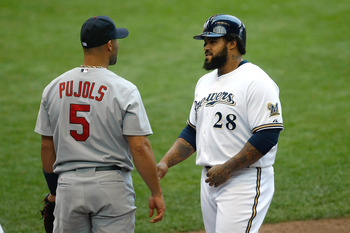
In his ever-pivotal walk year, the Prince put on a show.  Ever wonder how Ryan Braun really beat Matt Kemp in the MVP race, even though Kemp's stats were better?  Look no further.  Providing Braun with ultimate lineup protection, Fielder walked more than he struck out in 2011 (highly rare for a power hitter) and blasted 38 homers and 120 RBIs while slugging .566.  It's no wonder that a feared power hitter like Braun, who bats directly in front of Fielder, went the whole season being intentionally walked just twice.  If I were a pitcher, I wouldn't want to face the Prince either.  Competition: Albert Pujols (STL), Carlos Pena (CHC), Joey Votto (CIN), Lyle Overbay (PIT), and Brett Wallace (HOU).

2B Brandon Phillips, CIN
Who's the best shortstop in the NL Central?  Why of course, it's Dat Dude BP!  Brandon Phillips, who entertains fans on Twitter with the aforementioned handle, enjoyed one of his best seasons in a year that found him taking home his first Silver Slugger and his third Gold Glove after making his second All-Star appearance in July.  Besides continuing to be a 20-20 threat and a consistently clutch run producer, Phillips batted .300 for the first time in his career.  His positive leadership and attitude and vital traits to the Reds organization at the moment as its future is unclear.  Way to go, Brandon.  Competition: Skip Schumaker (STL), Neil Walker (PIT), Jose Altuve (HOU), Darwin Barney (CHC), and Rickie Weeks (MIL).

3B Aramis Ramirez, CHC
Ramirez had another slow start in the power department for the second year in a row.  This time, however, his swing was looking good and his mechanics were correct, he just wasn't clearing the wall for whatever reason.  The Chicago weather heated up around the same time his bat did, though, and he finished with 26 homers.  A rare breed of the low-strikeout slugger, Ramirez struck out only 69 times.  In his final season with the Cubs he cemented his place as one of the Cubs' great third basemen of all-time.  Competition: Scott Rolen (CIN), David Freese (STL), Casey McGehee (MIL), Pedro Alvarez (PIT), and Chris Johnson (HOU).
NL Central SS: Starlin Castro
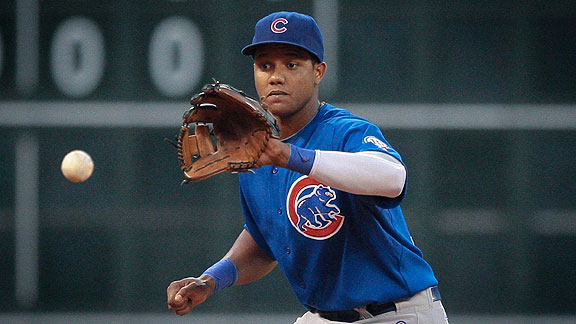
SS Starlin Castro, CHC (2nd)
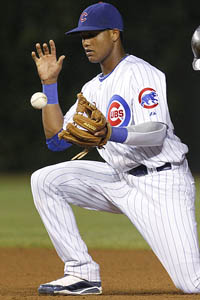
In one of the better breakout performances of 2011, this sophomore was the National League's hit king with 207 knocks.  Developing power began to show its potential as the season went on, and much improved baserunning skills showed the makings of a franchise player.  While defense is still an issue, it was better than it was a year before and strides of improvement can be expected for 2012.  With so much raw talent, there's no telling the ceiling on this guy's future.  If 2011 was just the beginning, it was pretty awesome.  Competition: Clint Barmes (HOU), Ryan Theriot (STL), Yuniesky Betancourt (MIL), Ronny Cedeno (PIT), and Paul Janish (CIN).

LF Ryan Braun, MIL
Steroids, anyone?  Even if Braun took performance-enhancing drugs during the 2011 season, it was exciting to watch while it lasted.  He took the middling Brewers to the NLCS and led the best team in the league for most of the season.  Braun put up above average numbers even for power hitters but perhaps more impressive was the .397 OBP, which meant runners on base for the batters behind him, most notably the Prince.  An outburst of speed at age 27 also had pitchers distracted.  Competition: Alfonso Soriano (CHC), Carlos Lee (HOU), Matt Holliday (STL), Ryan Ludwick (PIT), and Yonder Alonso (CIN).

NL Central CF: Andrew McCutchen
CF Andrew McCutchen, PIT (2nd)
McCutchen put it all together in his second full season.  The Pirates, who surprised the world with their contention into July, relied on McCutchen's 20-20 talent everyday.  His energy invigorated a dead Pittsburgh franchise and the winning ways will be back sometime soon as long as Andrew McCutchen is in center.  He revealed a newfound patience in 2011, a tool that eludes most young power-speed dual threat players.  Competition: Jason Bourgeois (HOU), Marlon Byrd (CHC), Nyjer Morgan (MIL), Drew Stubbs (CIN), and Jon Jay (STL).

RF Lance Berkman, STL
Say what?  I was thinking the Cardinals' signing of Berkman - to start in right field, no less - would be something along the lines of disastrous.  Apparently Berkman still has game though, and he proved it with an incredible .412 OBP and 31 homers, batting .301 overall.  His defense was okay in right field, but his offensive production far outweighed any criticism there.  Playing 145 games, he also walked 92 times, among the leaders in the NL.  This was simply one of the best offensive seasons in baseball, not just of right fielders or comeback veterans.

SP Matt Garza, CHC
The NL Central was a surprisingly weak division for starting pitchers.  Garza, though, was huge for his team.  In a Cubs rotation that essentially imploded with the loss of the #4 and #5 starters in the first week of the regular season, Garza provided stability and consistent outings all season long.  In return, he earned some of the worst run support in the NL.  Being a leader and ultimate team player, however, was not lost on this writer.  Competition: Yovani Gallardo (MIL), Chris Carpenter (STL), Kevin Correia (PIT), Bronson Arroyo (CIN), and Wandy Rodriguez (HOU).

CP John Axford, MIL
Any Cubs fan who watched the Cubs fail in Milwaukee last season got to see a load of this guy, but not for very long because the Cubs were little resistance to Axford's dominant ways.  He finished the season 46-for-48 in saves with a 1.95 ERA, striking out almost four for each batter he walked.  The Brewers can't ask for much more out of this 6-5 beast who seemingly came out of nowhere to become the shutdown closer on the NL's most complete team.  What a stud.  Competition: Carlos Marmol (CHC), Mark Melancon (HOU), Francisco Cordero (CIN), Jason Motte (STL), and Joel Hanrahan (PIT).


That does it for another installment of the MLB All-Division Team!  Next up is the AL West, followed by the NL West and finally a summary of the whole thing.  

Friday, December 16, 2011

Fit For a Prince, Or Was Yu da Man?

Prince Fielder would a better player to
build around than Yu Darvish.
Cubs pursuing first baseman Prince Fielder and pursued starter Yu Darvish; which move would have made more sense?


Two of the top free agents remaining in the winter free agent pool were being actively pursued by the Cubs, at least until one of them fell off the board officially earlier today.  Darvish, 25, is a right-handed starter who was the ace of the Hokkaido Nippon Ham Fighters in Japan since 2007 (his first full season), going 93-38 over seven total seasons.  Fielder, 27, is the big man from Milwaukee already known for his 230 career homers and supposed weight of 275 pounds (does anyone believe that?).  The Cubs have, through outside reports or press releases, made aggressive strides towards acquiring both.  It appeared before and still does now that getting both was not within the real of possibility for Theo & Co, which leaves the main question; which one actually helps the Cubs more in the short-term and long-term?

Although a great pitcher, no one knows how
well Yu Darvish will adjust to MLB hitters.
If you think the answer is Darvish, unfortunately we'll never find out how accurate that estimation is.  The Texas Rangers (UPDATED) won the exclusive bidding rights for Darvish and now will be the only team with a chance to sign him.  This doesn't mean he is now a Ranger, but it does mean that if Darvish is playing in MLB next season, it can now only be with Texas.  If the Rangers don't work out a deal with him, which is highly unlikely, I think he returns to Japan.  Now it's up to Rangers GM Jon Daniels and the rest of the Texas staff to work out a contract with him.  The Cubs, Yankees, and Blue Jays also placed bids for negotiating rights, but the Rangers appear to be the highest bider.

The negotiating rights process Darvish is going through is very similar to that of Daisuke Matsuzaka when the Red Sox won the negotiating rights for him in the 2006/07 offseason.  Matsuzaka, who was also pursued by the Yankees, signed with the Red Sox after they won negotiating rights, the two deals (negotiating rights and contract) coming at a combined price tag of over $100 million.  Dice-K has been a major disappointment for Boston and has caused plenty of second-guessing in the Darvish sweepstakes.

Matsuzaka was 26 when he signed, and he was hailed as the future ace of the Red Sox, an international star who would only dominate even more with the move to the United States.  How could American hitters possibly solve a pitcher with eight different pitches, analysts pondered.  Apparently they have, and five years into his Red Sox career he has given them just 49 wins on a stunningly mediocre 4.25 ERA.  He has missed significant time to injury each of the last three seasons.

Although Darvish's mechanics and pure 'stuff' would suggest otherwise, he could perform similarly.  At the time of his signing, Darvish was coming off five straight seasons with an ERA under 2.00 in Japan.  At the time of his, Matsuzaka was coming off four straight seasons with an ERA under 3.00.  One would hope Darvish will have more success, and his blistering fastball, drop-dead 12-6 curveball and physics-defying slider would suggest so.  But the possibility lingers that Darvish, like Matsuzaka, will struggle to adapt to American hitters who are more patient and skilled than ones he has faced before, especially in the power department.

Fielder brings a very different type of energy to the team.  Fielder is a known commodity in MLB and especially to Cubs fans who have been watching him grow over the past half-decade.  Since a breakout 50-homer season in 2007, he has been all over the league launching bombs with great regularity and positive swagger.  During the Winter Meetings a friend of his leaked that Fielder is most interested in playing for the Cubs than any of the other suitors, which include the Mariners, Nationals, and possibly Texas.  Then why, you ask, is a deal takin' so dang long?!  First of all, he's a Scott Boras client.  Boras has no problem running out the clock on teams to earn his clients each and every penny that they're "due".  Secondly, the Cubs have been non-committal about Fielder to the media so their interest level throughout the process has probably varied.  The Cubs are now in the mix, but a deal with Boras isn't going to be struck overnight.  We certainly won't see anything like the Albert Pujols-to-Anaheim deal, which saw the Angels make initial contact with Pujols just 36 hours before signing one of the most pivotal contracts in baseball history.

If trying to browse through media to gauge the Cubs' level of interest on Fielder, you're probably getting a lot of crossing signals.  Yes, it's very confusing at this point.  Many things I've heard say the Cubs are involved and in pursuit with intent to sign, while others, like manager Dale Sveum, have come out and said the Cubs are not involved at all.  In my opinion, Sveum is either surprisingly unaware of what his front office is up to or trying to do a cover-up job, and a bad one at that.  He said the Cubs organization has had no contact at all with Fielder, which is definitely untrue.

Whichever way you put it though, the Cubs have had serious interest in both.  In my opinion, the Cubs would be better off with Fielder instead of Darvish.  The fair criticism of Darvish in comparison to Matsuzaka and other recent Japanese pitchers who have fizzled is evidence enough that although he looks impressive now, the transition to MLB hitters is very tough.  This means dishing out big bucks to Darvish is a very volatile move, and if he can't get it together, the Cubs are stuck with another big contract that they don't want.

Even though Fielder also presents the obvious risk of an big contract and is no man invincible to natural decline with age, the level of risk is significantly lower.  If the Cubs had won Darvish, his new team would be thousands of miles away and his new competition would be far better.  If Fielder could track down one of those long-distance suburban taxi companies between Chicago and Milwaukee, he could probably take a cab from Miller Park to his new home at Wrigley.  He would be in the same division and same league, so for him the focus would basically be to continue what he has already been doing his whole career.

Also, what statement does the signing make?  If the Cubs were actually in full rebuilding mode, they would not even be considering these two top free agents.  Because the Cubs are the Cubs, however, and wreak the benefits of being a large-market team and are really the most famous franchise in the National League, they can afford to sign a superstar to build around, which can either accelerate the rebuilding process or send it backwards a few steps.  I think Fielder would be a great character to build around and bring stability to a position that demands it especially after the loss of Aramis Ramirez to those Brewers.

Darvish would have far too many immediate obstacles to become a team leader to build around.  The language barrier is a major obstacle, and a bust deal would reverse the depth issue because the Cubs would have to pay double-digit millions per year for a bad starter eating a rotation spot, similar to Matsuzaka's recent role with the Red Sox.  Although rotation depth is a major problem for the Cubs right now, this was not the right opportunity to fix it.  Thankfully the Cubs have taken a good step in finding rotation depth as they are now talking to Paul Maholm about a contract.  Other targets I would explore are Edwin Jackson, Javier Vazquez, Jon Garland, and Roy Oswalt.

So finally, Prince Fielder is the guy to build around if there is one between these two.  The Rangers winning Darvish rights may not be a bad thing; it prevents possibility of the Cubs making a deal far too volatile for their current losing situation.          

Saturday, August 20, 2011

Jim Hendry Walks On; Randy Bush New Interim GM

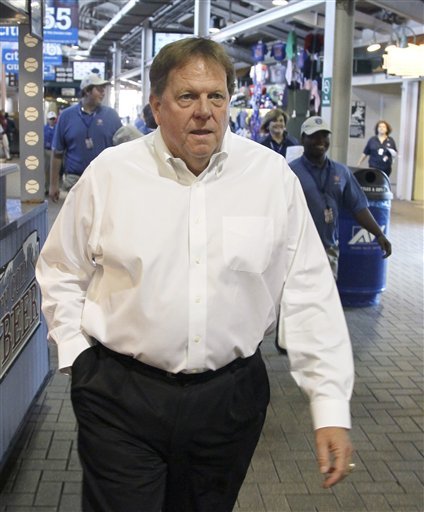
Jim Hendry walks the concourse for the last
time as general manager of the Cubs.
Late August has become a time of change for the Cubs the past two years.  Last August, Mike Quade replaced Lou Piniella as manager.  In a move I never thought would actually happen in season, GM Jim Hendry was officially fired yesterday, ending his 9-year stint with the Cubs.  Assistant GM Randy Bush has taken over on an interim basis but will not be considered for the full-time job as the organization searches for someone outside the organization, said chairman Tom Ricketts at the press conference.

Being general manager of a big market team requires standing up to a lot of scrutiny.  Sometimes you have to make move, regardless of whether you want to or not.  But Hendry was in a very odd spot.  Ricketts told him that he would be fired in mid-July but that it wouldn't be announced until August, after the deadline to sign draft picks and after the non-waiver trade deadline.  So Hendry had to sign all the remaining picks, including top pick shortstop Javier Baez, and make a trade in the Kosuke Fukudome trade, while knowing he was going to be fired.  Now that's loyalty.

Hendry was choked up during his interview at the podium, and he shouldn't be ashamed.  The Cubs under Hendry went 749-748 during his tenure, but he was still their most successful GM in over half a century, building them to three division titles with essentially two different teams.  He brought in two high profile managers in Dusty Baker and Piniella, both of whom had a sizzling start in their first two seasons but faded in their next two.  Hendry, with Baker, came five outs from getting the Cubs to the World Series in 2003.

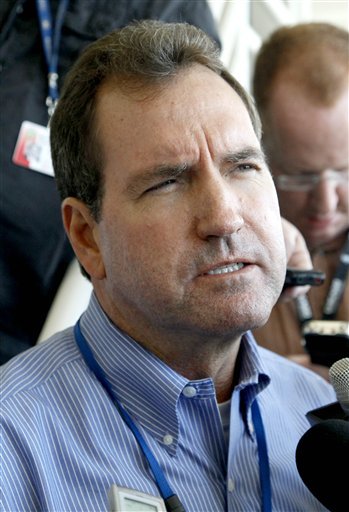
Interim GM Randy Bush
Despite all the success Hendry had, many fans thought it was time for him to go and the team to get a fresh start.  I can see understand the viewpoint, and although I didn't necessarily agree, I think the move sent waves in the form of a wake up call through the organization, specifically the players.  The next GM will be a high profile guy as well, which is a good thing.

The reason I didn't think they should remove Hendry is because, seeing the tough position Hendry was in the last two offseasons because of the large payroll, the Cubs have a bright future.  Of course, the payroll was Hendry's fault, but the draft class this year is one of the deepest they've ever had and lots of ending contracts should make this a bullish offseason.  Hendry was also prepared for the big free agent frenzy also, possibly going after Albert Pujols or Prince Fielder.  But if Hendry had to go, now is the right time.

Right now is a crucial time to get the Cubs back on the winning track, at least at the GM's desk.  With the draft picks signed, it's up to the GM (Bush, for now), scouting director Tim Wilken, VP of player personnel Oneri Fleita, and all of their staff to develop them and get 'em to the bigs as soon as they're ready.  While that is the focus for the next few years, the Cubs obviously have the opportunity to add more this winter in free agency and a new GM will want to prove himself by making a big splash such as a Pujols or Fielder.  Success or failure in these moves will decide the Cubs' success over the early 2010s.

Now the big question everyone wants the answer to is who the next GM will be.  Lists of candidates have already been thrown out there in the media and blogosphere.  Although Ricketts made clear in the press conference that the evaluation process will not be public at all, he did say he wants an experienced executive who comes from a winning culture.  This could include, but is not limited to, Josh Byrnes, Padres VP of baseball operations and former Diamondbacks GM who impressively built the 2007 NLCS team, Jerry DiPoto, Diamondbacks Senior VP of scouting and player development, or Rich Hahn, White Sox Assistant GM.  But if it was up to me, I'd go a different route.

Rays GM Andrew Friedman:
scouting and development master
The turnaround of the Tampa Bay Rays was been constructed by scouting and development.  They went from a 66-96 team to a 97-65 team overnight, and at the helm was GM Andrew Friedman.  In the process, Friedman mastered the art of winning from scouting upwards.  That combined with the free agent buying power and overall resources that the Cubs have, and Friedman could be the best in the business in no time.

Friedman is still the GM of the Rays, but reports have stated that, with the restrictions of the limited revenue sources the Rays have, he wants out.  Time to pounce!  

Wednesday, August 17, 2011

Changing Landscape on the Central Front

The Milwaukee Brewers are 19-2 in their last 21 games and now hold a seven-game lead in the NL Central over the Cardinals, a 12.5-game lead on the Reds and 14-game lead on the Pirates, but the story was drastically different not even that long ago.  On July 24, all four teams were within four games of first place in what was MLB's tightest division.  Now, however, the trade deadline seems to have separated the leaders significantly.

The Brewers, who acquired Francisco Rodriguez most notably before the deadline, are the obvious favorites to win the division now.  The Cardinals swung Colby Rasmus to the Blue Jays in a three-way trade that landed them Edwin Jackson.  In my opinion, this was a very bad move.  While Jackson could be  great rotation depth for a team that has lacked it this season and seasons past, Rasmus was too good to be traded, whether he gets along with manager Tony La Russa or not.  The Cards also acquired Rafael Furcal as a rental to start over Ryan Theriot.  The Pirates released Lyle Overbay after he was replaced by Derrek Lee and acquired Ryan Ludwick in two moves that appear to have backfired as they have dropped out of contention.  The Reds did pretty much nothing at the deadline and have dropped out of contention.  

What does all this mean?  It means that the Brewers should be the only team of the four to make the playoffs.  But if the Brewers don't make it far into the playoffs this season, they might not get another chance.  In case you haven't heard, Prince Fielder will be a free agent after this season, and the Brewers have little to no chance of resigning him.  According to sabermetrics, teammate Ryan Braun is actually slightly more valuable now to the Brewers than Fielder is (since 2007, Braun's 24.8 WAR beats Fielder's 19.1).  But sabermetrics, or any kind of metrics for that matter, can't measure clubhouse influence.  Fielder has played in Milwaukee since 2005 (two years before Braun arrived) and is the heart of soul of an underrated Brewers team.  Fielder showed real promise as a rookie in 2006, then broke out in 2007 with 50 homers, nearly winning MVP and putting his team in contention most of the season.  He nearly single-handedly woke up the Brewers from their early-to-mid-2000s slumber, and his loss to this team would be huge.

Just seven hours down the road is St. Louis, home of Albert Pujols and the Cardinals.  Pujols' WAR since 2007 is 38.0, making Braun and Fielder look mediocre.  Pujols is the longest-tenured player on the Cardinals and probably has been the best player in baseball since entering the league in 2001.  His consistent power and plate discipline for an entire decade has gone untouched until this year, when he landed on the DL in June.  But Pujols is still the best player on the team and one of the best in the league, and his upcoming free agency is a bigger story than Fielder's.  

Although the Cardinals have a better chance to sign Pujols than the Brewers do to sign Fielder, something tells me that Pujols has not been totally pleased with the loyalty shown to him by his front office in recent years.  The exclusive free agent period open for resigning players is not very long after the World Series, and I highly doubt a deal with any team will be done before he's officially open on the market.

The future of the NL Central will be dictated to a certain extent by where Pujols and Fielder land.  If they both walk in free agency, their teams will take a big hit and the power balance in the division will shift.  But the question is, who will be ready to take it?  The Cardinals will still have Matt Holliday and Lance Berkman to control the power department, while the Brewers will still have Ryan Braun and Casey McGehee, but the key cog would be missing on both teams.

Meanwhile, the rest of the division has an opportunity here.  The Astros don't have any talent ready to win, so they won't be taking advantage.  The Pirates got too many unexpected seasons from their pitchers to expect to compete again next year, unless they get some major help from the minors or free agency.  The Reds were supposed to be much better this year behind the power duo of reigning MVP Joey Votto and Jay Bruce.  If they could just add some pitching, they could take the division back next season.  That leaves just the Cubs, who aren't expected to contend next season but could if they sign Fielder or Pujols and add the correct mix of youngsters to the group.

The bottom line is that with Fielder and Pujols possibly on the move this fall, the NL Central, baseball's unfairest division, will be slightly evened out, at least for a couple years.   


Sunday, February 20, 2011

Cardinals, Pujols Strike Out Looking

In what will be the most anticipated free agent in baseball history, Albert Pujols will probably become a free agent after this season just nine months after LeBron James served the same title for basketball.  Pujols and the Cardinals were nowhere close to a deal when his deadline of Wednesday at noon came and passed.   Pujols is looking to cash in the biggest deal in baseball history, which was not what the Cardinals were offering.  Pujols could very well likely become the first player ever to earn more than $30 million per season.

Statiscally, Pujols deserves the largest contract in the history of baseball especially considering that inflation has caused the dollars to mean less.  However, this is still disappointing to me to the point where I cringe when I hear Pujols could be paid $32 or $33 million per year.  To the point where I scowled violently at former Braves manager Bobby Cox last season when he suggested Pujols should earn $50 million a year.  Future Hall of Famer or not, I can't help but wonder if Pujols is worth any of these figures.  He has led the National League in the last two seasons, but had never done it before that.  Ryan Howard, who has actually outhomered Pujols by 22 since 2006, will only be making near $25 million per year on his new deal.  Sure, Pujols is a better average hitter with a much better eye and doesn't strike out much, but is that worth the near $10 million extra he will be paid?  Or is it just part of the fame of being a free agent in such a position of power?  Even with Pujols, is it arrogance?

I think Albert Pujols is a great person and although he isn't the funniest or most interesting guy to listen to in a press conference or interview, that's not a bad thing.  Pujols has never been pegged as arrogant before and isn't one to get into confrontations with anyone, including opposing players.  But with this stubbornness about getting the largest deal ever, I can't help but to be disappointed that he is turning down this path of greed and selfishness that many free agents go down.

Luckily for the Cubs, the ridiculous $32-$34 million price range could be money the Cubs would be willing to spend.  With plenty of money coming off the books after 2011, including the bloated contracts of Kosuke Fukudome and Aramis Ramirez, there will be room in the budget to go after Pujols.  Signing Albert Pujols would be unbelievable, and the media attention that would follow would rival insanity.  In case you were wondering, the contract with Carlos Pena is for only one year, leaving room for the Cubs to go after Pujols or their Plan B, Prince Fielder.  Was this an intention move by GM Jim Hendry for exactly that purpose?  Food for thought.  Many fans will be happy to see Pujols be paid 'what he deserves', but I won't be one of them.  I don't know how much money Pujols really 'deserves', and nobody does.  Nobody can.  But two-time MVP, World Series Champion, future Hall of Famer or not, $33 million a year is hard to stomach.

Also: Read Mike Wilbon's article on why his hometown Cubbies should sign Pujols.

Sunday, February 6, 2011

2011 Cubs: Bold Predictions

This season's edition of the Cubs should be an interesting one.  With this season's fate to be most likely decided upon the play of unpredictable young players, it could really go anywhere.  I think these Cubs could win 90 games; I also think they could lose 100.  But the difficulty of these predictions is what makes them fun; one must visualize their own results, play it out in their own mind.  When I see these Cubs, here's what I see.  The following ten predictions, some more realistic than others, are in no particular order.

1. Starlin Castro will steal 25 bases.
Castro, known for his raw speed, didn't have much luck stealing bases at the Major League level in 2010.  Being thrown out eight out of 18 tries and being picked off multiple times, it was clear Castro has some work to do when it comes to knowing when to run and how to recognize pitcher pickoff moves.  This is something Mike Quade and his staff will surely work on in Spring Training, however, because Castro's speed may be the only real speed on this team.

2. The 2011 season will be Marlon Byrd's last as a Cub.
Byrd is known for his great clubhouse chemistry and attitude towards the game, and his fielding range in center field is outstretched by very few.  Clearly this sets a great example for young teams looking for a leader.  And although Byrd's contract with the Cubs runs through 2012, I see him being traded in most scenarios the Cubs could run into this season.  If the Cubs are well out of contention, he will be dealt at the deadline in July.  If the Cubs hang around and hover near .500, he will last the season but be traded in the offseason to beef up the pitching or veterans in the field.  If the Cubs win the division and play very well all season long, he will probably stick around.  But as we know, that's highly unlikely.  Why would the Cubs want to trade Byrd?  Because center fielder Brett Jackson, the Cubs' 2009 1st Round Draft Pick, is rapidly on his way towards the Majors.  Jackson's five tool ability makes him the perfect fit for the center field at Wrigley Field.  There probably isn't room for both Jackson and Byrd in this town.

3. Carlos Zambrano, Ryan Dempster, and Matt Garza will combine for 45 wins.
In the rotation for a full season barring injury, all three are locks for 10 wins.  Garza will be moving to the National League and out of the hitter-happy AL East, meaning he should only get better.  Considering he already wins 15 games in that AL East, there's no reason why he shouldn't in the NL Central.  Ryan Dempster also had a 15-win season in 2010, his first since 2008 but only the third in his career.  Dempster has never had a stretch of three seasons as dominant as the last three in his career, and actually posted a career high in K/9 innings at his 2010 age of 33.  He should be able to get there.  Carlos Zambrano for 15 wins?  I know it sounds like a stretch.  But Zambrano learned how to pitch last season; like actually learned to locate.  His fastball might top out at 90mph on a given night, but unlike earlier years, he can still win with that. Keep that in mind heading into this season, and I see these three being an a-okay trio at the top of the rotation.

4. The 2012 Cubs will make the playoffs.
It's as simple as that.  Although Carlos Pena is a free agent after 2011, this could mean the Cubs will want him back on a long term deal or, more likely, the Cubs will go after free agent Prince Fielder.  Either move should give the Cubs enough to contend in 2012.  2009 1st Round Draft Pick Brett Jackson should be in the Majors at some point in 2012, and he will be a special player who should make an impact immediately.  Another year of progression for Starlin Castro, who should be a star by then, will also help.  The Cubs' strong farm system, still strong despite dealing three of its top ten prospects to Tampa Bay in the Garza trade, has many pieces that will be contributing soon.

5. When the Cubs jokingly said they would have to retaliate by throwing at Cardinals shortstop Ryan Theriot for his criticism of the Cubs, they weren't kidding.
The scrappy Theriot isn't hard to miss, but his radio appearance on a St. Louis radio show was.  Theriot, just sucking up to Cardinals fans upon arrival, said that it felt great to "finally be on the right side" of the Cubs-Cardinals rivalry.  While it was no specific attack on the Cubs, Cubs players took offense to it.  Mike Quade is going to get his squad more emotionally pumped than Lou Piniella did, and retaliation to Theriot's comments could be an excuse for these Cubs to give the Cardinals a wake-up call and send a message that it isn't just St. Louis and Cincinnati for the division title.

6. By a wide margin, Kosuke Fukudome will lead the lead in bench warming, even if he is traded at the deadline. 
Tyler Colvin didn't show us all of his potential in 2010 and became less effective at the plate as the season went on.  Colvin will continue to develop and have an even better season in 2011.  While Fukudome can get on base, this is pretty much all he offers offensively.  That is a highly-regarded trait at the Trade Deadline, however, so he could be moved for his defense and on-base percentage.  Colvin's play will demand starting everyday while Reed Johnson actually offers more defensively than Fukudome does, making Fukudome dispensable.

7. These Cubs will prove that they actually do have emotions, and will show them.
This ties in to #5 as well.  The 2010 Cubs, for most of the season, appeared to be many of the 'living dead'.  The Cubs were on pace to lose well over 90 games, and yet with the exception of Carlos Zambrano there was no frustration to be seen on or off the field from the players.  This showed the fan base that the players didn't care enough, and the fans responded by not coming to games.

8. The current tandem at second base, Blake DeWitt and Jeff Baker, will fail.  Neither will be starting at second at the end of this season.
It's already clear that second base will be a major offensive weakness for the Cubs, and two below average hitters won't cut it.  The plan is to play DeWitt against righties, Baker against lefties.  It won't work because DeWitt can't hit enough to sustain a starting job (or platoon for that matter) and Baker's power contributions probably will be few and far between.  For a hitter like Baker who can hit for power when he gets in a roll, it's hard to build an base of consistency when you play around every other day but could go five days without playing.
 
9. You will have a sudden urge to splurge for that $15 replica helmet stuffed to the brim with loaded nachos.
See?  Your mouth is watering already.  Whether the Cubs are winning or not, there's nothing like a nice distraction.  The food options at Wrigley Field are, slowly, getting better.  And if you haven't tried this monster bowl yet, do it just once.  It's more experience than food, and hey, it's a darn good conversation starter.

10. The Cubs will finish at .500 or above, but miss the playoffs. 
The Cubs have talent there; the key will be getting a swagger back.  The whole 'Sweet Lou' and 'It's Gonna Happen' swagger of 2008 took a huge hit with the playoff loss to the Dodgers and was gone after a depressing 2009 season.  There was little to no swagger of the 2010 Cubs and this is something every winning team needs.  These Cubs will be younger than teams before, and young players bring energy.  This energy could by what the Cubs are fueled by.  The talent the Cubs do have is not stronger than that of the Reds, Cardinals, or even Brewers.  But we haven't seen the potential of hardly any of the prospects yet, and these Cubs could go anywhere.  If I have to make a prediction, I say they're a .500 team.

Wednesday, February 2, 2011

Hot Stove Buzz #6

After a sad start to their offseason, the Tampa Bay Rays have turned it around and made some moves to possibly keep themselves in contention after all.  After watching the majority of the talent on the 2010 Rays leave in Rafael Soriano, Dan Wheeler, Carlos Pena, Randy Choate, Grant Balfour, Joaquin Benoit, Dioner Navarro, J.P. Howell, Brad Hawpe, and Carl Crawford all leave via free agency, the outlook for the 2011 Rays looked bleak.  But in the last week, the Rays and their fans have gotten some hope in the form of the signings of Johnny Damon, Manny Ramirez, and Felipe Lopez.  Damon and Ramirez, former teammates on the Red Sox, both won World Series rings in 2004.  Damon got another one with the Yankees in 2009, although both have been all over the postseason in the past decade.  Lopez has never been in the playoffs, but has the same winning attitude that Damon and Ramirez have which is exactly what the Rays are looking for.  While I think Damon and Ramirez have a lot more potential remaining for offensive production, the motivation and confidence of the two have come into question in recent years.  Lopez has not had these problems, but definitely doesn't bring as much to the table at the plate or in the field.

When first reading that the Rays were close to signing such big names as Manny Ramirez and Johnny Damon, clients of superagent Scott Boras no less, I was surprised.  I'm sure many other fans were too, seeing as they are the Rays and have only been mentioned in the same breath as winning in the past three years.  However, after further review, the Rays actually have a history of going after high profile veterans.  Remember which team Wade Boggs got his 3000th career hit with?  Which team sluggers Jose Canseco and Greg Vaughn played on together in 2000?  Which team was the front runner to sign Barry Bonds after his finish with the Giants in 2007, although a deal was never reached?  Prior to now, it would be hard for me to see why a free agent would want to come to Tampa Bay considering how bad they were for the majority of the 2000s, but perhaps it was seen as a rebuilding challenge for an old veteran wanting a challenge.  Other recent news and notes:

-Jermaine Dye would rather retire than play in the Minors, a preference he also had last winter.  The Cubs and Brewers both gave him Major League offers last winter, but he didn't sign with either and sat out the season.  "I'm still working out.  I'm still in shape.  I'm still motivated," said Dye, although many teams aren't sure motivation is enough for him to earn a Major League contract offer.  Now 37, many scouts aren't sure Dye can hit well enough to deserve a full time job.  After a strong first half, Dye's second half of 2009 was very bad and that doesn't help his cause now either.

-In Bruce Levine of ESPNChicago.com's chat with fans regarding the Cubs and White Sox, there were a few interesting ideas thrown out there.  A fan asked Levine if the Cubs were "any closer" to signing shortstop Orlando Cabrera, to which Levine replied that he hadn't heard anything suggesting so.  But this sparked that idea to me; why not sign Orlando Cabrera to play second base?  Currently, the Cubs have three potential seocnd basemen in Blake DeWitt, Jeff Baker, and Darwin Barney.  DeWitt is only 25 but has little potential, Baker is 30 but never really had any potential unless he's facing a lefty, and Barney has potential but has little experience.  In a wacky and wild idea, the Cubs could dump DeWitt and Baker to anyone who will take them and let Cabrera and Barney man second base.  Just an idea.

-Albert Pujols on the Cubs?  Another idea from that chat is to have the Cubs make an aggressive push for Albert Pujols next winter.  Quite an interesting idea, especially considering the Cubs will have the financial flexibility to do it.  Prince Fielder will also be a free agent and has actually been realistically mentioned by experts as someone the Cubs could go after.  Could signing one of these two be the reason Carlos Pena was given only one season?  Will Tom Ricketts be aggressive enough to go after one of these two?  And finally, with Derrek Lee, Carlos Pena, and Micah Hoffpauir gone after 2011, who else would play first base in 2012?

-While the Cubs wanted to upgrade defensively at first base by signing former Ray Carlos Pena, the Rays also wanted to upgrade defensively by signing the best defensive first baseman of all time in Casey Kotchman.  That's too bad, because no matter what they'll have to downgrade after Kotchman.

-Alexei Ramirez was handed an extension of 4 years, $32.5 million with the White Sox.  At around $8 million per year, Sox fans are calling it a bargain.  It might be considering his offensive production power-wise is great for his position, and although he doesn't steal bases too well he is great defensively.      

Tuesday, June 22, 2010

First Basemen Front and Central

The first basemen of the central divisions of baseball may be as stacked as they ever have been in the history of baseball.  Ferocious power hitters and tenacious defenders, these guys have their names all over the offensive leaderboards.  All eleven of the eleven central teams have a great first baseman.

National League
The first basemen of the NL Central have combined for 69 homers this season, including 15 by Albert Pujols and Joey Votto each, 10 by Garrett Jones and Derrek Lee each, 6 by Lance Berkman and 13 by Prince Fielder.  St. Louis' Pujols, a three-time MVP of the NL, can be counted on for consistent power production like this for years to come.  Votto is one of the NL's top young stars, leading the Reds in their push for first at age 26.  Fielder, also only 26, has had great power for years now and became one of few Milwaukee Brewers to hit 50 home runs in a season back in 2007.  Derrek Lee, who mashed 46 HR in 2005 and 35 HR in 2009 on the Cubs, really hasn't hit as well as anyone would've liked him to in 2010 but he got hot this last weekend and looks to keep his roll going.  Lance Berkman is on the downside of his career at 34 but still is the main run producer for a failing Houston Astros offense.  Jones took Pittsburgh by storm in 2009 after his summer call-up, a thrilling young talent who, with Andrew McCutchen, has given something for Pirates fans to root for.

American League
The first basemen of the AL have combined for 65 home runs, including 7 by Billy Butler, 17 by Paul Konerko, 8 by Travis Hafner, 19 by Miguel Cabrera, and 14 by Justin Morneau.  Butler is the offensive face of the Kansas City franchise, a young slugger with dominant power still in developing stages.  Paul Konerko is having a big comeback year, flashing back to his 40 HR days of old.  Morneau is leading the AL in walks and has become a perennial fixture for the Twins.  Hafner's career has been damaged much by injury, and he hasn't played a full season since 2007 but could be getting back to his old productive self.  Cabrera has been the best offensive player in the American League in 2010.  If the Tigers make the playoffs, he is my surefire MVP.  His 19 HR and 60 RBI lead the AL, and the .328 AVG ain't too bad either.

Significance?  69 HR by NL 1B, 65 HR by AL 1B.  What's the big deal?
Well, many scouts and baseball personnel like Ryne Sandberg agree, power at the corners is crucial.  Ryno's theory is simple: power in the corners (1B, 3B, RF, LF) and speed and defense up the middle (C, 2B, SS, CF).  There is more power in the Central than any other division in both leagues, where there are 59 HR from the NL East (Ryan Howard, Ike Davis, Adam Dunn, Gaby Sanchez, and Troy Glaus) and 44 HR from the NL West (James Loney, Aubrey Huff, Todd Helton, Adam LaRoche, Adrian Gonzalez).  In the AL, there are 49 HR from the AL East (Kevin Youkilis, Mark Teixeira, Carlos Pena, Lyle Overbay, and Garrett Atkins) and 26 HR from the AL West (Daric Barton, Mike Napoli filling in for Kendry Morales, Justin Smoak, and Casey Kotchman).  While steals are on the rise in today's game, the home run ball is becoming underrated as the home run in critical in the winning formula.  With no power, there are no wins.  With no power, you get the 2010 Seattle Mariners who are last in the league in home runs and their home run leaders are Milton Bradley and Mike Sweeney with a whopping six.

The Final Home Run Stats
AL East: 49
AL Central: 65
AL West: 26

NL East: 59
NL Central: 69
NL West: 44

Want more on home runs?
Check out hittrackeronline.com and tatertrottracker.com for all the stats you want.