Showing posts with label rizzo. Show all posts

Monday, March 12, 2012

2012 Cubs Preview: Management/Intangibles

The days of the celebrity manager are gone on the North
Side, but Dale Sveum is a respectable guy who will
get things done.
New staff onboard for rebuilding process

Changes are all around the Cubs management heading into this season.  In the dugout, most of the team coaching staff has changed.  Bullpen coach Lester Strode is the only member of the staff who has been there since before 2010.  The rest of the staff consists of manager Dale Sveum, hitting coach Rudy Jaramillo, pitching coach Chris Bosio, first base coach Dave McKay, third base coach Pat Listach, bench coach Jamie Quirk, bullpen catcher Andrew Lane, and another bullpen catcher who is apparently yet-to-be-named.  

In the grand scheme of things, these coaches may seem irrelevant, seeing as it's the players who determine how many games the team actually wins.  Keep in mind, however, that these major league ball players aren't just superstars in their own world; they are on a sports team, and subject to orders of their coaches.  Unless you're name is Aramis Ramirez, you're going to listen to many of the pieces of advice your coaches give you.  Either that or you can take it up with the AAA coaches.

Plus, these coaches could also be on their way to higher positions in baseball.  Not all of them turn out to be great successes, however, as waving a runner home is definitely different than motivating a rebuilding team into the playoffs.  Not even two years ago, though, a certain Mike Quade was still to be found standing at third base whispering in the ears of Cubs players.  Like I said, not all of them turn out to be great successes.

It was time for some change down there.  I do believe that the manager has far, far more influence on the team than any other single coach.  A manager makes the calls on playing time so players want to impress the manager, while still staying as far away as possible.  It's nearly impossible to tell if success or failure of a team takes responsibility on the coaches.  For example, Jaramillo came to the Cubs widely regarded as the best hitting coach in the league, fresh off leading famous Texas Rangers teams to leading the league in category after category year after year offensively.  In Jaramillo's two years as Cubs hitting coach, it's been hard to tell the difference as the offense has stayed mediocre.  

Pitching coach Chris Bosio works with Matt Garza.
Off the field, the Cubs are in good shape.  I've talked a lot about president of baseball operations Theo Epstein and general manager Jed Hoyer; they know what they're doing in this rebuilding process and will do what it takes to get us there.  I just hope fans keep faith as this process will take time.  Meanwhile, however, they'll set us up with some interesting pieces to look at.  Third baseman Ian Stewart is intriguing.  If he has a 30-homer season in Chicago, which he is certainly capable of, people will know his name.  Because right now, the new Cubs are unknowns.  It used to be easy; Ramirez and Lee were the starting infield corners for seven years.  But Stewart and LaHair?  It doesn't have the same ring.  It will, though, and if it won't, then Hoyer and Epstein will find someone whose name will resonate with the fan base.  That's how you know the Cubs are in good hands.

A problem for this team is speed.  The 2012 Cubs will not steal many bases.  They will definitely be the bottom 10 teams in the league in steals.  If Joe Mather beats Tony Campana for the last spot on the roster, then the Cubs will be in the bottom three.  

In fact, offense overall will be a struggle on this team.  54 home runs from a year ago walked out the door when the Cubs let Carlos Pena and Aramis Ramirez walk.  Stewart, LaHair, and Anthony Rizzo are capable of reaching that number, but they are certainly not known commodities like the previous two.  Give Hoyer and Epstein credit for taking a risk on a couple of relatively unknown players.

Pitching-wise, this season will be an interesting one.  The starting pitching will not be particularly good, but at least the players in it play a role in the team's long-term plan.  This is why I would suggest to never start veteran Rodrigo Lopez or setup man Jeff Samardzija.  Last season, a lack of depth saw the Cubs need to scramble Ramon Ortiz, Doug Davis, and Lopez as stopgaps in an emergency injury stretch.  Hopefully that will never, ever happen again.  The newer starters for the back end of the rotation in Travis Wood, Chris Volstad, Paul Maholm, and more, all have a future with the Cubs.  This way all of their experience earned now can impact the future Cubs teams, and not the retirement home or another team.

Many are saying that "it'll get worse before it gets better" for the Cubs.  I have to disagree.  Record-wise, I would expect a similar finish to last year.  In the vibe of the team, however, there will be a knowledge of a bright future ahead.  The festive Wrigley atmosphere knows that better days are coming.  Last year, the desperation deals for Matt Garza and Pena caused confusion and didn't really leave the Cubs an identity.  They weren't ready to contend, but just made two aggressive moves as if so.  This year, the idea is rebuilding.  Whether or not Sveum wants to accept it (which he doesn't), that is the plan, and there will be no more desperation moves that cleans out our farm system - at least, not for a while.          

Friday, February 24, 2012

2012 Cubs Preview: Infield

Shortstop Starlin Castro
Rebuilt, unproven group looks to make lasting impact

If there's one thing for sure about this infield, it's that the times are a-changin' at Wrigley.  None of the four starters on the infield from just two years ago are still in the organization.  On Opening Day 2010, Derrek Lee started at first base, Mike Fontenot started at second, Ryan Theriot started at shortstop, and Aramis Ramriez started at third.  Lee, Fontenot, and Theriot were all traded midseason; Ramirez played through 2011 before leaving as a free agent and signing with Milwaukee.  The starters now are less familiar to the Cubs faithful, a younger group that will work hard all the same.

Starting at first base, for the time being, will be 29-year-old Bryan LaHair, a career minor leaguer who has had very little playing time in the majors.  In fact, the only major league action he's seen besides last year's 20-game trial was in 2008 with Seattle.  

First baseman Bryan LaHair
LaHair has a chance to prove he should have been in the major leagues all along, however, if he produce with his massive power potential.  He has hit at least 25 homers in each of the last three seasons in the minors in AAA, including 38 last year to make him the Pacific Coast League MVP.  He also boasted a .331 average and a .405 OBP, rounding out an excellent season overall. This hard work earned him a trip to the major league Cubs, and he didn't disappoint, blasting a huge game-tying home run in the bottom of the 9th inning to ruin Cincinnati pitcher Mike Leake's shutout.

With LaHair, the power potential is there.  His defensive and all-around offensive skills, however, remain to be seen at the major league level.  He will most definitely have to make adjustments as the season goes on; pitchers aren't going to leave a hitter like this with too many fastballs in the middle of the plate.  His key will be hitting breaking pitches; namely curveballs, which he seemed to have some trouble with last season.

First baseman Anthony Rizzo
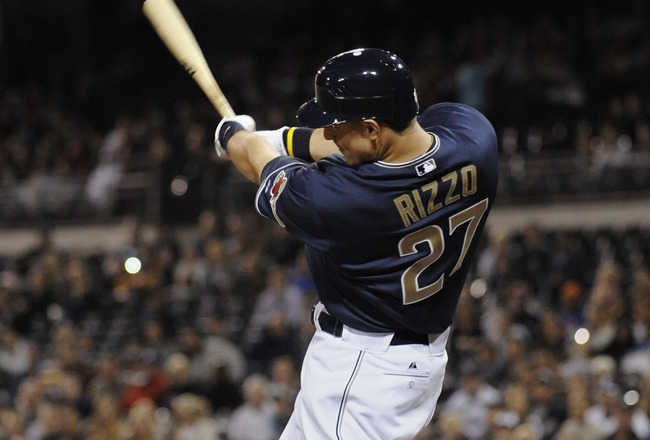
LaHair is exciting in his own right, but top prospect Anthony Rizzo is waiting in the wings to steal his job.  Rizzo was acquired from San Diego for another top prospect in starter Andrew Cashner.  Rizzo has monster power potential as well.  Last season he hit .331 with 26 homers and 101 RBIs for AAA Tucson in only 93 games.  The Theo & Jed brain trust resonate well with Rizzo, as Theo drafted him in Boston, then traded him to Jed in San Diego in the Adrian Gonzalez trade, and now they have gotten him back together.  

Some critics point to his major league trial in 2011 and raise red flags on his potential.  In 153 at-bats
 Rizzo batted only .141 with one home run, and I think all of the hype surrounding himself may have gotten to him.  That is not enough playing time for him to be judged on his future.  He still has the most polished talent of any prospect in the Cubs' system right now, and he'll make an impact soon.  The Cubs brass has said he'll start the season in the minors, but he hopes to change their minds with a strong Spring Training.

At second base, the story one year ago was the battle between Blake DeWitt and Darwin Barney.  There was DeWitt, the chronic underachiever in the big leagues who offered little offensive value and not as much effort as you would like on the field, and Barney, the younger option who was unknown offensively.  I endorsed Barney, and I'm still glad with that choice.  Although Barney isn't a great hitter, he made great contact last year and showed 100% effort all the time, using his superior athleticism. 

Second baseman Darwin Barney
I expect Barney's offense to continue to improve after it tailed off at the end of last season.  DeWitt's role this season, if there is one for the major league Cubs, remains to be seen.  He saw time at second base, third base, and left field last season and should again play numerous positions.  His .385 career slugging percentage shows he doesn't have hardly any pop in that bat; if he wants to make himself more valuable to the team, I suggest he become more patient to draw more walks and get on base.  

I also like what I've seen and heard about second baseman Adrian Cardenas, who could oust DeWitt for the utility role.  Cardenas has never played in the major leagues but did play left field, shortstop, third base, and second base for AAA Sacramento in the Oakland A's system.  He is two years younger than DeWitt at 25 and was claimed off waivers from Oakland earlier this month.  To make room on the 40-man roster, DeWitt was designated for assignment.  

Cardenas has a career .303 average and a .368 OBP in the minors, both good marks for a middle infielder.  Overall, if the Cubs are going younger and newer, Cardenas is the guy that should make the roster.

Second baseman Adrian Cardenas
As shortstop, the situation isn't nearly as confusing.  The cornerstone of the franchise (for now, at least) is the shortstop Starlin Castro who will be entering just his third season in the major leagues.  After a superb, All-Star 2011 season in which he nabbed the NL hits crown, Castro looks to build both offensively and defensively to become an MVP candidate sometime in the future.  Despite being super-athletic, agile and speedy, he has a lot of work to do on both sides of the ball.  

Offensively, he needs to develop more power to take his game to the next level.  If he could reach 20 homers per season, he would be in the same conversation as elite shortstops like Hanley Ramirez.  Defensively, he definitely needs to work on his accuracy.  He can fire the ball across the diamond like any other raging 22-year-old, but finding the glove is obviously key.  If he could even get his arm accuracy into the average range, his wide range at shortstop would make him an elite defender overall.  This kid doesn't need too many days off, but Dale Sveum should sit him at least once a month.  He was only yanked from a game after starting it once last year and that was in the 12th inning, so I wouldn't expect to see much of that, either.

Third baseman Ian Stewart
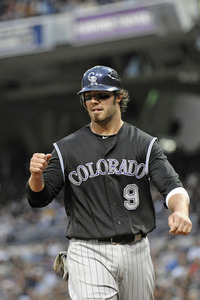
At third base, newcomer Ian Stewart will get the bulk majority of the playing time.  Stewart replaces the long-standing Aramis Ramirez who spent over eight seasons at the hot corner for the Cubs.  Stewart is coming off a horrible 2011 in which he didn't hit any homers in 48 games for Colorado.  He was highly-regarded as a prospect in the Rockies system, however, and hit 25 homers for the 2009 Wild Card champion team.  In Baseball America's 2005 prospect rankings, Stewart was #4 overall with vast power potential, coming off a 30-homer season in A ball at the age of 19!  In that same 2004 season he threw in 19 steals and a .398 OBP, but he hasn't been able to match that success since.  He has still been good with home run totals in the high teens, but couldn't recreate that monster season.

Stewart returned to the minors in 2011 for the first time since 2008.  He definitely showed that his injuries hadn't erased his talent with 14 homers and 42 RBIs in only 45 games, and he does walk more than most third basemen.  If he can unlock his power potential he showed early in his career and in 2009, this 27-year-old could be primed for a career year.

Cardenas and Jeff Baker should provide backup here.  I have never been a fan of Baker's because he's such a non-factor offensively, but I do have to admit that he has nice value to give lefties a day off against a lefty starter.  Baker has drastic righty-lefty splits, and his numbers against lefties are far more impressive.  In his career he's batting .309 against lefties and .239 against righties, while slugging a respectable .526 against lefties but only .364 against righties.  Of the 11 home runs he has hit while on the Cubs over two and a half seasons, all but one have come off a southpaw.

Well, there will be a lot of new faces around the infield this summer for the Cubs.  Of the seven players mentioned here, three were acquired this winter.  It's definitely a younger group, as Baker, 30, is the oldest player out of the entire group.  Although losing one of the team's core players over the last decade in Ramirez was a big loss to some, it was the right move in the long run.  The team needs to get younger and more athletic to build its own culture.  If Ramirez were one of the 'nice guys' of baseball and pledged to help the young kids learn the ropes, we might have a different story.  But then again, Carlos Pena is a 'nice guy', and he was let go of anyway.  It's up to the 22-year-old Castro to welcome his new teammates in.  He should get used to them too, because most of them are here to stay.    


Tuesday, January 17, 2012

Why Reed Johnson Should Have Gone Out On Top

I'm probably not on the same page as most other Cubs fans on this issue, but I think there's something to be said against the resigning of Reed Johnson, which took place a couple weeks ago.  So far I've been complementing the Cubs on pretty much all of their offseason moves, including the signings of Manny Corpas and Andy Sonnanstine and the trades of Sean Marshall and Tyler Colvin.  I did have reservations on the David DeJesus deal, but there are some things I like there, like his versatility and consistent approach.  The Johnson deal, however, simply doesn't make sense to me.  I'll explain why.

Johnson will be 35 in 2012, entering his fourth out of five seasons with the Cubs (he played with the Dodgers in 2010).  An unquestioned fan favorite who has a knack for clutch offensive skills and all-out, aggressive defense, he is a fundamentally strong baseball player.  Of the five tools, only his contact hitting and defense stand out.

I was formally introduced to Johnson in June 2005 as he hit a three-run homer at Wrigley Field with the Toronto Blue Jays.  He made a much bigger name for himself, however, once he came to a market that would truly appreciate his talent in the North Side of Chicago.

I have always been a Reed fan myself; it's hard not to be when he's the only one who operates at 110% of his ability on defense.  However, the Cubs just recently had a logjam in the outfield in 2010 as Kosuke Fukudome and Tyler Colvin battled for at-bats in right field.  Seems like the Cubs are asking for another one.  Sure, Johnson doesn't need many at-bats or hardly any starts, but he also shouldn't warm the bench for a week straight.

Personally I'd rather see Tony Campana, who was projected as the fourth outfielder, to fill the role that Johnson will in 2012.  Campana, although raw and unknown in potential, is young and has something to prove, unlike Johnson.  Campana's speed factor, which produced 24 steals in very limited playing time last year, is very valuable to a roster that seriously lacks it.  While Johnson plays hard on defense to the naked eye, his defense stats tell that he doesn't field it like he used to.  Johnson's range factor and fielding percentage were both below league average, not to mention a -.1 defensive wins above replacement compared to Campana's .9, even though Johnson got more playing time.

I don't need any statistics, however, to tell you that Theo and Jed are exercising a youth movement.  New Cubs regulars will include Ian Stewart, Travis Wood, and Bryan LaHair/Anthony Rizzo, all of whom are younger than those that they replaced in Aramis Ramirez, Rodrigo Lopez, and Carlos Pena, respectively.  Even though Johnson is a role player, his role is a misfit to me.      


Wednesday, January 11, 2012

Cubs Sign Paul Maholm

Paul Maholm, the Cubs' newest starting pitcher
The last four weeks or so must be the most eventful offseason month for the Cubs in a long time.  Theo and Jed's Rizzo-for-Cashner trade immediately gathered critical acclaim, but they weren't done yet.  They still aren't.

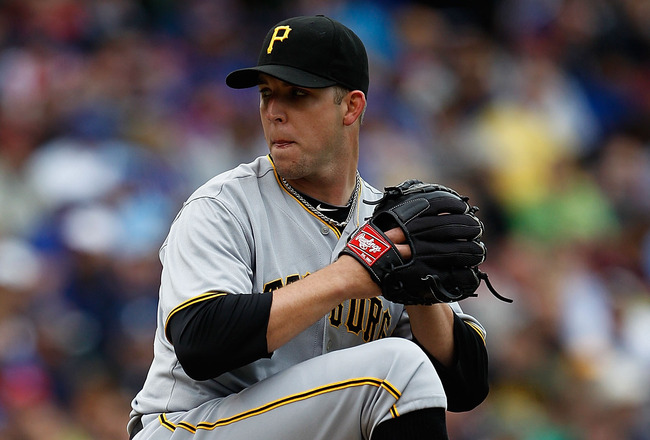
Paul Maholm, 29, is a seven-year major league veteran who has spent all of his seasons in Pittsburgh.  He joined the rotation for good in 2006 and has started in all 185 major league appearances.  He was the 8th overall pick in the 2003 draft, so his success was foreseen by many scouts.  He holds a misleading 53-73 career record with a 4.36 ERA and career K/9 innings and BB/9 innings rates of 5.5 and 3.0, respectively.  He doesn't have the typical skill set of an early first-round starter but has been a very reliable innings eater for the Pirates for the last half-decade.  His performance hasn't really given him the 'ace' moniker, but his surrounding staff has.

Maholm is a groundball pitcher; he will rely on his infield defense a whole lot.   Although he'll soon be on the wrong side of 30 and doesn't have any overpowering pitches, this is a terrific signing for the Cubs.  He gives the Cubs a reliable veteran option to contrast the inconsistent tendencies of rotation-mates Randy Wells and Travis Wood, just to name two.  MLBTradeRumors.com ranked Maholm as the ninth-best starting pitcher available in the free agent market.

For fans still skeptical about the results of all these recent moves, I have some good news.  If you think about it, this move makes a Matt Garza trade much more likely.  Garza is a star at this moment and the Cubs front office is working for a deal.  Ironically as soon as I realized that this makes a Garza trade more likely, Jed Hoyer told the media that it isn't a "precursor" to any other deal, implying a Garza trade.  I don't believe that.  When has a GM ever announced that a move they just made was a precursor to another deal - before the second deal has been agreed on?  Hoyer can't say that a Garza trade will follow because then if the deal falls through, the front office will look bad and expectant fans will be disappointed.  A politically correct move by Hoyer and a statement needed to be made, but I don't believe it to be true.

Cubs fans shouldn't expect the world from Maholm.  He'll finish with a record near .500 and an ERA anywhere between 3.50 and 5.00 most likely.  He'll earn his value, however, in inducing ground balls and being a model big league regular for others to learn from.  Although his year-to-year results are inconsistent, he's coming off the second-best season in his career and is a known commodity in the big leagues, which is more than we can say for any of our mediocre options in Iowa at starting pitcher.  Good move.

Sunday, January 8, 2012

Cubs Acquire Anthony Rizzo for Andrew Cashner

Anthony Rizzo
Man, Theo and Jed really do like this kid.

More than a month after initially talking to the Padres about Anthony Rizzo, the Cubs finally found the right deal to reel him in.  That deal was Andrew Cashner and Kyung-Min Na for Rizzo and Zack Cates.  A blockbuster deal as far as prospects go, but I like it.

I think this is a really risky move by the Padres.  Cashner was supposed to be the Cubs' #5 starter in 2011 until an injury in his first start caused him to miss nearly the entire season.  Despite the injury risk, San Diego still was aggressive about acquiring the Cubs' first-round pick from 2008.  So far Cashner's career has been defined by his 100 mph fastball and that injury.  His minor league record is impressive with a 2.82 career ERA and only three homers allowed in over 180 innings, but closer study reveals he doesn't have his mechanics down well enough to be considered an elite prospect.  He does strike out about eight batters per nine innings but also walks about four in nine innings.  This means his K/BB ratio is around 2.00, which is not impressive at all.  For comparison, most elite pitchers have around a 4.00 or 5.00 ratio.

Andrew Cashner
Interestingly enough, Cashner became somewhat homer-prone in his midsummer major league trial in 2010.  I said before how he only allowed three homers in 180+ minor league innings.  In just over 50 major league innings, Cashner allowed eight home runs.  His ERA from that trial was 4.80, and that K/BB ratio got even worse to 1.67.  Like most other fans and observers of the game, I assumed these struggles were due to a lack of experience and the typical issues a rookie deals with upon arrival in MLB.  I guess I was never really sold on him, though.  That fastball is amazing and his simple delivery seems to defy physics, but his changeup was not where it needed to be.

Rizzo didn't have much luck in the majors either.  His trial came in 2011 and he batted .141 with just one home run in over 150 plate appearances.  Obviously I don't watch the Padres every day, but from what I can tell it seemed he never got into a rhythm.  That actually helps the Cubs, however, as it dropped his stock to the point where just Cashner could get him.  Rizzo will be worth it, too.  Across three levels of minor league ball, Rizzo has put up back-to-back 25 HR, 100 RBI seasons.  In 2011, however, he did it in much more impressive fashion, as if 100 RBIs in the minors wasn't impressive to begin with.  Rizzo batted .331, got on base at a .404 clip, had a .652 slugging percentage, recorded his first career triple, and did it all in 93 games.  101 RBIs in 93 games?!  Cubs fans, meet Anthony Rizzo.  He's here to stay.

Times a-changing: This Cubs Convention poster, advertising
 the 2011 Convention, is only a year old.  Two of the three
featured players are out of the organization.
Cates, 22, was the Padres' third-round pick in 2010.  This 6'3" righty spent all of 2011 with Fort Wayne in A ball.  His 8.5 K/9, 4.0 BB/9, and 2.09 K/BB are reminiscent of Cashner.  The main difference is Cates is still two or three years from the bigs while the Padres will most definitely throw Cashner into Petco Park for at least part of 2012.  Cates has some nice potential.  Let's give it a year and see where he stands after that.

The outfielder Na was signed out of South Korea and played the 2011 season at age 19, bouncing from rookie ball to even AA.  He gives little offensively with virtually no power at all but has some speed.  His size  (5'10", 170 lbs) is a minus, but apparently his defense is good.  Either that or he paid his way through the Cubs' minor league system.  I can't figure out how he moved up so quickly.  I don't think we lost anything here, though.

Theo Epstein announced after the trade that he expects Rizzo to start 2011 in AAA.  Theo himself must be excited to have Rizzo, a prospect of his own in Boston until he went to San Diego in the Adrian Gonzalez trade.  For now, however, Rizzo is still a prospect.  Personally I'm really excited for this kid to debut, but he needs some time in Iowa first.  We don't want to burn him out before he's ready.  As of right now, Bryan LaHair is our first baseman.  But soon, and hopefully for a long time, Anthony Rizzo will be the man!