|
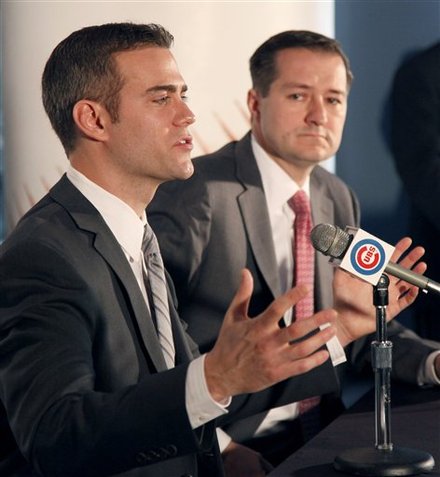
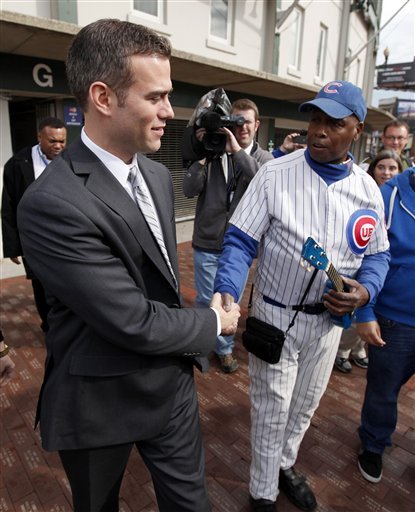
| Athletics GM Billy Beane |
The Moneyball movie, released September 23 last fall, displayed two perspectives on the Oakland Athletics. The first one, which was the selling point of the movie and common reaction from the general public, was that the movie celebrated a truly historic and unprecedented story of a comeback team; not only on the field itself, but within the front office.
The other perspective, an underlying and somewhat depressing observation, was a comparison of the 'Moneyball' 2002 A's and the 2011 version. On the release date of the movie, the A's won in Anaheim in the sixth-to-last game of another losing season, their fourth in five years. It was a 3-1 final, raising the team's record to 71-86 on the season in standout starter Gio Gonzalez's second-to-last start with Oakland. The A's had closed out their home schedule the day before with a win over the defending AL champion Texas Rangers - in front of a measly crowd of barely 14,000. After the game in Anaheim, the A's won three of their remaining five games to finish the season at 74-88 with some young talent, most of which has since been dumped in the genesis of another do-over rebuilding plan. This is not the first such plan since the A's were last relevant in 2006, and it probably won't be their last in the near future. At the helm the entire time, however, has been general manager Billy Beane.
The 2002 A's were definitely a team definitely that faced failure before the season even started. The team three major starts in closer Jason Isringhausen, first baseman and reigning MVP Jason Giambi, and center fielder Johnny Damon, as the movie focused on. What the movie failed to explain, however, was how the A's did still have the best rotation trio in the major leagues in Barry Zito, Tim Hudson, and Mark Mulder besides a quick flash of Hudson. If you exempt a few seconds showing him making an error, the film also whiffed on mentioning the team's shortshop, Miguel Tejada, who just happened to win the AL MVP that year. Throw in Zito's Cy Young, and you've got the MVP and Cy Young winners together on the same 103-win team that won its division. Wasn't this team supposedly struggling? An example of the legendary tale of the underdog? If I didn't know better, I would say this was the class of the American League, complete with star power and value deals.
But the movie credits Beane and the fictional Peter Brand as the undisputed saviors with their conservative money-saving approach of finding unsung heroes with the best value. It's a great approach, but you can't win 103 games if the best players on the team are Scott Hatteberg, Chad Bradford, and David Justice. You just can't. There has to be a supporting cast. It's a humbling, feel-good story that these rejects were made stars in their own way through harnessing their skills of getting on base and, in Bradford's case, maintaining impeccable control. But it takes a full team effort to avoid 'losing the last game of the season'.
Beane did also play a major role in acquiring the team's other stars, as he drafted Mulder and Zito with the team's first-round draft picks in 1998 and 1999, respectively. But since this era he hasn't had much luck. The 2002 LDS loss to the Minnesota Twins was their third consecutive year of being eliminated in the LDS - in the fifth and final game, no less. They lost the decisive Game 5 again in 2003, this time to the Red Sox. As is protocol for the cash-strapped A's, the team watched as Tejada had bolted for free-agent money by 2004 and Mulder and Hudson were dealt a year later in a desperation move to stay competitive by acquiring mid-level talent for depth. Conventional wisdom pegged the team to roll over and die.
A couple newly-found stars, however, kept the A's in the W column. Despite major roster turnover in between, the A's won at least 88 games every year from 2000 to 2006, making the playoffs in the first four and last of those seven years. A new wave of players, including powerful third baseman Eric Chavez, shortstop Bobby Crosby, starter Dan Haren (who had been acquired in Mulder's trade to St. Louis), right fielder Nick Swisher, and lights-out strikeout closer Huston Street emerged to bring Oakland back over the hump and into the playoffs in 2006. Hell, the team even took a flier on a 38-year-old Frank Thomas, recently ousted from the White Sox, and he gave them 38 homers in a season no one saw coming. The changing of the guard worked, as Beane, after his team triumphantly beat down the Twins in a three-game sweep of the ALDS, had successfully led the A's back to the ALCS for the first time since the Dennis Eckersley days.
With this quick wheeling-and-dealing, Beane saved his team from depressingly regressing into submission after his star players had past their prime. Although not all these moves were entirely popular in Oakland, they put the team within a few games of the World Series in 2006. A truly incredible series of events took place there. To many he appeared to be demolishing the team by trading away two of the three in the famed 'Big Three'. Instead, the A's were back and better than ever just a year later.
The years since haven't exactly been smooth sailing. 2007 was a catastrophic year for the Athletics, as the wheels fell off in the form of injuries to Chavez, Crosby, Street, outfielder Mark Kotsay, and starter Rich Harden all hampered the team's performance. And bam, Beane goes to work. This time he sends Swisher to the White Sox, Haren to the Diamondbacks, Kotsay to the Braves, and at the trade deadline of 2008 he sent Harden to the Cubs.
It didn't produce immediate results. The A's suffered through a losing season in 2007 for the first time in nine years, and they had nearly identical results the year after. Besides the random emergence of power-hitting outfielder Jack Cust, these were not teams to write home about. Beane wanted to do something about that.
Three quick acquisitions for the 2009 season meant Billy was all in. Beane brought back a now 38-year-old Giambi in search of a miracle, acquired prime slugger Matt Holliday from Colorado, and plugged in clutch veteran shortstop Orlando Cabrera. However, Holliday suffered through a power outage and Giambi suffered through an everything-outage. The movement was ill-fated from the beginning, as the young guns of the pitching staff were nowhere near ready to compete under winning expectations. Giambi, Holliday, and Cabrera were all quickly disposed of by the start of September, another quick "three-and-out" for our man Billy.
The 2009 season wasn't a total lost effort, however, as some of those youngsters on the pitching staff got valuable experience from their struggles. Power closer Andrew Bailey even won Rookie of the Year. The result of this development were impressive performances the next year from starters Gio Gonzalez, Trevor Cahill, Brett Anderson, and Dallas Braden, none of whom were older than 26. The offense wasn't there, so the A's stayed in mediocrity in 2010. If the A's could secure some offense, the experts said, Oakland would a be a team to beat in 2011. As had been the case for a while, the A's had some nice young players but fell short because they didn't have a complete team. This wasn't necessarily Beane's fault, but evidently his strategies weren't working like they used to.
The situation in Oakland became even more desperate after their cross-bay counterpart, the San Francisco Giants, took home the World Series trophy in 2010. The resulting loss in market share hurt an already economically-wounded franchise. As you can guess by now, Beane refused to give up on the team and went back to work again on securing offense.
Beane successfully dragged in designated hitter Hideki Matsui, left fielder Josh Willingham, and right fielder David DeJesus, three under-the-radar veteran offensive pieces. Matsui and Willingham offered power, while DeJesus offered on-base skills and defense. Those two joined an offensive core of value players in catcher Kurt Suzuki, third baseman Kevin Kouzmanoff, and consistent second baseman Mark Ellis.
Right when the A's looked to be in an improved position from the year before on Opening Day 2011, the strength of the team fell apart. That standout rotation blew up. While Gonzalez still had a great season, Cahill's ERA ballooned to over 4.00, unacceptable for the ace of a playoff contender. Braden and Anderson both missed most of the season to injury. A bust prospect reincarnated in Brandon McCarthy literally came out of nowhere to be the new #2 starter. The A's payroll of $66 million was the ninth-smallest in the league. Even that was up six spots from the year before, and four spots up from 2009.
The A's franchise is at a crossroads right now. Management has been calling for a move to the southern Bay Area for over five years as the team's average attendance at the archaic O.co Coliseum is dismal at best. The 2011 average of 18,232 doesn't sell out most NBA arenas, and is currently being beat by the nearby Golden State Warriors' average of 18,705. Of course NBA tickets are more expensive than baseball tickets, so the Warriors are making significantly more revenue on each home date.
Commissioner Bud Selig approved a move to Fremont, California for the A's in late 2006, where the proposed Cisco Field was to be constructed. Funding fell through, and the plan was scrapped. Now the A's call for a move to San Jose. The Comish has been far less decisive this time. A few months ago, he announced that the A's situation was now a "top priority" for his office to deal with. Not to give approval, that is, but to make a decision either way. Meanwhile one of his historic franchises, an original American League franchise founded in 1901 in Philadelphia, is rotting in this state of dismay without the necessary funds to improve the team or the fan base to get these funds.
A move to San Jose is imminent for the front office. Beane admitted in December that they're building the team under the assumption that they will have a new ballpark there in a handful of years, because they don't have any other choice. But for the next couple years, there's little hope in sight. For the umpteenth time as Oakland's GM, Billy Beane again had to hit the self-destruct button. He let go of DeJesus and Kouzmanoff and traded his budding top two starters, sending Cahill to Arizona and Gonzalez to Washington. The result is a depleted team with very little elite talent.
This latest rebuilding plan will take a few years, and it's a necessary process if the A's want to have a winner in time for the potential move to San Jose. The plan has already been started by Beane, but should he really be the one to execute it? As you've read here, Beane had immense success in the early 2000s and a dismal reign since. The A's haven't had a winning season since 2006. Some say Beane was given this monster extension under the old 'any publicity is good publicity' theory in that the A's want to keep Beane just to draw attention to themselves. But under the financial constraints they have seemingly always been subject to, I don't think there's any single better candidate for the job. Beane has never been afraid to make bold trades and be aggressive in his shuffling, a trait that has served the team well as evidenced by their constant supply of promising young players. But it's just really, really hard to build a winner under those conditions. Now get Billy a new ballpark and some cash, and he'll have the team battling Texas and Anaheim for the division every year.
Billy has already started the rebuilding process with the dumping of those aforementioned players. It's going to get worse before it gets better, as this year's team could easily lose 100 games. But to let go of Beane now wouldn't make sense. If ownership were looking for a different approach, Beane would have been fired before he sent away the team's two biggest stars in Gonzalez and Cahill. Now, they might as well let him finish what he started.
The other perspective, an underlying and somewhat depressing observation, was a comparison of the 'Moneyball' 2002 A's and the 2011 version. On the release date of the movie, the A's won in Anaheim in the sixth-to-last game of another losing season, their fourth in five years. It was a 3-1 final, raising the team's record to 71-86 on the season in standout starter Gio Gonzalez's second-to-last start with Oakland. The A's had closed out their home schedule the day before with a win over the defending AL champion Texas Rangers - in front of a measly crowd of barely 14,000. After the game in Anaheim, the A's won three of their remaining five games to finish the season at 74-88 with some young talent, most of which has since been dumped in the genesis of another do-over rebuilding plan. This is not the first such plan since the A's were last relevant in 2006, and it probably won't be their last in the near future. At the helm the entire time, however, has been general manager Billy Beane.
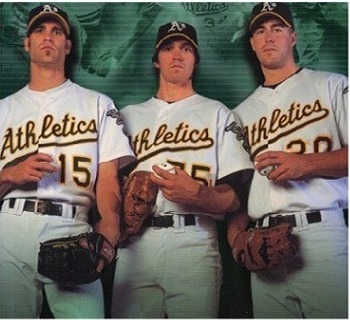 |
| Oakland's Famed 'Big Three' (from left): Tim Hudson, Barry Zito, and Mark Mulder |
 |
| The 2002 AL MVP, shortstop Miguel Tejada |
Beane did also play a major role in acquiring the team's other stars, as he drafted Mulder and Zito with the team's first-round draft picks in 1998 and 1999, respectively. But since this era he hasn't had much luck. The 2002 LDS loss to the Minnesota Twins was their third consecutive year of being eliminated in the LDS - in the fifth and final game, no less. They lost the decisive Game 5 again in 2003, this time to the Red Sox. As is protocol for the cash-strapped A's, the team watched as Tejada had bolted for free-agent money by 2004 and Mulder and Hudson were dealt a year later in a desperation move to stay competitive by acquiring mid-level talent for depth. Conventional wisdom pegged the team to roll over and die.
 |
| Third baseman Eric Chavez |
With this quick wheeling-and-dealing, Beane saved his team from depressingly regressing into submission after his star players had past their prime. Although not all these moves were entirely popular in Oakland, they put the team within a few games of the World Series in 2006. A truly incredible series of events took place there. To many he appeared to be demolishing the team by trading away two of the three in the famed 'Big Three'. Instead, the A's were back and better than ever just a year later.
The years since haven't exactly been smooth sailing. 2007 was a catastrophic year for the Athletics, as the wheels fell off in the form of injuries to Chavez, Crosby, Street, outfielder Mark Kotsay, and starter Rich Harden all hampered the team's performance. And bam, Beane goes to work. This time he sends Swisher to the White Sox, Haren to the Diamondbacks, Kotsay to the Braves, and at the trade deadline of 2008 he sent Harden to the Cubs.
It didn't produce immediate results. The A's suffered through a losing season in 2007 for the first time in nine years, and they had nearly identical results the year after. Besides the random emergence of power-hitting outfielder Jack Cust, these were not teams to write home about. Beane wanted to do something about that.
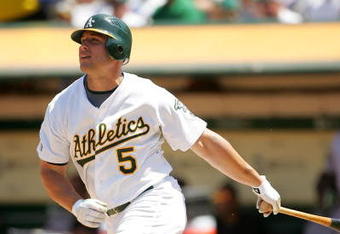 |
| Left fielder Matt Holliday. Acquired in Beane's push for a winner in 2009, he didn't even last a full season. |
The 2009 season wasn't a total lost effort, however, as some of those youngsters on the pitching staff got valuable experience from their struggles. Power closer Andrew Bailey even won Rookie of the Year. The result of this development were impressive performances the next year from starters Gio Gonzalez, Trevor Cahill, Brett Anderson, and Dallas Braden, none of whom were older than 26. The offense wasn't there, so the A's stayed in mediocrity in 2010. If the A's could secure some offense, the experts said, Oakland would a be a team to beat in 2011. As had been the case for a while, the A's had some nice young players but fell short because they didn't have a complete team. This wasn't necessarily Beane's fault, but evidently his strategies weren't working like they used to.
The situation in Oakland became even more desperate after their cross-bay counterpart, the San Francisco Giants, took home the World Series trophy in 2010. The resulting loss in market share hurt an already economically-wounded franchise. As you can guess by now, Beane refused to give up on the team and went back to work again on securing offense.
 |
| Left fielder Josh Willingham. Another one- and-done impact player. |
Right when the A's looked to be in an improved position from the year before on Opening Day 2011, the strength of the team fell apart. That standout rotation blew up. While Gonzalez still had a great season, Cahill's ERA ballooned to over 4.00, unacceptable for the ace of a playoff contender. Braden and Anderson both missed most of the season to injury. A bust prospect reincarnated in Brandon McCarthy literally came out of nowhere to be the new #2 starter. The A's payroll of $66 million was the ninth-smallest in the league. Even that was up six spots from the year before, and four spots up from 2009.
The A's franchise is at a crossroads right now. Management has been calling for a move to the southern Bay Area for over five years as the team's average attendance at the archaic O.co Coliseum is dismal at best. The 2011 average of 18,232 doesn't sell out most NBA arenas, and is currently being beat by the nearby Golden State Warriors' average of 18,705. Of course NBA tickets are more expensive than baseball tickets, so the Warriors are making significantly more revenue on each home date.
Commissioner Bud Selig approved a move to Fremont, California for the A's in late 2006, where the proposed Cisco Field was to be constructed. Funding fell through, and the plan was scrapped. Now the A's call for a move to San Jose. The Comish has been far less decisive this time. A few months ago, he announced that the A's situation was now a "top priority" for his office to deal with. Not to give approval, that is, but to make a decision either way. Meanwhile one of his historic franchises, an original American League franchise founded in 1901 in Philadelphia, is rotting in this state of dismay without the necessary funds to improve the team or the fan base to get these funds.
 |
| The proposed Cisco Field, now placed in San Jose. If approved now, completion projects to be in time for the 2016 season. |
This latest rebuilding plan will take a few years, and it's a necessary process if the A's want to have a winner in time for the potential move to San Jose. The plan has already been started by Beane, but should he really be the one to execute it? As you've read here, Beane had immense success in the early 2000s and a dismal reign since. The A's haven't had a winning season since 2006. Some say Beane was given this monster extension under the old 'any publicity is good publicity' theory in that the A's want to keep Beane just to draw attention to themselves. But under the financial constraints they have seemingly always been subject to, I don't think there's any single better candidate for the job. Beane has never been afraid to make bold trades and be aggressive in his shuffling, a trait that has served the team well as evidenced by their constant supply of promising young players. But it's just really, really hard to build a winner under those conditions. Now get Billy a new ballpark and some cash, and he'll have the team battling Texas and Anaheim for the division every year.
Billy has already started the rebuilding process with the dumping of those aforementioned players. It's going to get worse before it gets better, as this year's team could easily lose 100 games. But to let go of Beane now wouldn't make sense. If ownership were looking for a different approach, Beane would have been fired before he sent away the team's two biggest stars in Gonzalez and Cahill. Now, they might as well let him finish what he started.